
The American Civil War has been explored on screen countless times, but The Legend of Van Dorn approaches the period through a figure likely to be unfamiliar to many viewers. Major General Earl Van Dorn was a Confederate cavalry commander whose military career, celebrity, drinking and complicated private life created the ingredients for a historical drama that spends almost as much time in candlelit drawing rooms as it does on the battlefield.
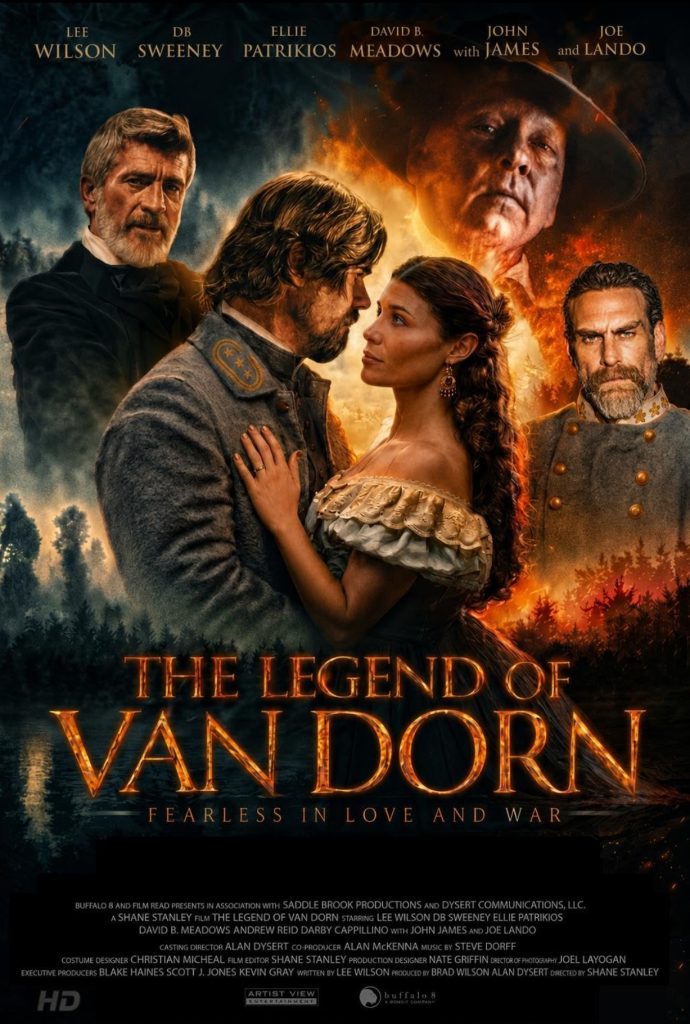
Directed by Shane Stanley and written by its leading man Lee Wilson, this 102-minute period drama is based on events from Van Dorn’s life, with Wilson playing the controversial general. Rather than attempting to encompass the entire Civil War, the screenplay concentrates upon Van Dorn’s military resurgence and the affair with married Tennessee woman Jessie Peters that threatens to undo everything around him.
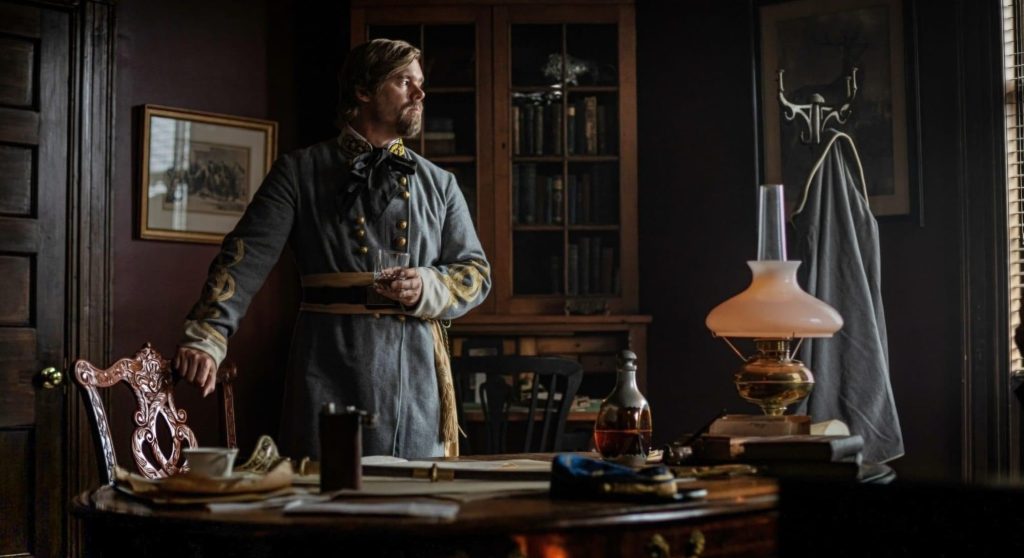
The film opens in Hamilton, Alabama, in 1862, where Van Dorn becomes involved in a plan to disrupt Union General Ulysses S. Grant’s communications. We are introduced to a man already carrying a formidable reputation, including stories of earlier encounters with the Comanche, while the discovery that Abraham Lincoln has placed a bounty on his head infuriates him.
Wilson’s screenplay quickly establishes that it doesn’t want to present Van Dorn exclusively through military manoeuvres. An early scene involving an elderly enslaved man is clearly designed to demonstrate the more compassionate qualities the film attributes to its protagonist. When the man says he cannot share a drink with Van Dorn, the general finds a playful loophole by asking him to check whether the wine is corked instead.
It’s indicative of the film’s overall approach to Van Dorn. He is presented as charismatic and capable of kindness while simultaneously being reckless, adulterous and increasingly vulnerable to his own appetites. The film is far more interested in those contradictions than simply putting a heroic general on horseback for two hours.
News of Van Dorn’s military success spreads, and an encounter with Robert E. Lee precedes his transfer to Tennessee. His reputation gets there before he does. Locals line the streets as his carriage arrives, cheering their new celebrity general, and it doesn’t take long to notice that some of the local women are particularly enthusiastic about the new arrival.
One of them is Jessie Peters.
Ellie Patrikios plays Jessie, a young married woman who is immediately fascinated by Van Dorn. Their attraction develops during a lavish welcoming party, where Van Dorn secretly arranges for place cards to be switched so that Jessie will sit at his table. She wants to hear his stories, he wants her to show him around town, and neither seems particularly good at pretending that the interest is purely conversational.
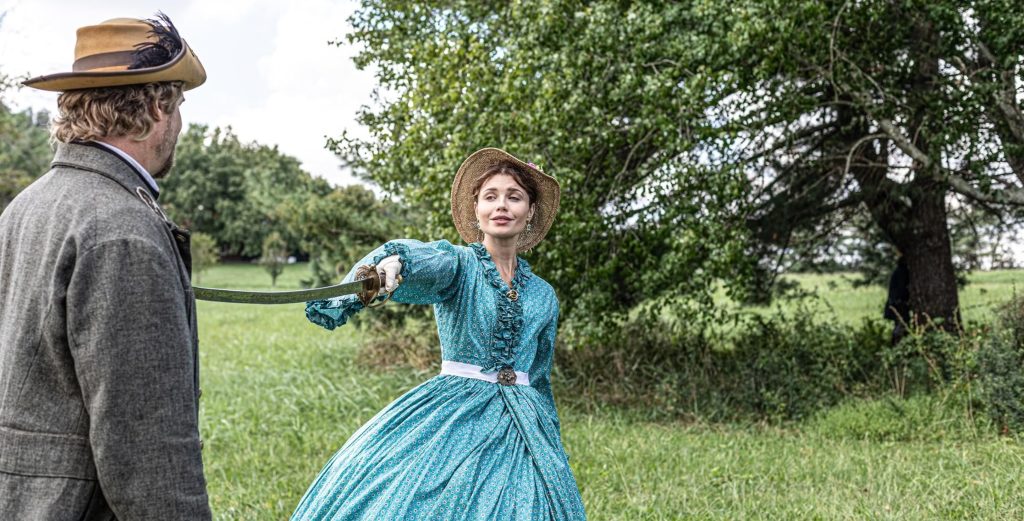
Van Dorn even places a hand on her backside while they dance. Jessie removes it and reminds him that she belongs to another man.
That warning lasts roughly as long as you suspect it will.
The Legend of Van Dorn Is a Handsome Historical Drama
The welcoming ball is also the moment when Stanley’s production announces just how good it can look. The room is illuminated with candles and other practical light sources, haze hangs through the environment and musicians accompany townspeople moving across the dance floor. Cinematographer Joel Layogan and the lighting team create an image filled with warmth, shadow and atmosphere.
For an independent historical production, it is genuinely impressive.
Period films can expose limited resources mercilessly. Modern objects have to disappear, costumes need to survive scrutiny and locations must convince us that we’ve travelled more than 160 years into the past. The Legend of Van Dorn succeeds remarkably well in creating that illusion.
Nate Griffin’s production design, Ruby Guidara’s art direction and Carmel Roman’s set decoration combine with Christian Micheal’s costume design to give the film a convincing visual identity. The women’s dresses are particularly striking, while military uniforms, interiors, furnishings and exterior locations consistently support the period rather than fighting against it.
The result frequently looks more expensive than you would expect from an independent production. There is genuine craft visible in the frame, and Stanley is clearly interested in giving the story the visual scale of an old-fashioned historical drama.
Our principal reservation about the cinematography is not its lighting or image quality, both of which are frequently excellent, but some of the shot selection. There are stretches dominated by close-ups and medium close-ups where wider compositions and more ambitious blocking could have allowed the sets, costumes and groups of performers to do more of the visual storytelling.
At those moments, the production occasionally moves closer to the visual grammar of prestige television than sweeping cinema. That’s hardly disastrous when the television in question would be exceptionally handsome, but the production design is good enough that we sometimes wanted the camera to step backwards and let us see more of it.
When Stanley does open the film out, there is plenty to admire.
Battle sequences bring gunfire, explosions and physical combat into proceedings, with soldiers wrestling on the ground as the fighting becomes chaotic around them. These aren’t enormous sequences attempting to compete with a studio epic involving thousands of extras, but they’re convincing enough to establish the danger surrounding Van Dorn’s military career.
One quieter moment during the fighting is more revealing. Van Dorn remains beside a fallen soldier, speaking to the dying man rather than treating him as another anonymous casualty. It continues the screenplay’s attempt to find humanity within somebody whose profession necessarily involves sending men into battle.
Yet war isn’t ultimately the most dangerous thing in Van Dorn’s life.
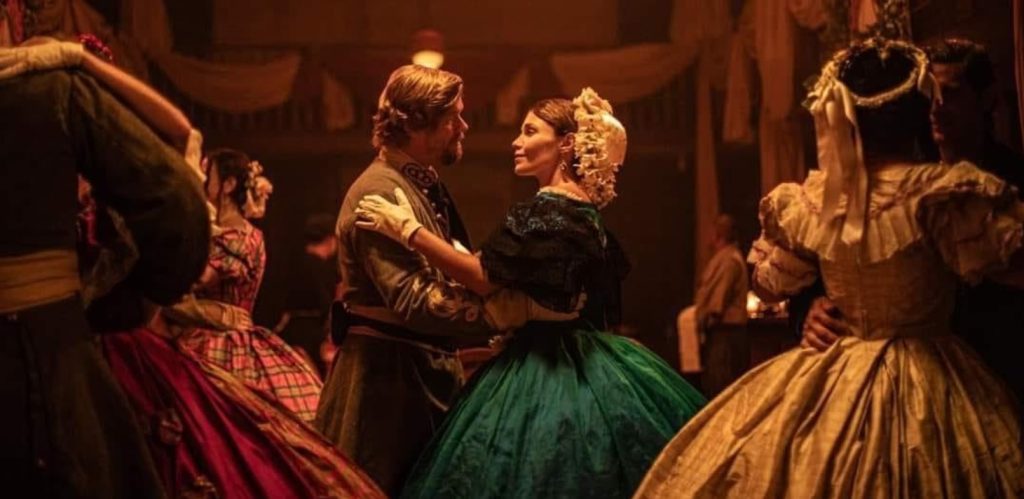
His attraction to Jessie develops into an affair after the pair spend time together away from town and passionately kiss. Their meetings become increasingly difficult to conceal, while those around Van Dorn recognise that the general’s attention is drifting away from matters considerably more important to the war effort.
David B. Meadows plays General Nathan Bedford Forrest, one of the men troubled by Van Dorn’s behaviour, while Andrew Reid appears as Major Kimmel. The friction between military responsibility and personal desire gives the middle of the film much of its dramatic tension. Van Dorn can outmanoeuvre an enemy army, but apparently resisting somebody else’s wife presents a considerably more difficult strategic challenge.
Jessie’s husband, Dr George B. Peters, played by Joe Lando, eventually learns of the affair. When Jessie is confronted, her husband forbids her from seeing Van Dorn again or even leaving their home. He subsequently pretends to leave before returning after Van Dorn has entered the house, catching the general and threatening him at gunpoint.
It is an effective reminder that rank and battlefield reputation mean very little when you’re standing in another man’s bedroom while that man is holding a rifle.
The film also introduces D.B. Sweeney as Stansted, and it is great to see him here. Sweeney has built an extensive career that includes The Cutting Edge, Fire in the Sky, No Man’s Land and Eight Men Out, in which he portrayed “Shoeless” Joe Jackson. His presence adds another recognisable face to a cast that also includes John James, Darby Cappillino and Jay DeMarcus.
At the centre of everything is Wilson.
Playing a historical figure in a screenplay you’ve written yourself presents an interesting challenge because there is always a danger of becoming too protective of the character. Wilson doesn’t entirely sanitise Van Dorn. The general can be charming and compassionate, but he’s also impulsive, drinks heavily and willingly begins a relationship with a married woman despite knowing exactly how destructive the consequences could become.
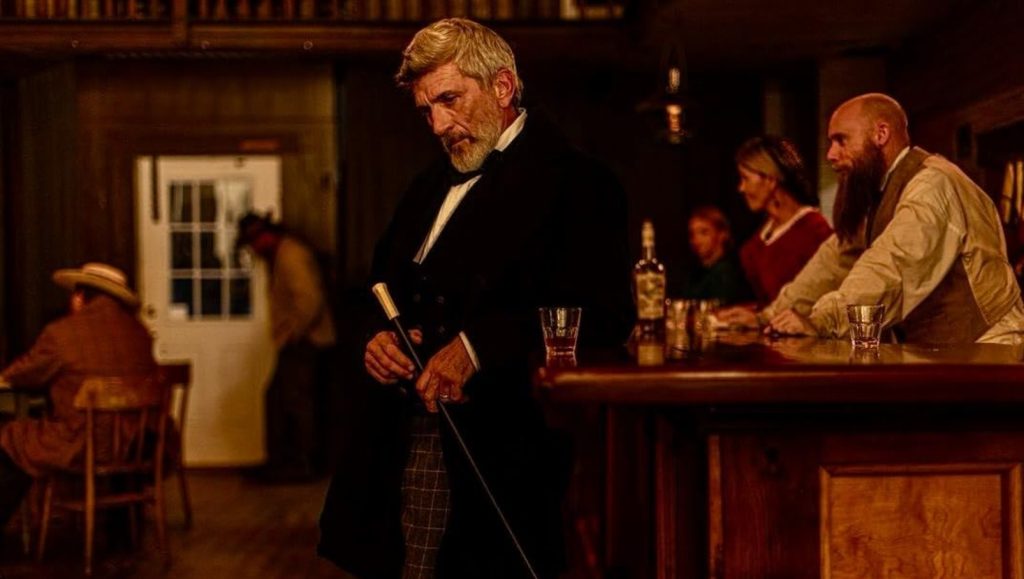
Wilson gives him the presence required of somebody accustomed to commanding rooms as well as soldiers. His dialogue is delivered with an old-fashioned formality appropriate to the film Stanley is making, and that tone extends across much of the ensemble.
The screenplay itself is another considerable strength. Conversations have rhythm and character, while the language feels sufficiently removed from contemporary speech without becoming so mannered that everybody sounds as though they’re reciting from a historical document. With so much of the film built around meetings, dinners, dances and private conversations, that dialogue needs to hold attention between the larger sequences, and for the most part it does.
Patrikios is particularly impressive as Jessie. Born in London according to the biographical information supplied with the film, she handles the Tennessee accent convincingly and has a natural screen presence that makes Jessie’s attraction to Van Dorn believable. She is striking on camera, certainly, but the performance goes beyond simply providing Van Dorn with a beautiful woman to pursue.
The chemistry between Patrikios and Wilson gives the central affair enough heat to sustain a large part of the narrative, and Jessie becomes increasingly important as Van Dorn’s public responsibilities collide with his private decisions. Patrikios looks very comfortable in a period production and is certainly a performer worth watching.
Steve Dorff’s score further reinforces the classical approach, while Stanley also serves as editor. At 102 minutes, the film has room for its relationships and political conversations to develop without becoming excessively drawn out, balancing quieter exchanges with military action and the escalating danger surrounding the affair.
The Legend of Van Dorn is not attempting to be a comprehensive examination of the Confederacy or the American Civil War. Its focus is narrower, concentrating on Van Dorn as a military celebrity whose battlefield abilities exist alongside serious personal flaws. That distinction matters because viewers expecting a sprawling Civil War epic may be surprised by how much of the film is essentially a romantic historical drama.
The war remains important, but the bedroom becomes every bit as dangerous as the battlefield.
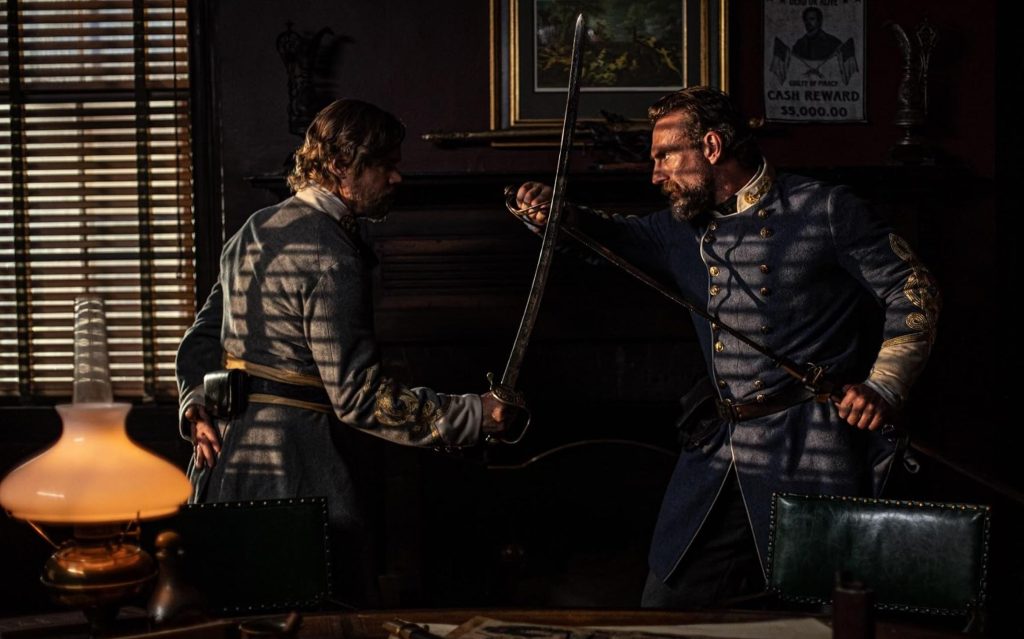
Stanley’s direction is particularly effective when working with atmosphere. Candlelight, smoke, period interiors and carefully chosen locations give the picture texture, while Layogan’s cinematography frequently creates beautiful faces against deep shadows. Even when we wanted more wide compositions, the individual images are polished and thoughtfully lit.
There is also something refreshing about seeing an independent production attempt a period film at this scale. It’s considerably easier to put three actors in a modern house and make a drama than it is to recreate Tennessee during the Civil War, dress an entire supporting cast, organise horses, stage battles and ensure that the twenty-first century isn’t accidentally visible behind somebody’s shoulder.
The extensive crew deserves credit for making that world convincing. From costume and makeup through props, construction, armoury, locations and the camera department, this is precisely the sort of production where dozens of departments need to work together before the audience can believe a single frame. The results are there on screen.
The Legend of Van Dorn ultimately succeeds because it understands that a historical figure doesn’t have to be familiar to make for an interesting film. Stanley and Wilson present Van Dorn as a man capable of considerable military achievement while being far less successful at controlling himself. His reputation brings adulation, his charm brings attention and his decisions bring consequences.
With excellent period detail, atmospheric cinematography, strong dialogue and a very good ensemble, this is an impressively mounted independent historical drama. Some broader compositions could have made its visual scale feel even grander, but that is a relatively small complaint when so much care has clearly gone into putting the 1860s on screen.
And if nothing else, The Legend of Van Dorn provides a useful military lesson that probably wasn’t taught at West Point: however celebrated a general you might be, having an affair with the wife of a man who owns a rifle remains a catastrophically poor tactical decision.
| Acting | |
| Direction | |
| Cinematography | |
| Writing | |
| Sound | |
| Screen Critix Rating |