
Happiness should be one of the easiest things in the world to recognise. We know when we feel it, we spend enormous amounts of time trying to obtain more of it, and entire industries exist to convince us that their particular product, lifestyle or philosophy might finally deliver it. Yet ask somebody to define happiness, explain where it comes from or tell you how to hold onto it, and things suddenly become considerably more complicated.
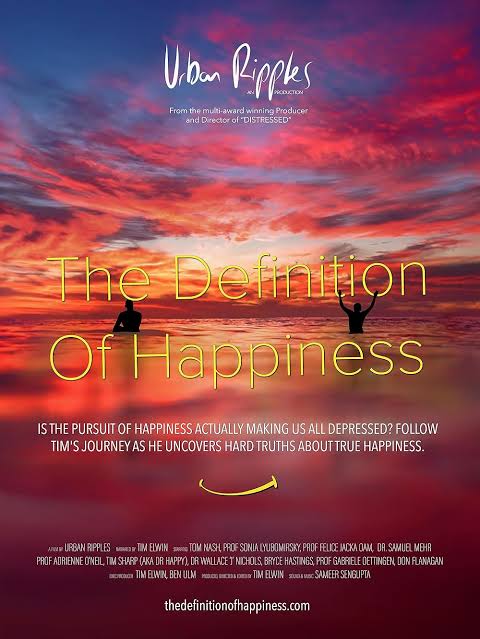
Australian filmmaker Tim Elwin goes looking for some answers in The Definition of Happiness, a 96-minute documentary born partly from his own brushes with mortality. This isn’t presented as somebody claiming to have discovered the secret to a perfect life. Elwin instead wants to understand what genuinely contributes to wellbeing, what gets in its way and whether changing how we think about happiness might be more useful than endlessly chasing it.
The documentary opens peacefully, looking towards the ocean as the sun sits just beneath the horizon. Elwin’s narration immediately punctures any danger of proceedings becoming overly solemn when he describes happiness as a “shifty little sucker”. He believes he eventually found some understanding of it himself, but only after getting frighteningly close to death, and he’d rather the rest of us discovered an easier route.
From there we are transported to New York, where the Naked Cowboy and Naked Cowgirl offer their own thoughts on what makes them happy. It’s an amusing way to establish the documentary’s approach. Elwin isn’t interested solely in academics explaining happiness from behind desks. He talks to experts, unusual personalities and ordinary people, repeatedly asking variations of a deceptively simple question.
What makes you happy?
Street interviews produce everything from photography to hot dogs, demonstrating fairly quickly that there isn’t going to be a universal answer. What makes The Definition of Happiness interesting is that Elwin isn’t really searching for a definitive list of things everybody should acquire. He’s more interested in whether there are underlying behaviours and ways of thinking that make happiness easier to experience.

Elwin describes himself, with refreshing self-awareness, as a “privileged middle-aged white guy from sunny Australia”. He knows how that sounds when introducing himself as the person who is about to spend more than an hour discussing adversity and wellbeing. His personal history, however, explains why the subject matters to him.
Before getting there, the documentary brings in specialists including Sonja Lyubomirsky, Professor of Psychology at the University of California, Riverside. Among the subjects discussed is the pursuit of money and fame. There is an important distinction between financial security making life easier and the relentless pursuit of wealth or status making somebody happy. Being able to pay the bills is obviously preferable to lying awake wondering how to afford them, but continually postponing happiness until some future level of success has been achieved can become its own trap.
That distinction runs throughout the film. Happiness isn’t necessarily waiting at the end of a road after we’ve finally accumulated enough money, possessions, professional success or approval. The journey towards those things can itself create stress and disappointment, particularly when our expectations are constantly being moved further away.
The Definition of Happiness Looks Beyond the Easy Answers
Religion inevitably enters the conversation. Elwin encounters a street preacher urging passers-by to repent before later speaking with a 91-year-old pastor whose Christian faith provides him with enormous comfort. The elderly man believes he will spend eternity with God and speaks warmly about loving people who might otherwise feel unloved.
Elwin isn’t religious himself, and the documentary doesn’t require him to become religious in order to engage with somebody who is. That’s important because The Definition of Happiness is strongest when it treats happiness as something that can arrive through very different routes. For one person that might be faith, for another it could be photography, friendship, exercise, music, food or standing half-naked in the middle of New York wearing a cowboy hat.
The pastor also attends exercise classes at 91, moving along to techno music that he freely admits isn’t exactly to his taste. He might not be requesting the playlist at home, but if it gets a 91-year-old moving, the DJ has done something right.
The documentary becomes considerably more personal when Elwin discusses the medical problems that changed his own life. After a health emergency left him spending several days in a stroke ward, he was told to stop smoking, drinking and taking drugs. He did. Exercise followed, including running along beaches, his weight dropped and physically he began feeling healthier.
Emotionally, something else was happening.
Elwin found himself crying frequently and was told that this was normal. Interestingly, he talks openly about those emotions rather than treating them as something embarrassing. Men are still frequently encouraged to suppress vulnerability, “man up” and keep difficult feelings to themselves, and Elwin’s willingness to discuss crying because he was experiencing powerful emotions gives this part of the documentary an honesty that a purely academic discussion couldn’t provide.
Six months later, life hit him again.
Elwin was involved in a serious motorcycle accident, and the documentary warns squeamish viewers before revealing the extent of the resulting injuries. Medical imagery shows devastating damage, including a hand shattered in numerous places and severe pelvic injuries. Elwin survived something that could very easily have ended differently, and that experience became fundamental to the questions he is asking here.
It would have been easy for The Definition of Happiness to become entirely autobiographical from this point, but Elwin keeps opening the conversation outwards. His experiences explain the journey rather than becoming the whole journey.
One particularly interesting stop involves the late marine biologist Dr Wallace J. Nichols, author of Blue Mind. Elwin discusses his own addictive personality and how he has learned to redirect that part of himself, while Nichols talks about the relationship between our brains, dopamine and the things that provide us with satisfaction.

Nichols’ “blue mind” concept concerns our response to water in its different forms and the calmer mental state that proximity to it can encourage. That might involve the ocean, a lake or other experiences around water, with the idea extending towards feelings of calmness, connection, compassion and creativity. It isn’t difficult to understand why this resonates so strongly with Elwin, whose documentary repeatedly returns visually to beaches and oceans.
The contrasting “red mind” is associated with stress and heightened alertness. The discussion around news and social media feels particularly relevant, with modern life giving people almost uninterrupted access to things capable of making them frightened, angry or anxious. Some threats are entirely real, others are amplified, but our nervous systems aren’t necessarily wonderful at distinguishing between immediate danger and the latest thing screaming for our attention through a screen.
Elsewhere, psychologist Gabriele Oettingen discusses WOOP, standing for Wish, Outcome, Obstacle and Plan, a practical method for thinking about goals without relying entirely upon positive thinking. The film also touches upon exercise, food, music, social connection and self-compassion, building its argument from numerous smaller components rather than pretending that happiness can be unlocked with one inspirational slogan.
Perhaps the most memorable encounter is with Tom Nash. Having experienced meningococcal disease and subsequently lost his limbs, Nash identifies function, friends and food as three things contributing to his happiness. Elwin joins him as he cooks steaks, and what could easily have been presented as a sentimental story about overcoming adversity instead feels much more matter-of-fact.
Nash has endured something extraordinary, but he isn’t presented as somebody whose job is to make everyone else feel guilty for having problems. He is simply a man getting on with his life, enjoying what remains available to him and refusing to accept that physical disability automatically requires unhappiness.
That feeds into one of the documentary’s broader questions: is happiness harder to achieve now than it was several decades ago?
There is no simplistic answer. Previous generations faced wars, economic depressions, recessions, disease and countless personal hardships. Modern life hasn’t invented adversity. What has changed are some of the pressures surrounding us, particularly the constant comparison, information and stimulation provided by technology.
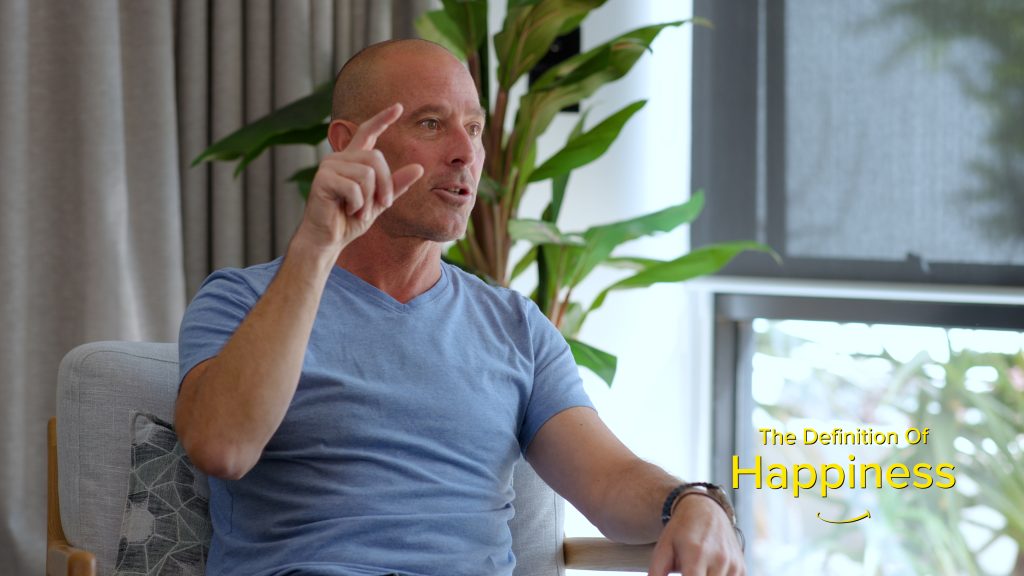
The Definition of Happiness could easily have become heavy going with this much psychology, philosophy and personal testimony packed into it. Elwin’s filmmaking prevents that. Although interviews form much of the documentary, they rarely feel like somebody placed a camera on a tripod and recorded an expert until they stopped talking.
The editing continually moves between conversations, landscapes, cities, streets, beaches and crowds. Multiple angles keep interviews visually alive, while the extensive B-roll gives the film a polished travel-documentary quality. Drone photography sweeps across beaches and coastal properties, moves beneath bridges and provides striking overhead perspectives. Elwin is credited as cinematographer as well as director, writer and editor, and the visual quality is consistently impressive.
The music is equally effective, supporting the imagery without overwhelming what people are saying, while the dialogue remains crisp and easy to understand. That sounds like a basic requirement for a documentary built around conversation, but poor location audio can cripple otherwise fascinating interviews. There are no such problems here.
Most importantly, Elwin never claims to possess a magic wand capable of making everyone watching instantly happy. The film’s official synopsis describes a journey across three countries involving experts in psychology and human behaviour, with Elwin looking for ideas that actually hold up rather than simple “hacks”. That modesty helps enormously.
Some of the individual ingredients will be familiar. Exercise is good for us. Human connection matters. Constantly pursuing money isn’t necessarily fulfilling. Spending time in nature can be restorative. Looked at individually, none of these observations is revolutionary. What Elwin does effectively is connect them to real people and his own experiences, making the documentary feel less like an instruction manual and more like an invitation to examine your own life.

That’s ultimately where The Definition of Happiness succeeded most strongly for us. It made us question whether we are actually happy, what parts of our lives contribute to that happiness and which things might quietly be working against it.
A documentary cannot make those decisions for anybody, and Elwin is smart enough not to try. What it can do is encourage a small course correction. Perhaps that means spending more time with people you care about, exercising, putting the phone down occasionally, listening to music, standing beside the ocean or simply recognising that happiness isn’t a prize waiting to be awarded once everything else in life has finally been completed.
The Definition of Happiness is beautifully photographed, professionally assembled and consistently engaging, but its greatest achievement is considerably simpler. For 96 minutes, Tim Elwin asks us to think seriously about something most of us spend our entire lives pursuing without ever stopping to define.
And once the credits roll, you might find yourself asking the same question.
| Acting | |
| Direction | |
| Cinematography | |
| Writing | |
| Sound | |
| Screen Critix Rating |