
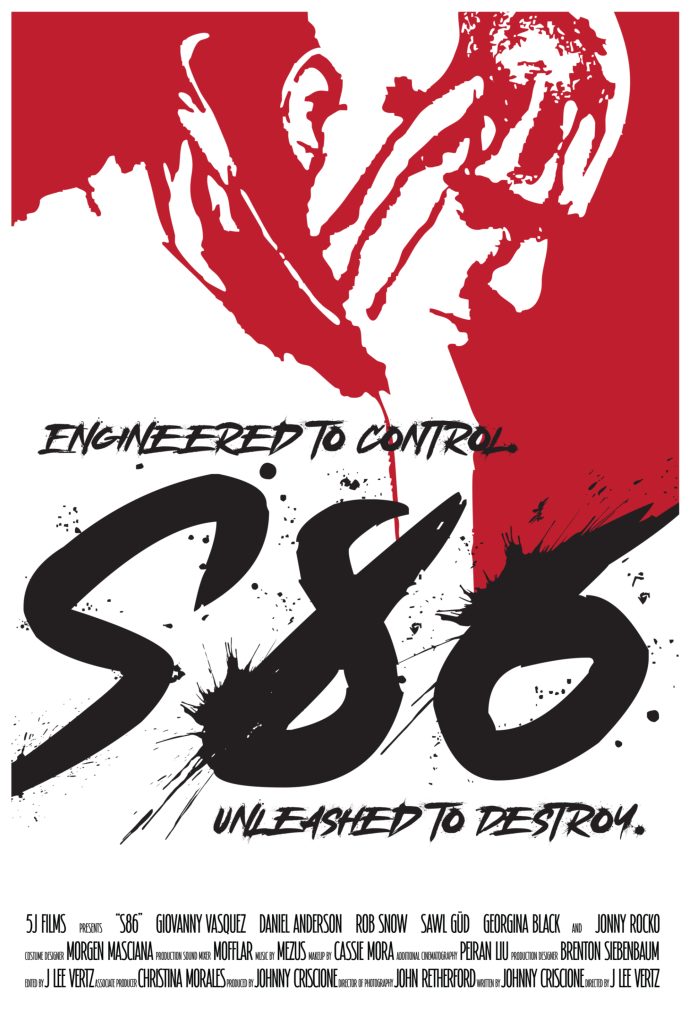
Independent horror and science fiction films often live or die by their ambition. Limited budgets can restrict what filmmakers are able to put on screen, but sometimes a strong concept, clever filmmaking and a willingness to embrace practical effects can compensate for financial limitations. S86, directed by J. Lee Vertz and written by Johnny Criscione, is one such film. While it occasionally shows the rough edges that come with independent productions, it is also an entertaining and surprisingly ambitious sci-fi horror feature that delivers plenty of atmosphere, violence and intriguing ideas.
The film wastes little time establishing its dark tone. It opens with Dr. Jensen lying wounded on a grassy field, clutching a lanyard as blood pours from his injuries. Before audiences can fully process what has happened, S86 launches into an impressive title sequence filled with slow-motion imagery of screaming mouths, syringes, shattered spectacles, chains and scientific charts. It is both stylish and unsettling, immediately giving the impression that this is a film aiming higher than its budget might suggest.
From there, we meet Graves and Carter, two men transporting a hooded Dr. Jensen in the back of a van. Their tense conversation hints at larger events that have already taken place before the narrative jumps back eighteen hours earlier to reveal how Jensen ended up in captivity.
Jensen, played by Robert Snow, is introduced leaving his workplace, a pharmaceutical company called Pharmacyn. Clearly distressed, he hurriedly phones his partner and tells them to gather their belongings because they need to leave immediately. Before he can escape, however, he discovers he is not alone in his vehicle. A mysterious figure emerges from the back seat and incapacitates him with a chemical-soaked rag.
What follows is a kidnapping, interrogation and transport to a remote location known only as “The Farm”, where Jensen becomes a pawn in a sinister conspiracy involving pharmaceutical experimentation and biological weapons.
One of the film’s most memorable sequences arrives early with the introduction of Subject 13. Presented through a title card identifying both Danny and Subject 13, the audience witnesses a restrained test subject being electrocuted before receiving an injection of a mysterious red serum. The results are catastrophic. The victim begins convulsing violently before transforming into a rabid, zombie-like creature that breaks free and unleashes brutal carnage.
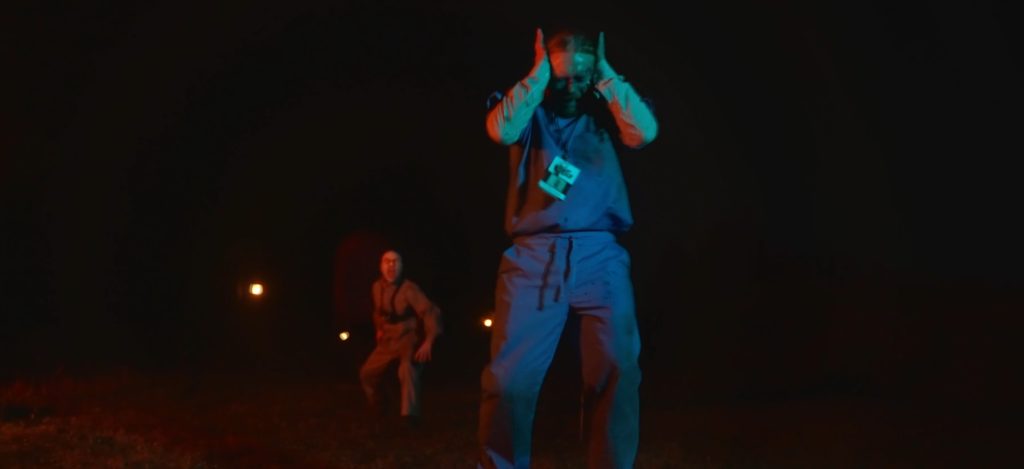
This sequence serves as the film’s first major showcase for its practical effects work, and it is genuinely impressive. Sawl Güd’s performance as Subject 13 is physically intense and unsettling, while the make-up design transforms him into a convincing bio-engineered monster. The combination of practical effects, lighting and performance creates a creature that feels dangerous and unpredictable. Accompanying the chaos is an eerie musical score that occasionally evokes memories of the Silent Hill franchise, adding further dread to the proceedings.
As the story progresses, Jensen is delivered to The Farm, where he finds himself at the mercy of Dr. Black and Dr. Love. These two figures represent the darker side of Pharmacyn’s operations, berating Jensen for actions taken behind their backs and making it clear that they have very specific plans for his future.
The film gradually reveals itself to be something akin to a low-budget Resident Evil. There are obvious parallels in the pharmaceutical conspiracies, experimental bio-weapons and secretive corporate wrongdoing. While S86 never attempts to compete directly with major studio productions, it successfully creates a similar atmosphere of scientific horror and paranoia.
What is particularly impressive is how much production value Vertz and his team manage to squeeze from what was clearly a modest budget. Cinematographer John Retherford delivers several striking images throughout the film, from the aerial drone footage of the van travelling through rural landscapes to the atmospheric night sequences bathed in red vehicle brake lights. One standout moment sees Jensen kneeling in darkness, illuminated entirely by the crimson glow of surrounding vehicles as Dr. Black and Dr. Love confront him. It is a simple visual idea, but an effective one.
The visual effects work also deserves praise. Independent productions often struggle when attempting ambitious visual effects sequences, but S86 generally integrates its digital work successfully. Combined with strong practical make-up effects and convincing gore, the film frequently punches above its weight visually.
The screenplay introduces several intriguing ideas throughout its seventy-minute runtime. One particularly effective sequence involves the villains releasing Jensen into the wilderness, only to unleash Subject 13 moments later. What follows plays almost like a twisted hunting exercise, with the creature tracking Jensen across the countryside like a bloodhound while its creators observe the results. It is an inventive scenario that not only generates suspense but also demonstrates the horrifying effectiveness of the biological weapon.
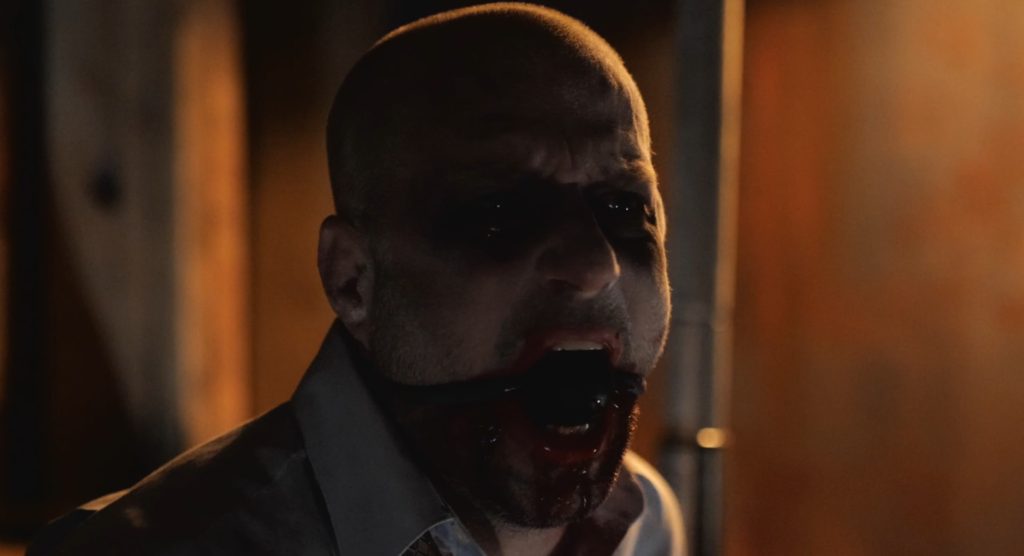
The performances vary in quality, which is not unusual for an independent production. There are moments where line delivery feels slightly uneven, and a handful of scenes could have benefited from additional polish. However, the cast remains committed throughout, and that commitment goes a long way towards maintaining audience investment. Robert Snow performs well as the increasingly desperate Jensen, while Giovanny Vazquez and Daniel Anderson create an entertaining dynamic as Graves and Carter. Georgina Mercedes Black and Johnny Rocko also make solid antagonists as the sinister scientists overseeing the experiments.
Another strength of S86 is its pacing. At just seventy minutes long, the film never overstays its welcome. Vertz keeps the narrative moving steadily forward, balancing exposition, horror sequences and action scenes effectively. The result is a film that remains engaging throughout and rarely feels bogged down by unnecessary material.
The score by J. Lee Mezus and J. Lee Vertz further enhances the experience. Whether accompanying tense chase sequences, gruesome laboratory experiments or quieter moments of suspense, the music consistently supports the mood without overwhelming the scenes.
S86 is not a perfect film. Some performances are stronger than others, and certain moments reveal the limitations of the production’s budget. Yet these issues never derail the overall experience. What remains is an ambitious, entertaining and often impressive science fiction horror film that clearly has passion behind every frame.
For fans of bio-horror, zombie-inspired creatures, pharmaceutical conspiracies and films in the vein of Resident Evil, S86 offers plenty to enjoy. It may be operating on a fraction of the budget of the films that inspired it, but through clever filmmaking, effective practical effects and some genuinely memorable sequences, it manages to carve out its own identity.
Independent horror thrives on creativity, and S86 has that in abundance. It is a strong effort from J. Lee Vertz and his team, and one that genre fans should absolutely seek out.
| Acting | |
| Direction | |
| Cinematography | |
| Writing | |
| Sound | |
| Screen Critix Rating |