
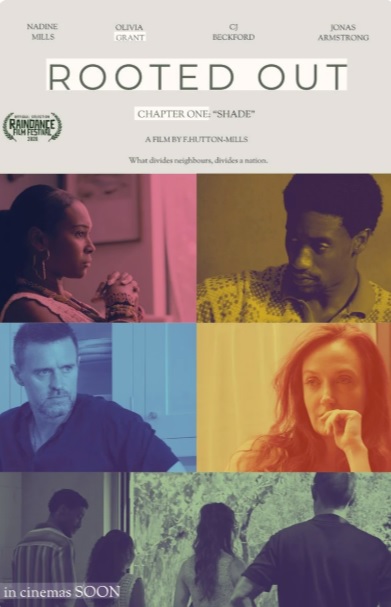
Few films are willing to tackle subjects as immediate and potentially divisive as race, identity and social unrest, but Rooted Out – Chapter 1 embraces that challenge head on. Making his feature directorial debut, Freddie Hutton-Mills places a seemingly ordinary neighbourhood dispute against the backdrop of one of Britain’s most turbulent periods in recent memory, using domestic conflict to explore wider conversations surrounding prejudice, perception and communication.
Rather than offering easy answers, the film asks difficult questions.
The story opens quietly enough. Claire (Olivia Grant) stands in her garden looking towards the large tree growing in her neighbours’ back garden while a radio report discusses racial division in the United Kingdom. It immediately establishes the film’s central themes before giving way to a striking opening montage. Real news footage surrounding the aftermath of the 2024 Southport attack and the riots that followed plays across the screen, accompanied not by sombre orchestral music, but by an unexpectedly funky score. It is an unusual creative choice, yet one that immediately gives the film its own identity.
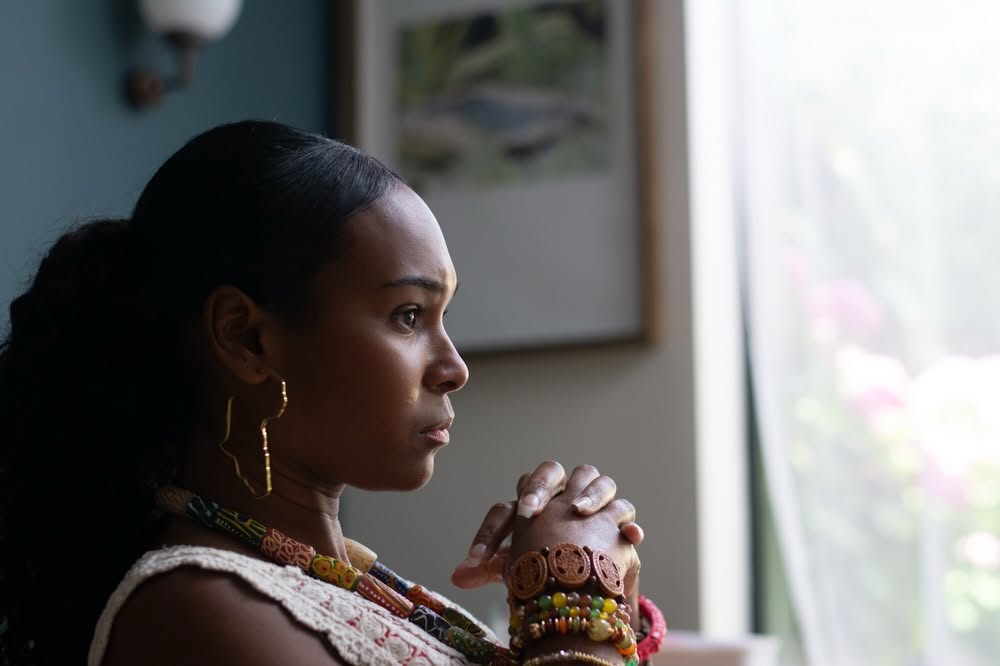
Set during August 2024, the story alternates between two neighbouring households. Claire and her husband Peter are introduced going about their everyday routines. Claire begins her morning exercising in the living room while Peter prepares to build a birdhouse in the garden. Across the fence lives a Black family consisting of Kojo, Ama and their two young sons, who are similarly shown enjoying a seemingly ordinary morning together while television news continues to report on the unrest taking place across Britain.
It is an effective structure. Hutton-Mills repeatedly cuts between the two families, allowing the audience to see that both households are simply living ordinary lives despite the chaos unfolding elsewhere in the country.
Claire’s biggest concern initially has nothing to do with politics. Her prized flowers are dying because the neighbouring tree blocks much of the sunlight reaching her garden. Peter, meanwhile, finds himself far more interested in the political discussions dominating the news cycle.
One of the film’s strengths is the way it handles these conversations. Peter and Claire debate everything from racial terminology to media coverage of the riots, attempting to navigate increasingly sensitive issues without causing offence. Peter also discusses his previous television appearances, revealing he once found himself in legal trouble following comments made during a broadcast concerning homosexuality and pronouns. He is reluctant to remain silent about current events, believing the media often applies different standards depending on who commits acts of violence. Claire, however, desperately wants him to avoid returning to television after the controversy of his previous appearance.
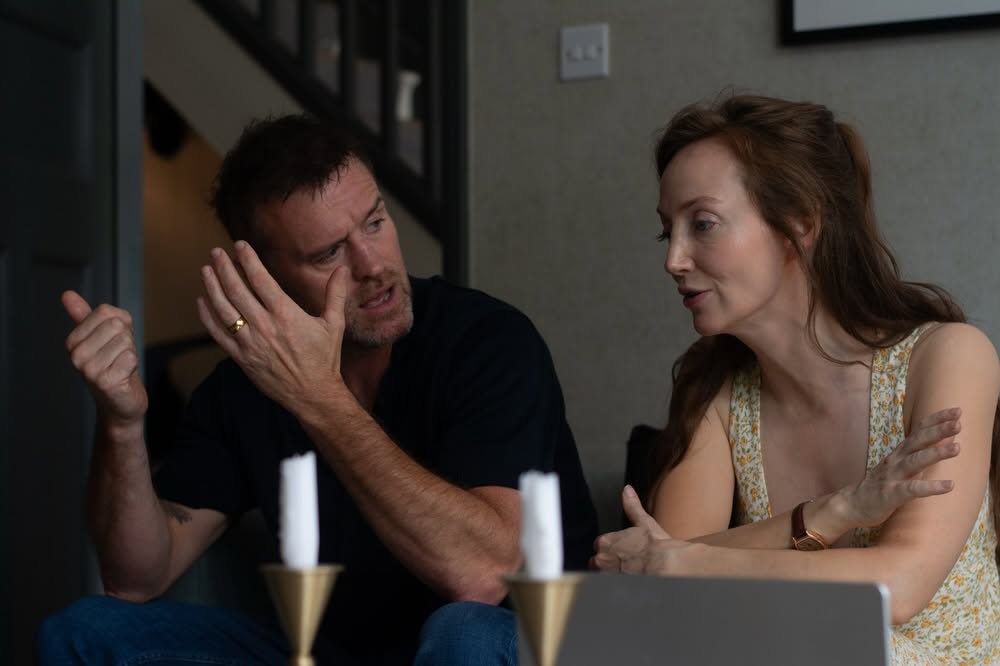
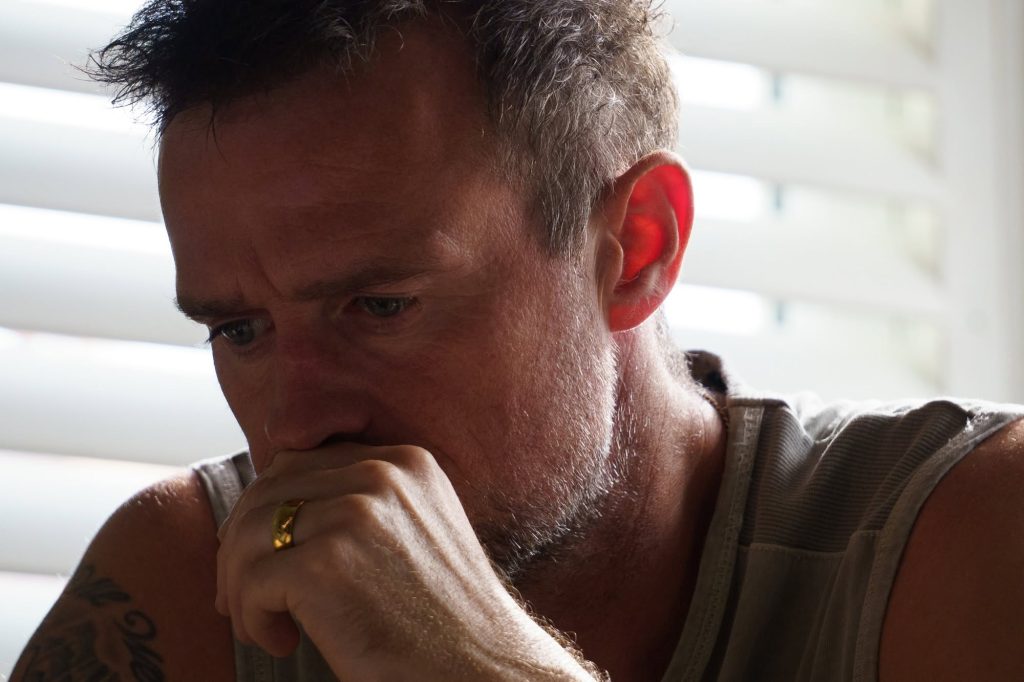
Jonas Armstrong gives the film’s standout performance as Peter. Initially, his appearance, spending much of the film wearing a vest and tracksuit bottoms, might lead audiences to make certain assumptions about his character. Cleverly, the screenplay turns those expectations on their head. Peter proves to be thoughtful, articulate and far more nuanced than first impressions might suggest. He frequently attempts to examine issues from multiple perspectives and often acts as the calmer voice during disagreements.
Claire, by contrast, slowly reveals a more confrontational side. Although her frustrations begin with something as mundane as a tree blocking sunlight, some of her comments hint at prejudices beneath the surface. One particularly uncomfortable exchange sees her asking Kojo how much sunlight people receive in Ghana, despite him being British and holding a British passport. Moments like these quietly expose assumptions people can make based solely on appearance, reinforcing one of the film’s recurring themes that appearances can often be misleading.
Meanwhile, the neighbouring family are given equal opportunity to express their own perspectives. They are horrified both by the murders in Southport and by the riots and destruction that followed. Rather than presenting one side as wholly right or wrong, the screenplay allows each household to react to the same national events from their own viewpoint.
For much of its runtime, Rooted Out – Chapter 1 functions almost like a chamber piece, driven almost entirely by dialogue. Surprisingly, this never becomes a weakness. The conversations remain engaging enough to sustain interest, even though the central conflict itself takes time to fully emerge.
It is only around the one-hour mark that Peter and Kojo finally share a scene together. Standing outside their respective homes, Peter awkwardly apologises for the riots, almost as though he personally bears responsibility for the actions of others. Kojo instead extends an olive branch, inviting Peter and Claire to his son’s birthday celebration.
That goodwill is quickly shattered.
The arrival of the postman delivers the film’s catalyst, a solicitor’s letter sent by Claire demanding legal action unless the neighbouring family removes their tree. The letter cites blocked sunlight, falling leaves, structural concerns and excessive noise as reasons for its removal.
The dispute immediately escalates.
Rooted Out – Chapter 1 Explores Division Through Neighbourly Conflict
One cannot help but feel that a friendly conversation would have been a more reasonable first step than involving solicitors, and that appears to be exactly what Peter believes. He is genuinely shocked to discover Claire has taken legal action without even discussing it with him. During the confrontation that follows, Peter repeatedly attempts to de-escalate the situation and encourage an open conversation between neighbours. Claire, however, insists that all future communication should go through lawyers, repeatedly undermining Peter’s efforts to resolve matters peacefully.
It is a fascinating character dynamic. Peter’s desire for dialogue contrasts sharply with Claire’s increasingly rigid position, while the neighbours’ understandable frustration adds another layer of tension.
Technically, the production is polished throughout. The cinematography is consistently attractive, with carefully composed frames and naturalistic lighting giving the film an understated realism. Despite relying heavily on conversations, Freddie Hutton-Mills keeps scenes visually engaging through confident staging and editing.
The soundtrack is another pleasant surprise. Rather than leaning into sombre dramatic music, the film frequently employs funk-inspired cues that give certain scenes an unexpected rhythm without feeling out of place.
The performances across the board are excellent. Jonas Armstrong anchors the production with a layered, thoughtful portrayal of Peter, while Olivia Grant gradually peels back Claire’s frustrations and prejudices without turning her into a caricature. The supporting cast deliver similarly believable performances, ensuring every conversation feels authentic rather than overly theatrical.
Perhaps Rooted Out – Chapter 1‘s greatest achievement is refusing to simplify its subject matter. It would have been easy to present obvious heroes and villains, but instead the screenplay explores how misunderstandings, assumptions and poor communication can slowly erode relationships between otherwise ordinary people. The wider political backdrop never overwhelms the personal story, instead acting as a pressure cooker that intensifies existing tensions.
Despite running for seventy-nine minutes before the dispute reaches full force, the dialogue remains compelling enough that the film rarely loses momentum. Every conversation gradually builds towards the inevitable confrontation, making the eventual fallout feel earned.
As the title suggests, the tree itself becomes more than simply a tree. It serves as a symbol around which larger issues of identity, prejudice, ownership and community quietly grow.
Thought-provoking, topical and confidently directed, Rooted Out – Chapter 1 is an impressive debut from Freddie Hutton-Mills. Anchored by excellent performances, intelligent writing and a willingness to explore uncomfortable conversations without resorting to simplistic answers, it offers a compelling examination of how everyday disagreements can become something far more significant when communication breaks down.
It is a film that encourages discussion long after the credits have rolled, and perhaps that is exactly what it sets out to achieve.
| Acting | |
| Direction | |
| Cinematography | |
| Writing | |
| Sound | |
| Screen Critix Rating |