
There is something timeless about stories set deep in the wilderness. Removed from civilisation, surrounded only by towering trees and the sounds of nature, they often become stories about survival, trust and the ghosts we carry with us. Pearls, the award-winning short from writer and director Mike Simms, embraces all of those ideas, delivering a gripping twelve-minute drama that packs an impressive emotional punch.
The film wastes little time establishing an air of mystery. It opens with a close-up of a young boy staring at a single pearl resting in the palm of his hand. The image is simple, but immediately intriguing. Before long, the story jumps forward several years to the 1930s, where that same boy, now grown into a young man named Paul (Noah Perchard), arrives at a remote Newfoundland logging camp hoping to earn a living.
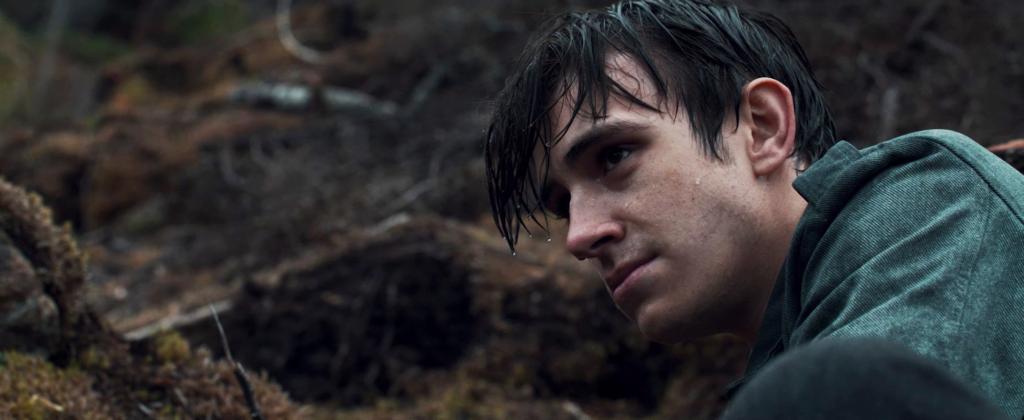
Paul is only there on a week’s trial, and his introduction to the camp is hardly welcoming. Foreman William (Lawrence Barry) warns him that logging is relentless work and that the other men will quickly turn against him if he cannot keep pace. Adding further tension is the fact that the workers have not been paid for some time, with William insisting their wages are on the way despite growing frustration among the crew.
Fortunately for Paul, he finds an ally in Bennie, played with warmth and quiet authority by Stephen Oates. Bennie agrees to show the newcomer the ropes and quickly becomes the closest thing Paul has to a friend in the unforgiving environment. Not everyone is quite so welcoming. Brian Marler’s Floyd immediately establishes himself as the camp bully, intimidating Paul, stealing his cigarettes and making it clear that newcomers are not especially appreciated.
While working near a lake, Paul notices another pearl lying on the shoreline. He quietly slips it into his pocket before Bennie approaches, but their peaceful moment is interrupted when another argument erupts among the loggers, this time involving accusations that Floyd has been stealing from his fellow workers. These small confrontations steadily build the atmosphere without ever feeling forced.
Simms cleverly weaves flashbacks throughout the narrative. We return to Paul’s childhood where, in stark contrast to the harsh logging camp, he spends carefree days on a dock with a young girl named Maria. The colours become noticeably brighter and warmer during these scenes, creating a visual distinction between happier memories and the bleak reality of Paul’s adult life.
One particularly touching flashback sees young Paul discovering a pearl and offering it to Maria as a gift. However, those idyllic memories clearly hide something much darker. The sequence ends abruptly with Paul desperately screaming Maria’s name before waking suddenly back at camp.
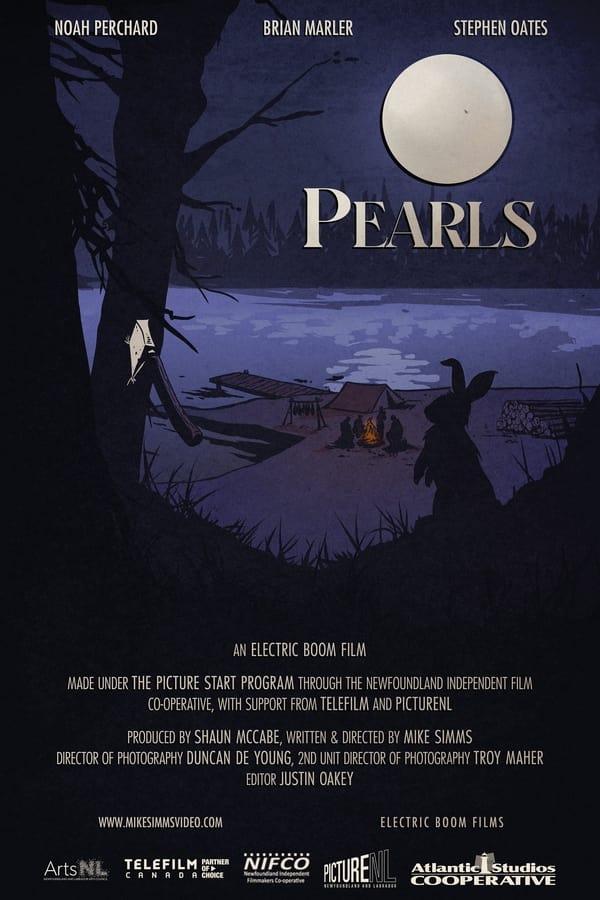
As evening falls, the loggers gather around the campfire for dinner and a game of cards. What begins as another ordinary conversation soon takes an unexpected turn when Paul realises one of the men seems strangely familiar. A chance encounter from his past resurfaces, and the mood around the campfire shifts dramatically. It is here that Pearls quietly transforms from a period drama into something far more suspenseful, allowing the mystery to deepen without resorting to cheap twists.
What makes Pearls so effective is its restraint. Rather than relying on constant exposition, the screenplay trusts its audience to gradually piece together the connection between Paul’s traumatic childhood memories and the tension building in the present. The mystery unfolds naturally, allowing the emotional weight of the story to build throughout its concise runtime.
Visually, the film is outstanding. Cinematographer Duncan De Young captures Newfoundland’s forests beautifully, using the natural landscape to create both beauty and unease. The daytime sequences highlight the vastness of the wilderness, while the evening camp scenes are particularly impressive. The campfire lighting gives these moments an intimate, almost theatrical quality without ever feeling artificial.
The colour grading deserves special mention as well. The vibrant flashbacks contrast wonderfully against the muted greens, browns and greys of the logging camp, subtly reinforcing Paul’s loss of innocence without the film ever needing to explain it outright.
The performances across the cast are equally strong. Noah Perchard gives Paul an understated vulnerability that makes him easy to root for. Rather than overplaying the character’s trauma, he allows much of Paul’s emotional burden to remain beneath the surface until key moments demand otherwise.
Stephen Oates is excellent as Bennie, portraying a man who earns the respect of those around him through quiet leadership rather than intimidation. His kindness provides a welcome balance to the harsher personalities within the camp. Brian Marler also impresses as Floyd, creating an antagonist whose presence alone generates unease long before the screenplay fully reveals why Paul fears him.

Behind the camera, Mike Simms demonstrates considerable confidence as both writer and director. The pacing is remarkably efficient, never wasting a scene despite telling a story that spans decades through carefully placed flashbacks. Every scene feels purposeful, ensuring the film never outstays its welcome.
Victor Lewis’ musical score complements the drama beautifully, supporting the emotional beats without overwhelming them, while the editing by Justin Oakey maintains excellent momentum throughout the twelve-minute runtime.
It is easy to understand why Pearls picked up the Best Atlantic Short Award at AIFF. The production values are consistently high, the performances feel authentic, and the storytelling is both engaging and emotionally resonant. More importantly, the film understands that genuine suspense often comes not from spectacle, but from the slow revelation of buried trauma.
By the time the credits roll, Pearls has delivered far more than its modest runtime might suggest. It is a beautifully crafted period drama with thriller elements, elevated by superb cinematography, strong performances and confident direction.
Mike Simms has assembled an impressive team whose craftsmanship is evident in every frame, and if Pearls is any indication of what’s to come, audiences should be very interested in whatever they create next. It is a polished, emotionally engaging short film that leaves a lasting impression long after its final scene.
| Acting | |
| Direction | |
| Cinematography | |
| Writing | |
| Sound | |
| Screen Critix Rating |