
Grief has a way of transforming familiar places into something entirely different. A childhood home can become a reminder of everything that has been lost, while an ordinary possession can carry an emotional weight far greater than its physical value. These ideas form the foundation of Remedy the Dead, an atmospheric eighteen-minute short film from writer and director Gabriel Brown that explores bereavement through a carefully constructed blend of intimate drama and supernatural uncertainty.
Set in Scotland in 1983, the film follows Ellie (Bryony Corrigan), a young woman struggling with the death of her father, Connor (Michael Carter). Returning to the place where she grew up, Ellie finds herself confronting memories that refuse to remain comfortably in the past, with Brown gradually introducing the possibility that her father’s presence may not be entirely confined to those memories.
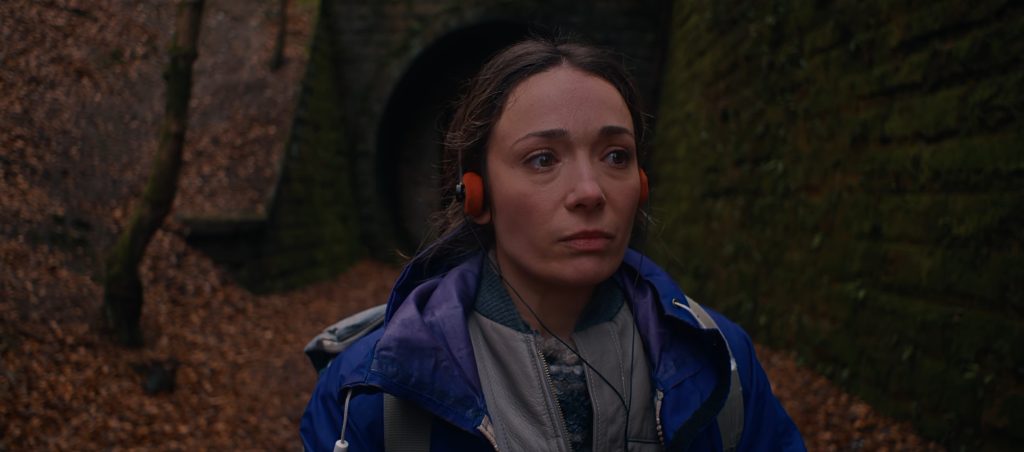
The opening immediately establishes the film’s visual confidence. An indistinct image of a tunnel slowly reveals Ellie as she approaches the camera, her figure coming into focus as she moves closer. She places a pair of headphones over her ears, inserts a cassette into a portable player and presses play. Rather than music, we hear a recording of her father’s voice, introducing an important connection between sound, memory and the emotional absence at the centre of the story.
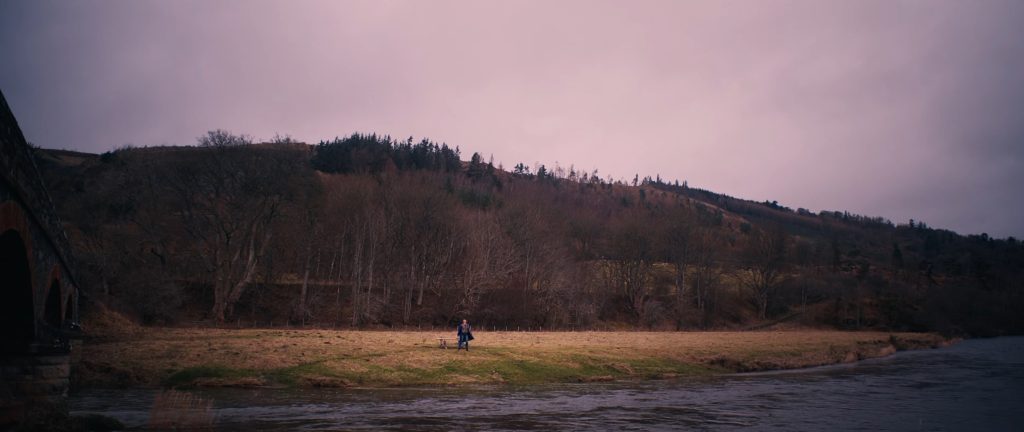
Brown allows the Scottish landscape to become part of Ellie’s experience. As she crosses a bridge and walks beside a river, the surrounding countryside is captured with considerable beauty, providing a peaceful contrast to the grief she is carrying. The natural scenery is more than an attractive backdrop, offering moments of apparent calm while the recorded voice repeatedly draws Ellie back towards her loss.
One particularly effective sequence finds Ellie stopping beside the water before returning to the cassette player. As Connor’s voice begins speaking, the image changes aspect ratio, narrowing into a more enclosed 4:3 frame. It is a striking visual decision that subtly alters our relationship with the scene, as though the recording has momentarily changed the way Ellie experiences the world around her.
The effect is strengthened by the content of Connor’s words. His expression of regret at being unable to see her latest artistic achievement provokes an anguished reaction from Ellie, whose grief erupts in a scream. Brown allows the emotional impact to emerge through Corrigan’s performance rather than relying on an elaborate dramatic explanation, making the moment particularly affecting.
The journey towards her childhood home introduces a more unsettling quality. As Ellie walks along a quiet country lane, indistinct figures appear in the background, moving across the road behind her. Their blurred presence is easy to overlook, yet it suggests that the landscape may contain something beyond the ordinary. Brown doesn’t immediately explain these appearances, allowing uncertainty to develop naturally.
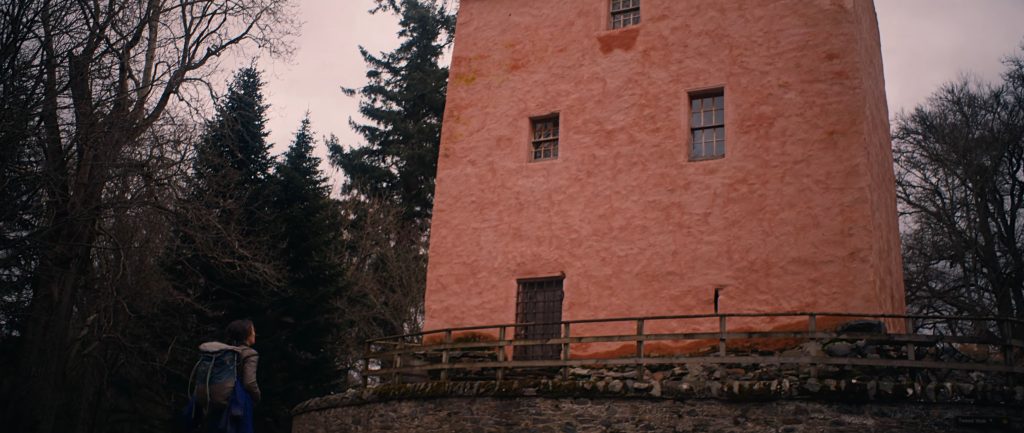
Ellie eventually arrives at an unusual, tall house and lets herself inside. The building appears to have been left undisturbed, with furniture concealed beneath dust sheets and fruit decaying on a table. These details establish a home that has effectively been suspended in time, its familiar domestic surroundings now reflecting absence and neglect.
The house also provides Brown with an opportunity to make sound an increasingly important part of the storytelling. When Ellie listens to another recording, the image again adopts the narrower aspect ratio, reinforcing the connection between her father’s voice and the film’s changing visual language. However, the sound gradually begins to feel less like something coming through her headphones and more like a voice occupying the room itself.
It is a subtle but effective shift. What initially offered Ellie a means of reconnecting with her father becomes something she can no longer comfortably explain, turning a familiar recording into a source of unease. The film’s supernatural suggestions work particularly well because they emerge from objects and experiences already established as emotionally significant.
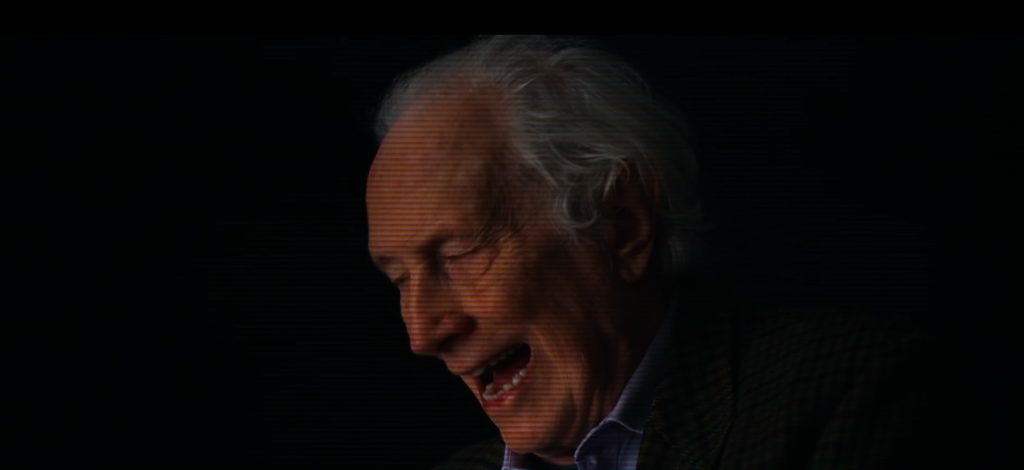
Brown continues developing this uncertainty through the house itself. An exterior nighttime image shows the building illuminated as the enormous shadow of a man approaches across its wall, while a later sequence sees Ellie awakened by a television that has apparently switched itself on. On the screen is a talk show featuring her father, further challenging her understanding of what is happening.
Ellie knows Connor is dead, and the film uses that certainty to create tension between what she believes and what she appears to be experiencing. When father and daughter eventually encounter one another, the emotional implications become more important than any straightforward explanation of the phenomenon.
Bryony Corrigan delivers a convincing central performance, communicating Ellie’s grief through expressions and physical reactions that frequently reveal more than dialogue could. There is a vulnerability to her portrayal, but also an underlying frustration that gives the character greater emotional depth. Her response to the recordings, in particular, makes the relationship with her absent father feel established even before their interactions become more direct.
Michael Carter is equally effective as Connor. An experienced performer whose film credits include Star Wars: Return of the Jedi, in which he played Bib Fortuna, An American Werewolf in London and The Keep, Carter brings a reassuring presence to the role. His performance provides an important counterpoint to Corrigan’s distress, helping the film maintain its emotional credibility even as the circumstances become increasingly unusual.
The cinematography by Andrew Rush Walker is another considerable strength. The Scottish locations are photographed beautifully, while the interiors make effective use of the house’s distinctive character. The carefully controlled focus, changes in framing and movement between natural surroundings and enclosed domestic spaces give Remedy the Dead a visual identity that feels considered throughout.
Sean Grinham’s editing also deserves recognition, particularly in the transitions between aspect ratios and the way the recorded material is integrated into the narrative. These choices are not merely decorative flourishes. They contribute directly to the film’s treatment of memory, establishing a visual distinction between Ellie’s immediate surroundings and the moments in which her father’s voice appears to alter her perception.
At eighteen minutes, Remedy the Dead has sufficient room to establish its emotional foundation without unnecessarily prolonging the mystery. The pacing is measured, allowing the performances and imagery to carry the narrative, while the supernatural elements are introduced with enough restraint to avoid overwhelming the more personal story underneath.
What makes the film particularly engaging is its understanding that grief does not always follow a straightforward progression. Familiar sounds, places and possessions can unexpectedly bring the past into the present, and Brown finds an effective cinematic language for expressing that experience. The possibility of something paranormal occurring adds another dimension, but the film’s emotional concerns remain its strongest feature.
Brown has already built an extensive body of short-form work, and Remedy the Dead demonstrates a filmmaker developing a confident command of visual storytelling. The decision to use changing aspect ratios, carefully staged imagery and sound as expressions of Ellie’s internal experience shows an appreciation of how cinematic techniques can communicate ideas without requiring characters to explain them.
There is a maturity to the film’s approach that makes its modest running time feel substantial. Corrigan and Carter provide the emotional foundation, while the cinematography and carefully constructed atmosphere elevate what could otherwise have been a conventional story about returning to a family home after a bereavement.
Remedy the Dead is an accomplished and moving short film that combines strong performances, striking Scottish scenery and imaginative visual storytelling. Its supernatural ambiguity gives the narrative an intriguing edge, but it is the exploration of grief and the desire to reconnect with someone who has died that leaves the lasting impression. Gabriel Brown has delivered a thoughtful, professionally realised piece of filmmaking that is easy to recommend.
| Acting | |
| Direction | |
| Cinematography | |
| Writing | |
| Sound | |
| Screen Critix Rating |