
There is something admirable about a filmmaker taking on a subject that matters deeply to them, particularly when that subject concerns people whose struggles are often overlooked. Independent cinema provides an opportunity to tell stories that might otherwise struggle to find an audience, and the determination required to complete a feature film should never be underestimated. However, passion and good intentions are only part of the filmmaking process. An important story still needs the technical skill, narrative structure and performances necessary to communicate its message effectively.
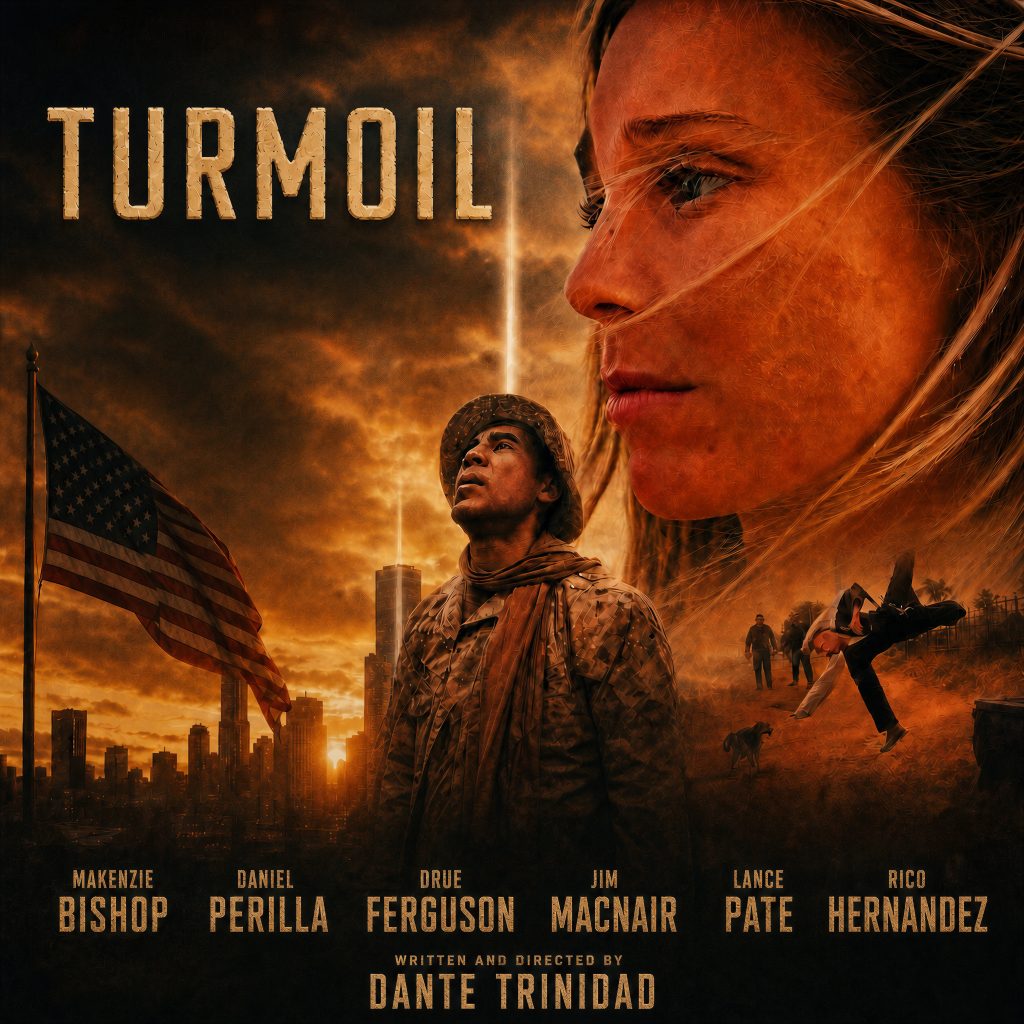
Unfortunately, this is where Turmoil, the feature debut of writer, director and producer Dante Fortaleza Trinidad, encounters considerable difficulties. Its exploration of homelessness, post-traumatic stress disorder and the challenges faced by military veterans has genuine emotional potential, but the execution is so inconsistent that the film frequently struggles to engage on even a basic dramatic level.

Trinidad’s connection to the material is particularly significant. An Iraq War veteran who subsequently worked as a nurse caring for former service personnel, he developed the film as a means of addressing experiences he understood personally. Working with a small crew and a cast that included real veterans rather than established professional actors, Trinidad set out to create something honest about the psychological consequences of military service and the importance of finding support.
That background gives Turmoil a sincerity that deserves acknowledgement. The problem is that sincerity alone cannot compensate for the numerous filmmaking weaknesses that undermine its intentions.
The story follows Daniel (Daniel Perilla), a homeless veteran attempting to survive while struggling with memories of his military service. Sleeping in his car and on the streets, he experiences disturbing recollections of combat alongside moments in which the boundaries between memory and reality become uncertain. In one early sequence, he imagines an encounter with a fellow soldier who offers to exchange something for his sweets, only for the figure to disappear.
These moments establish the psychological difficulties Daniel is experiencing, although their presentation lacks the visual and editorial precision needed to make them particularly affecting. The transitions between his present circumstances and wartime memories are often abrupt, while the noticeably altered colour grading of the combat sequences feels more like an attempt to suggest a foreign location than a fully developed visual approach.
Daniel’s circumstances begin to change when he encounters the instructor of a Brazilian jiu-jitsu gym. After witnessing a cleaner treating Daniel harshly while he sleeps outside, the instructor intervenes and offers him shelter and work at the gym. It is an act of kindness that provides the film with its central dramatic opportunity, allowing Daniel to discover a community where discipline, companionship and personal responsibility might help him rebuild his life.
There is a worthwhile story here, particularly in the suggestion that recovery can begin through seemingly ordinary gestures of compassion. Unfortunately, the screenplay rarely develops these relationships with sufficient depth. Characters are introduced, conflicts appear and situations resolve themselves with little preparation, leaving the narrative feeling like a collection of loosely connected ideas rather than a cohesive journey.
The gym itself provides the setting for much of the film’s comedy and conflict. Daniel becomes increasingly interested in the students practising on the mats, while a developing connection with Mackenzie (Mackenzie Bishop) introduces the possibility of a more personal relationship. Elsewhere, an antagonistic student behaves like a stereotypical school bully, despite being considerably older than the sort of character his actions suggest. At one point, he deliberately pours water onto the mats Daniel is cleaning before telling him that he’s missed a spot, an act of playground bullying from a man who appears to have left school several decades earlier.
These moments demonstrate one of Turmoil’s most persistent problems: the film often struggles to establish a convincing tone. Scenes intended to be humorous can feel awkwardly staged, while more serious exchanges are weakened by dialogue that sounds unnatural or excessively explanatory. Rather than allowing relationships to develop through believable interactions, the film frequently has characters articulate its themes directly.
The performances are similarly uneven. Daniel Perilla has the difficult responsibility of carrying a story built around psychological trauma and personal recovery, but the material rarely gives him the opportunity to develop a convincing emotional progression. Much of the supporting cast also appears uncomfortable in front of the camera, with hesitant delivery and inconsistent reactions making it difficult to become absorbed in the drama.

The use of non-professional performers is not inherently a weakness. Indeed, casting people with direct experience of military life could have brought an unusual degree of authenticity to the production. However, effective direction remains essential, particularly when performers have limited acting experience. Here, the distinction between genuine experience and convincing dramatic performance becomes increasingly apparent.
More damaging still is the film’s sound.
Throughout Turmoil, dialogue is frequently muffled, inconsistently balanced or difficult to understand. Some exchanges appear to have been dubbed or replaced in post-production, yet the replacement dialogue is not always convincingly synchronised with the performers’ movements. At times, individual words seem to fluctuate in volume, producing a distracting effect that repeatedly pulls attention away from the story.
These are not minor imperfections that can simply be overlooked because the production had limited resources. Clear dialogue is fundamental to narrative filmmaking, and when an audience has to concentrate on deciphering what characters are saying, their ability to engage with the performances and emotional content is seriously compromised.
The cinematography presents further difficulties. Several sequences suffer from noticeably soft or incorrect focus, including a scene in which a new instructor addresses students at the gym. Framing and blocking are also inconsistent, with some compositions appearing insufficiently considered and others failing to direct attention towards the most important elements of a scene.
Lighting rarely provides much dramatic distinction between locations or situations, while the editing struggles to establish a consistent rhythm. Musical transitions can feel abrupt, and the combination of uneven coverage, awkward pauses and inconsistent audio gives the production a noticeably unfinished quality.
The film’s handling of emotional scenes is also questionable. Mackenzie returns home and speaks to her deceased father in her bedroom, breaking down as she expresses how much she misses him. Her mother watches through a gap in the door before retreating to the bathroom to cry herself, all accompanied by a piano rendition of Bryan Adams’ Heaven. The choice is so conspicuous that it becomes difficult to concentrate on the intended emotion, and one cannot help wondering whether Bryan Adams was aware his song would be providing the soundtrack to this particular family tragedy.
It is an unfortunate example of the film’s tendency to underline feelings that should be communicated through the performances. Rather than allowing the characters’ grief to emerge naturally, the scene seems determined to tell the audience precisely how sad it is supposed to be, with the music doing much of the heavy lifting.
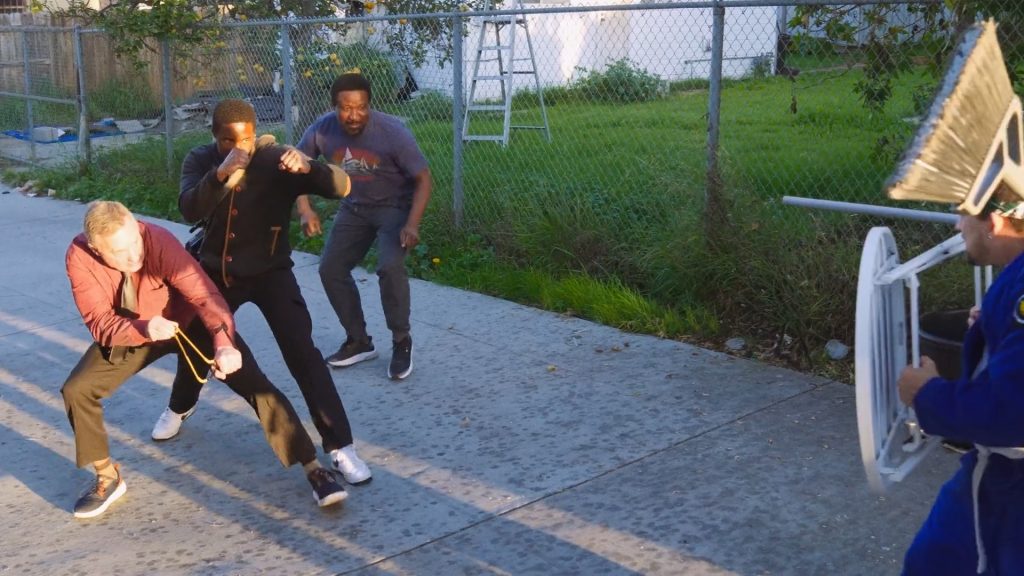
The screenplay introduces additional complications as it attempts to combine Daniel’s recovery with romance, gym rivalries and increasingly exaggerated confrontations. A particularly unconvincing development involves members of a rival martial arts establishment threatening the gym before a confrontation escalates into a group fight. Daniel initially attempts to defend himself using techniques he has apparently absorbed through the revolutionary training method of watching other people practise while mopping the floor.
Just as the situation becomes increasingly desperate, his instructor and several fellow students arrive to join the confrontation. The entire sequence begins to resemble the enormous street fight between rival news teams in Anchorman: The Legend of Ron Burgundy, except here everyone is taking themselves completely seriously. Even the gym’s resident bully appears to have received the call to assemble, creating something closer to a low-budget superhero team-up than a believable confrontation between martial arts establishments.
To make matters even more convenient, a reporter and cameraman happen to be nearby and investigate the sounds of fighting. It is the sort of coincidence that might have worked perfectly well in Anchorman, where absurdity is the entire point, but in a drama about a homeless veteran coping with trauma, it only serves to highlight how far the film has wandered from its original purpose.
There are quieter moments that suggest a more effective version of Turmoil might have been possible. The relationship between Daniel and the gym instructor offers an opportunity to explore trust, compassion and the difficulties of accepting help, while Mackenzie’s personal loss could have provided a meaningful parallel to Daniel’s experiences. Unfortunately, neither thread is developed with sufficient subtlety or consistency to give the story the emotional weight it needs.
The central difficulty is not that Turmoil attempts too much with too little money. Independent filmmakers have repeatedly demonstrated that compelling cinema can be created with modest resources, provided the material is developed around the production’s practical capabilities. Instead, the film’s problems arise from weaknesses in the fundamentals of filmmaking, including screenplay construction, performance direction, sound recording, cinematography and editing.
Trinidad’s decision to make a feature without previous filmmaking experience is undoubtedly ambitious. His personal connection to the subject, combined with the participation of veterans and others familiar with the issues being explored, gives the project a purpose beyond simple entertainment. Turmoil also received the Audience Choice Award at the Santa Monica Film Festival, demonstrating that its message has connected with at least some audiences.

That recognition deserves respect, but it does not remove the need to assess the finished film on its own merits. A production can be meaningful to those involved and still fall short as a piece of cinema, just as an important subject does not automatically produce an effective screenplay.
There is a considerable difference between having a story worth telling and knowing how best to tell it. Trinidad clearly possesses the former, and the compassion behind Turmoil is never in serious doubt. What the film lacks is the technical confidence and storytelling discipline required to transform that compassion into something consistently engaging.
Developing these skills through shorter projects, greater attention to sound and image, and more structured work with performers could help Trinidad build on the experience of completing his first feature. The ambition and commitment are evident, but the practical execution requires substantial improvement.
Ultimately, Turmoil is a disappointing film built around an admirable intention. Its examination of veteran homelessness, trauma and the healing potential of human connection provides a worthwhile foundation, but the weak performances, fragmented storytelling and persistent technical problems prevent that foundation from supporting a convincing feature. There is heart behind the project, and that should not be dismissed, but good intentions cannot overcome the fundamental shortcomings of the finished film.
| Acting | |
| Direction | |
| Cinematography | |
| Writing | |
| Sound | |
| Screen Critix Rating |