
It has been a while since Screen Critix last encountered the work of Usher Morgan and Katie Vincent. Preggo arrived back in 2015, followed by Pickings and Trapped Inside in 2018, while Homebound was reviewed in 2021. Time certainly moves quickly, and the filmmaking duo now return with Plucked, an ambitious 110-minute period feature that combines dark comedy, marital warfare and increasingly dangerous thrills within the confines of Gilded Age New York.
Set around 1886, the film introduces Katherine Greene (Katie Vincent) at the Westchester home she shares with her husband, Peter (Jared Canfield). The opening initially presents the house in monochrome before bursting into vivid colour as the credits begin, accompanied by modern music that immediately signals this isn’t going to be an overly traditional period drama.

Katherine soon receives a letter confirming that her request for divorce has been approved. She initially attempts to read it inside, but the activity surrounding preparations for Peter’s forthcoming gathering drives her outdoors, where she can finally absorb what it means. Her decision isn’t merely a plot device waiting to be revealed later. Plucked establishes it early and allows the impending collapse of the marriage to hang over everything that follows.
Peter discovers Katherine outside and makes his displeasure with her perfectly clear. Guests are expected, appearances must be maintained and his increasingly rebellious wife threatens to disrupt the evening he has planned. Maggie (Catherine Curtin), the household’s principal maid, knows about Katherine’s intentions and supports her, although she warns that simply leaving Peter might not prove as straightforward as Katherine hopes.
From there, Plucked begins assembling the personalities who will turn one uncomfortable social occasion into something considerably more volatile. Among the most immediately entertaining is James (J. Anthony Crane), an unabashed flirt with a fondness for alcohol and a habit of needling the people around him. Crane understands the character’s function extremely well, giving James the confidence of a man who seems perfectly happy to entertain himself at somebody else’s expense.
Dinner, Divorce and Disastrous Manners
One of Plucked’s greatest strengths is the way it establishes conflict through character interaction rather than immediately rushing towards its thriller elements. Katherine is deliberately late joining Peter’s guests, and when she finally appears, her behaviour grows increasingly provocative. Vincent clearly enjoys playing a woman who has reached the point where maintaining her husband’s preferred version of respectability no longer holds much appeal.

Peter attempts to control the situation, demanding that she change and behave more appropriately. Katherine responds by handing him the divorce papers. From that point onwards, the social gathering effectively becomes a battlefield in which polite conversation and carefully maintained appearances struggle against the resentment already consuming their marriage.
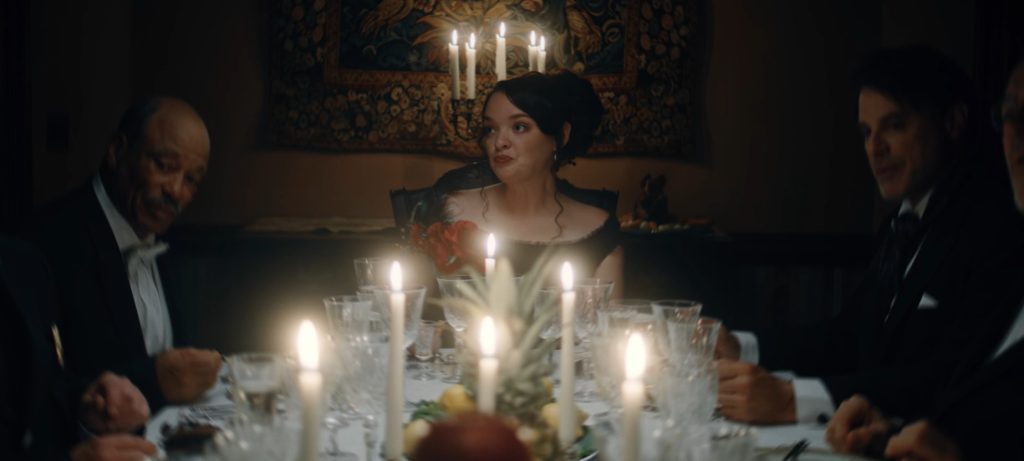
A particularly effective sequence places Katherine and Peter at opposite ends of the long dining table. Their guests continue talking and laughing while the couple stare at one another, each perfectly aware of the significance of the letter Peter has just received. Katherine continues eating and drinking as she watches him, eventually turning her attention towards the guests themselves and openly challenging assumptions concerning her involvement in the family’s financial affairs.
It is here that Plucked works especially well as a dark comedy. The humour isn’t separate from the marital conflict but generated by it, with Peter desperate to preserve an atmosphere of civility while Katherine increasingly refuses to participate in the performance. His eventual claim that a patient requires urgent attention in Danbury provides him with an opportunity to escape an evening that has gone spectacularly differently from the one he intended.
His departure also leaves Katherine alone with James. Their earlier chemistry quickly becomes physical, and Katherine is so unconcerned about concealing what is happening that even an interruption from a maid does little to embarrass her. She eventually sends Maggie and the other maids away with money to enjoy themselves, leaving the house considerably emptier.
Peter’s eventual return marks an important tonal shift. Discovering Katherine and James together sends the simmering hostility into outright violence, transforming the elegant home from the setting for social embarrassment into something much more threatening. The escalation works because Morgan and Vincent have spent considerable time establishing the personalities, grudges and power dynamics beforehand. The violence isn’t arriving from nowhere. It is the physical manifestation of a marriage that has already collapsed emotionally.
Plucked Looks the Part
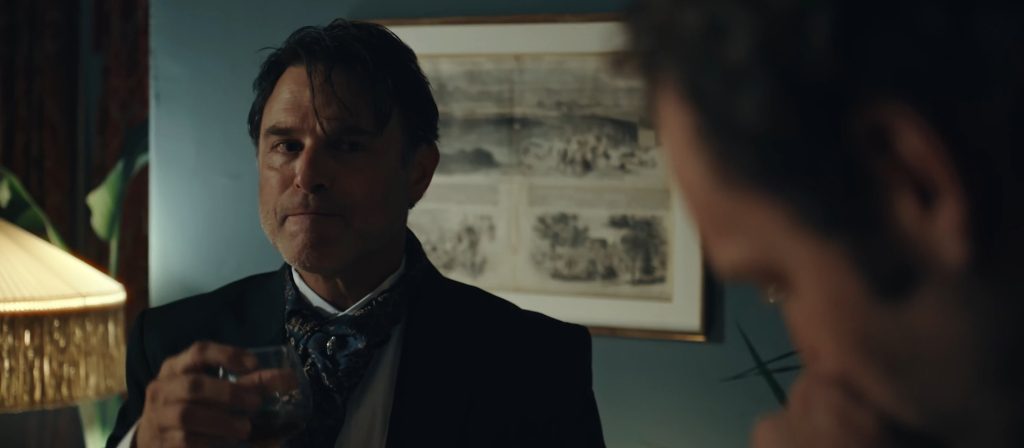
For an independent production attempting to recreate late nineteenth-century New York, Plucked is visually impressive. Cinematographer Giuseppe Masi makes excellent use of the period location, particularly throughout the interiors, where candles and fireplaces frequently appear within the compositions. The practical sources complement the wider lighting design and help create images that feel warm, textured and appropriate to the setting without sacrificing clarity.
The widescreen presentation also gives the characters room to inhabit their surroundings. That becomes particularly effective around the dinner table and within the larger rooms of the house, where the physical distance between people can become part of the dramatic composition. There are occasional moments where the focus becomes slightly soft despite relatively limited movement within the frame, but these are exceptions within an otherwise accomplished piece of cinematography.
Colour is equally important. After the monochrome opening, Plucked embraces a vivid palette rather than attempting to make its period setting visually restrained. That choice complements the film’s willingness to combine nineteenth-century surroundings with a more contemporary energy.
The production design by Casey Schwartz and costume design by Cynthia Oliveira Souza are crucial to selling the period. The dresses, suits, furnishings and decorative details allow the film to establish its era visually rather than constantly reminding the audience through dialogue. For a story that spends substantial time inside one home, that environment needs to withstand close scrutiny, and considerable effort is visible on screen.
Music provides another interesting contrast. Rather than restricting itself to music associated with the period, Plucked incorporates modern songs alongside classical and operatic material. Combined with the colourful imagery, it prevents the film from feeling like a reverential recreation of a nineteenth-century drama. Morgan and Vincent are interested in the setting, but they aren’t constrained by the expectation that every stylistic decision must belong to 1886.
A Marriage Coming Apart
The performances are consistently strong across the ensemble, although Vincent and Canfield understandably carry much of the dramatic weight. Vincent makes Katherine entertainingly unpredictable without losing sight of the anger underneath her behaviour. Her deliberate provocations can be funny, but they are also the actions of someone who has decided she no longer intends to remain within the role Peter expects her to occupy.
Canfield has the opposite task. Peter spends portions of the film attempting to contain his anger because his reputation and authority depend upon appearing in control. Watching that control deteriorate gives the performance much of its tension. The dinner sequence benefits enormously from what passes silently between Katherine and Peter, with looks across the table communicating as much as some of their dialogue.
Crane is also memorable as James, whose flirtatious confidence and irreverence inject energy into the gathering. Curtin’s Maggie, meanwhile, occupies a very different position within the household, allowing the film to show Katherine interacting with someone who knows considerably more about her private intentions than the assembled guests.
Morgan and Vincent also employ recurring flashbacks involving a wedding ceremony, providing another visual thread against the disintegration unfolding within the house. Rather than turning the film into a simple succession of increasingly outrageous events, these glimpses keep the idea of marriage itself present as Katherine and Peter move further away from whatever their relationship once represented.
At 110 minutes, Plucked gives its characters plenty of room to argue, flirt, provoke and reveal themselves. The film is at its strongest when allowing those personalities to collide, particularly during the dinner gathering, where social etiquette and private hostility exist simultaneously. The screenplay understands that an uncomfortable look across a table can sometimes generate as much tension as a physical confrontation.
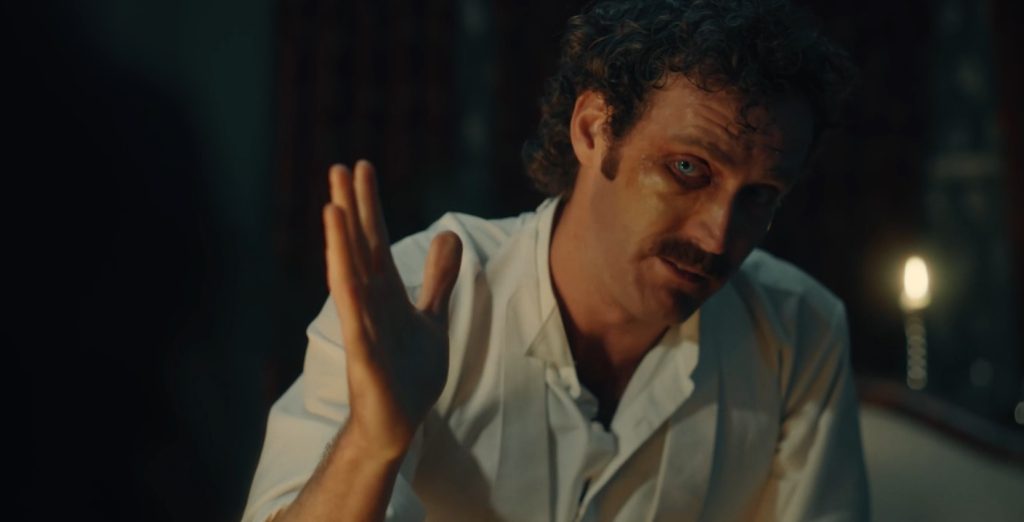
Plucked is an impressive return from Morgan and Vincent, demonstrating considerable growth in scale and visual confidence since the films Screen Critix encountered several years ago. Its combination of period drama, dark comedy and thriller elements gives the feature a personality of its own, while the cinematography, lighting, costumes, locations and strong ensemble performances make its nineteenth-century world convincing.
Most importantly, the film understands that its real battleground isn’t simply the Greene household but the marriage occupying it. Katherine’s determination to leave and Peter’s inability to accept the humiliation set pride, control, resentment and desire against one another until civility can no longer contain them. The result is a handsome, entertaining and increasingly volatile period feature that makes a very bad evening for its characters into a rather enjoyable one for the audience.
| Acting | |
| Direction | |
| Cinematography | |
| Writing | |
| Sound | |
| Screen Critix Rating |