
The opening image of Molly immediately tells us that writer-director Darius Shu has an eye for the unusual. Inside a launderette, a small fish swims within what appears to be a washing machine converted into an aquarium. It is an attractive visual in its own right, but over the course of this 23-minute romantic drama, the significance of that little fish becomes increasingly clear.
Vinnie (Hiroki Berrecloth) works at the launderette, spending his days surrounded by the repetitive motion of washing machines and the customers who pass through the doors. He enjoys the opportunity to observe people coming and going, although his own life appears considerably quieter. That changes when Ryan (Frank Kauer) arrives to do some washing and discovers first that he needs change for a five-pound note and then that he has forgotten detergent.
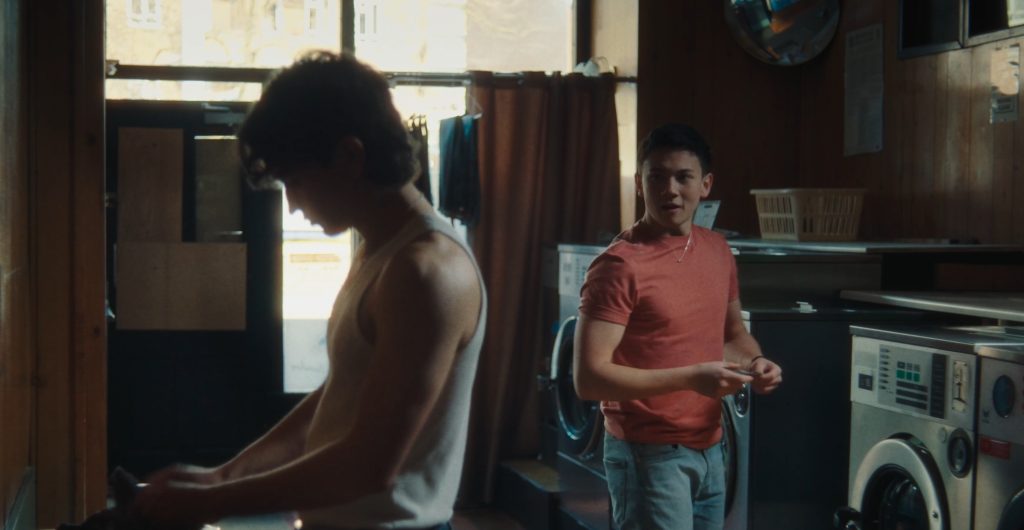
The resulting conversation introduces the two young men with pleasing simplicity. Ryan notices the unusual aquarium and asks about the fish, which Vinnie identifies as a molly. From there, what could have been an entirely forgettable interaction between employee and customer becomes the beginning of something considerably more important.
Ryan returns to the launderette on subsequent days. Sometimes he is accompanied by friends, while on another occasion he brings clothes for dry cleaning. Their familiarity gradually increases, expressed through looks, conversations and playful behaviour rather than an immediate declaration of romantic intent. One of the film’s most charming sequences sees Ryan dancing to Erasure’s A Little Respect before Vinnie eventually joins him. Later, they sit together while the machines continue turning behind them, Ryan casually putting his arm around Vinnie.
Shu allows these moments to accumulate until the relationship feels established rather than simply required by the screenplay. There is excitement in Vinnie’s discovery of someone new, but Molly is ultimately interested in what happens when attraction develops into a relationship and two people discover that their expectations of intimacy aren’t necessarily identical.

More Than Physical Attraction
That becomes particularly apparent when Connor (Aldous Ciokajlo Squire) enters the picture. Vinnie notices Ryan talking and laughing with him and becomes increasingly jealous, eventually imagining the two men kissing. When Connor next visits the launderette, Vinnie confronts him, returns his washing and orders him out.
It is an uncomfortable demonstration of Vinnie’s insecurity, but Shu doesn’t allow jealousy to become the film’s final explanation for his behaviour. Once Vinnie and Ryan spend time together away from the launderette, Molly begins revealing something more complicated.
At Ryan’s home, the pair look through footage he has captured with an old camcorder, including images of the stars. The sequence moves their relationship into a more private space, away from the washing machines and customers that have surrounded their courtship. When they eventually end up in bed together, Ryan attempts to initiate sex and Vinnie asks him to stop.
Ryan does.
That simple response is important. There is no attempt to turn the moment into melodrama or make Ryan immediately antagonistic because Vinnie has established a boundary. Instead, he accepts it and suggests that they can try another time. Vinnie then explains that the problem isn’t timing or nervousness. He cannot see himself having sex with Ryan or anybody else. Sex simply isn’t something he wants, despite loving Ryan and simultaneously fearing the possibility of being alone.
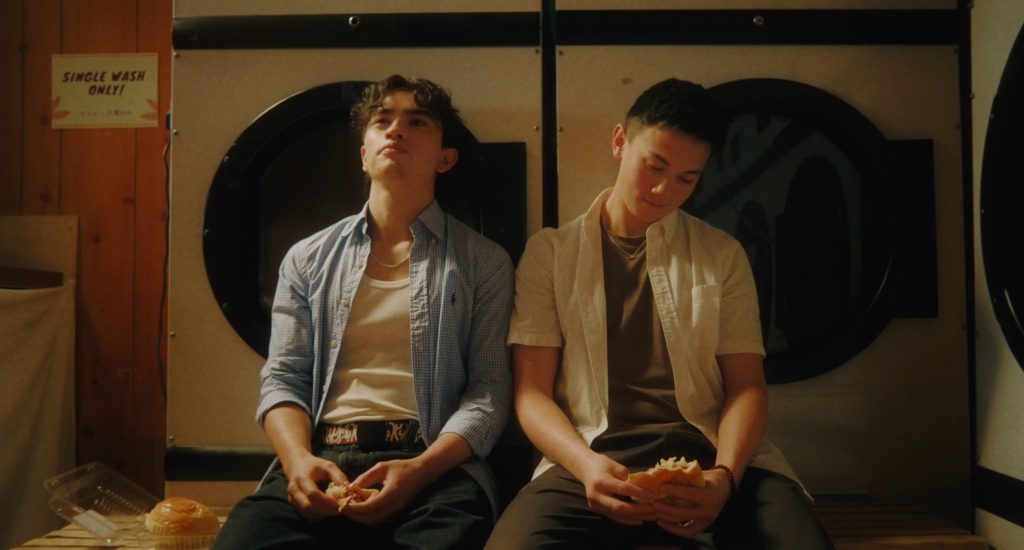
The conversation gives new meaning to the image that opened the film. Vinnie identifies with the molly swimming inside its unusual home, providing the short with a visual metaphor for someone trying to understand where his own emotional and sexual identity fits within expectations surrounding romantic relationships.
Molly consequently becomes considerably more interesting than a straightforward story about two young men falling in love. Queerness and asexuality are central to the film, but the questions it raises extend beyond any particular sexuality. Jealousy, infatuation, uncertainty, the excitement of discovering someone new and the fear that two people might want different things from a relationship are experiences capable of crossing sexual and gender boundaries.
Molly Finds Beauty in the Everyday
Shu is also responsible for the cinematography and editing, and Molly is visually accomplished throughout. Presented in a 1.66:1 aspect ratio, the film makes excellent use of the launderette’s confined environment. Rows of circular machine doors, reflections, windows and the repetitive movement of clothing behind glass provide Shu with plenty of opportunities to create interesting compositions.
The film grain contributes further texture, while the lighting gives the short a genuinely cinematic appearance. There is considerable attention to framing and production design, meaning the central location never feels visually monotonous despite hosting a substantial portion of the story. Production designer Arron Blake deserves recognition for helping create that environment, while Shu’s cinematography consistently finds ways of making an everyday location attractive on screen.
Berrecloth and Kauer are equally important to the film’s success. Berrecloth gives Vinnie a vulnerability that becomes increasingly significant as his feelings for Ryan develop, while Kauer brings an easier confidence to Ryan. Their contrasting personalities make the developing relationship convincing, particularly because so much of the attraction is communicated through behaviour rather than exposition.
The soundtrack complements that youthful romantic energy. Benjamin Doherty provides the original music, while the inclusion of Erasure’s A Little Respect gives the dancing in the launderette a distinctive musical identity, temporarily transforming an ordinary workplace into a private space shared by two people becoming increasingly comfortable around one another. Billy Cullum’s Friends is then played over the end credits.
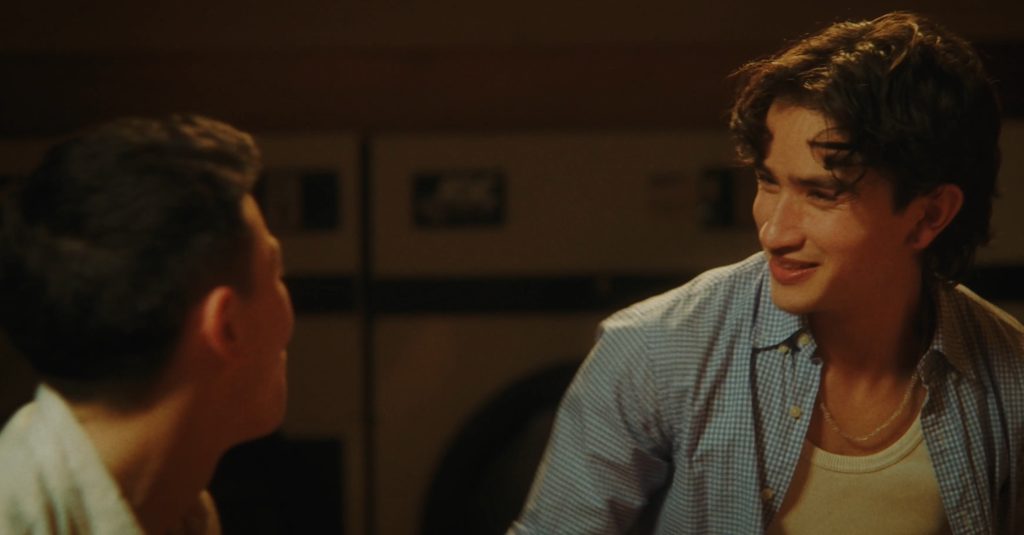
At 23 minutes, Molly has enough room to establish Vinnie and Ryan’s attraction before complicating it, without stretching a relatively intimate premise beyond its natural limits. The early scenes allow us to enjoy the excitement of their developing relationship, which makes Vinnie’s later admission more meaningful because there is already something worth potentially losing.
Most importantly, Shu approaches the subject without treating Vinnie as a problem requiring a solution. His feelings for Ryan are not invalidated by his attitude towards sex, nor does the film suggest that emotional intimacy is somehow an inferior substitute for physical intimacy. Instead, Molly asks what happens when affection, attraction and sexual desire don’t arrive in the combination that conventional romantic narratives often assume they will.
Molly is a beautifully photographed and very well performed short that begins with the familiar pleasure of watching two people discover an attraction before developing into something more thoughtful about intimacy and expectations. Shu’s confident direction, strong visual instincts and the natural chemistry between Berrecloth and Kauer make the film enjoyable on a purely romantic level, while Vinnie’s eventual honesty gives it considerably more substance. The little fish inside the washing machine initially looks like an eccentric piece of production design, but by the end, it has become an effective symbol for a young man trying to understand how he can love somebody while remaining true to himself.
| Acting | |
| Direction | |
| Cinematography | |
| Writing | |
| Sound | |
| Screen Critix Rating |