
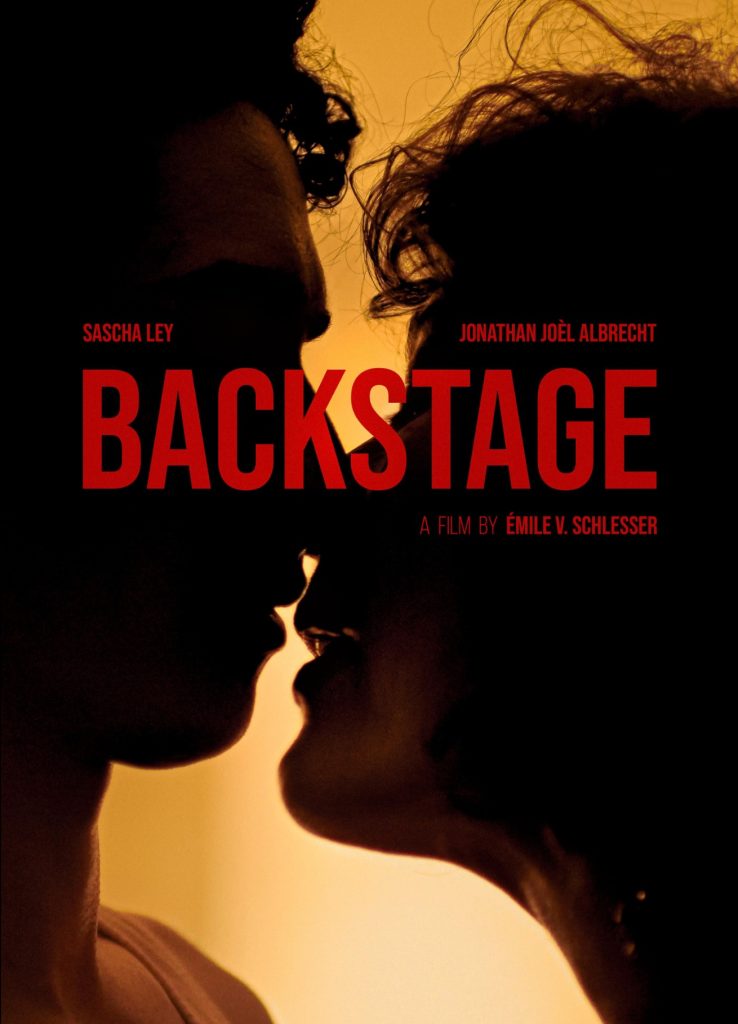
The theatre can be a place of transformation, but it can also create an uncomfortable imbalance between those desperate for an opportunity and those with the power to provide one. Émile V. Schlesser’s Backstage explores the darker side of that relationship through a compelling 26-minute drama in which professional ambition, sexual boundaries and manipulation become increasingly difficult to separate.
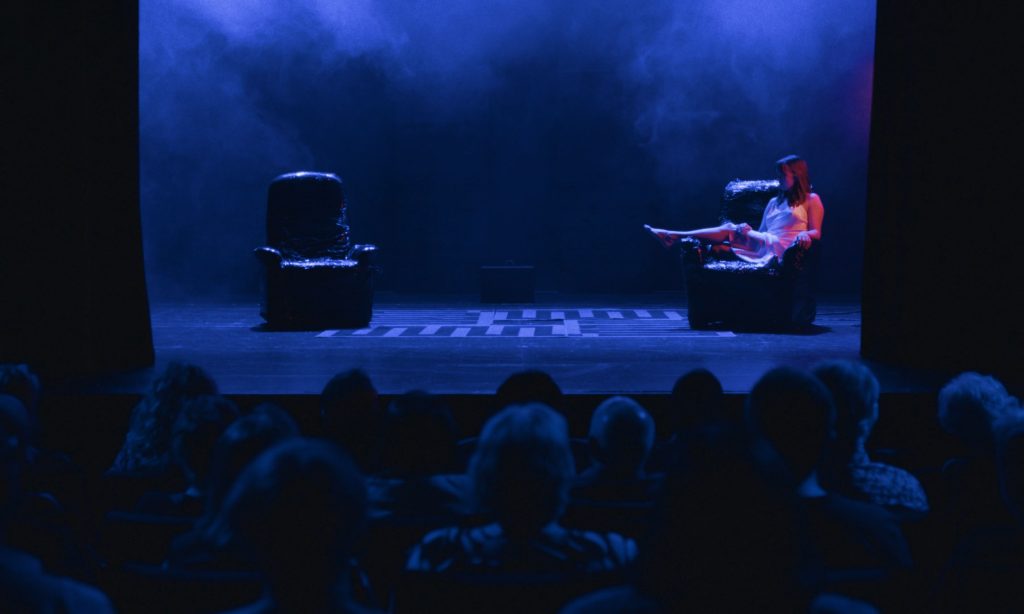
The German-language Luxembourg production introduces Lukas (Jonathan Joél Albrecht), a young actor rehearsing opposite Vero (Jil Devresse) under the watchful eye of theatre director Cosima Lambrecht (Sascha Ley). Lukas is struggling with an intimate moment in the play, specifically a kiss that neither performer seems entirely certain how to approach. Their uncertainty frustrates Cosima, who considers the rehearsal a mess and attempts to bring Lukas out of his shell by encouraging him to scream directly in her face, much to the amusement of Vero, who watches from the side of the stage.

It establishes the dynamic efficiently. Lukas is talented but inexperienced and uncomfortable, while Cosima is clearly determined to push him beyond his inhibitions as a performer. Schlesser, working from a screenplay written with Jonas Brand, initially presents that relationship within the familiar pressures of theatrical rehearsal, before gradually showing how Cosima’s influence over the young actor begins to extend far beyond appropriate professional boundaries.
There is also another presence watching from the auditorium. Philippe Delacroix (Tommy Schlesser) initially appears in the shadows, and Lukas subsequently learns from Vero that Philippe has a history with Cosima. Once her assistant, he became an actor and found success after Cosima took him to Vienna. For Lukas, Philippe consequently represents both competition and an uncomfortable example of what proximity to Cosima might offer.
When Opportunity Becomes Leverage
Backstage becomes particularly effective when it begins questioning where professional mentorship ends and exploitation starts. After a difficult rehearsal, Cosima reassures the dejected Lukas that casting him was the correct decision. The encouragement should represent exactly what a young actor needs from his director, but their interaction crosses a professional boundary when they share a kiss.
The situation becomes considerably more troubling when Philippe is brought onto the stage to perform Lukas’s part opposite Vero. Lukas is forced to watch from the auditorium as another actor assumes the role he has been rehearsing, and his emotional response makes clear just how much the production means to him. His career aspirations provide Cosima with precisely the leverage she needs.
Later, after initially brushing him aside when he wants to talk, Cosima sends Lukas her address. At her hotel room, professional encouragement becomes increasingly entangled with sexual attention. She tells him about a planned production of Salome in Vienna and suggests he would be perfect for it, lavishing him with compliments while simultaneously becoming more intimate. Lukas eventually pulls away, apologises and leaves.
The following day he arrives at the theatre to discover Philippe performing in his place.
It is a strong illustration of Backstage’s central concern because no lengthy explanation of the power imbalance is required. Lukas knows what Cosima can potentially do for his career, and he has already seen evidence of what she apparently did for Philippe. He also discovers how quickly professional favour can be withdrawn when he doesn’t respond to her personal advances as she expects.
Schlesser and Brand allow that tension to develop without reducing Cosima to a simplistic villain. Ley gives the character considerable presence, making her capable of encouragement and apparent warmth while always retaining the authority to decide who stands on her stage. That makes her manipulation more unsettling because it operates through opportunities, praise and approval as much as through overt threats.
Strong Performances Across the Stage
Albrecht gives an excellent performance as Lukas. His uncertainty during the early rehearsal could initially be interpreted simply as the nervousness of a young performer struggling with intimacy on stage, but the film gradually reveals a man attempting to establish boundaries within an environment where refusing the person in charge may carry professional consequences. Albrecht captures that vulnerability without making Lukas passive, particularly as the situation moves towards a confrontation he can no longer tolerate.
Ley is equally impressive as Cosima. There is an unpredictability to her treatment of Lukas that keeps their scenes tense, especially because professional criticism and personal desire become increasingly intertwined. Her authority over the production means that even apparently affectionate moments carry an uncomfortable weight.
Devresse also makes Vero more than an observer caught between the principal conflict. Her presence gives Lukas someone with whom he can behave more naturally, while her reaction when the production begins falling apart reinforces that Cosima’s actions affect an entire company rather than only the actor she is targeting. Tommy Schlesser’s Philippe initially appears positioned as Lukas’s rival, but the film ultimately finds more interesting territory than a straightforward competition between two actors.
That becomes crucial on opening night. Lukas and Vero finally perform their difficult scene successfully in front of a full audience, earning enthusiastic applause as the curtain closes on the act. Backstage briefly gives Lukas the validation he has been seeking before returning him to the much less secure environment behind the curtain.
When Cosima visits his dressing room and again initiates physical intimacy, Lukas finally reacts forcefully, making it explicit that he does not want to be touched. Cosima’s response is not simply personal rejection. She uses her professional authority against him, locks him inside the dressing room and attempts to install Philippe as his replacement for the remainder of the performance. What began as an actor struggling to perform a kiss has therefore developed into something considerably more significant about consent away from the stage.
There is a particularly effective distinction here between performance and reality. Lukas eventually learns how to negotiate an intimate scene with Vero as part of his work, but that does not give Cosima any entitlement to him once he steps backstage. The film understands that being an actor, including performing physical intimacy when a role requires it, does not erase personal boundaries.
Backstage Is Technically Accomplished
The filmmaking surrounding the performances is equally assured. Thorsten Harms’ cinematography makes excellent use of the theatre, with the stage, auditorium, dressing rooms and backstage spaces providing visually distinct environments. Red lighting and theatrical fog during rehearsal are particularly striking, while the contrast between performers exposed beneath stage lights and figures watching from the darkness of the auditorium reinforces the film’s interest in observation and control.
The lighting throughout is excellent, and Backstage consistently looks like a professionally mounted production. Schlesser’s editing maintains the dramatic momentum without turning the film into a succession of confrontations, while the clean sound recording is especially important for a story taking place within an environment where voices, movement and music naturally carry through large spaces.

Rickie Lee Kroell’s music is another highlight. Percussion, bass and crashing cymbals sometimes create the sensation of an orchestra preparing itself before a performance, giving the film a restless musical energy. There are moments in which the combination of music, theatrical spaces and a protagonist under enormous creative pressure brings to mind the nervous intensity associated with films such as Whiplash and Birdman, while Backstage remains firmly focused on its own subject.
The reversal at the centre of the story is also noteworthy. Cinema has frequently explored stories involving powerful male producers or directors exploiting young performers. Backstage places a woman in that position of institutional and sexual power and a young man on the receiving end. The reversal isn’t treated as a novelty or an excuse to diminish more familiar examples of abuse. Instead, it reinforces the broader point that exploitation is fundamentally about power, access and the ability of one person to influence another’s future.
At 26 minutes, Backstage has sufficient room to let that dynamic develop while remaining tightly focused on Lukas’s experience. The theatre itself proves an ideal setting, creating a world where people are constantly performing, receiving direction and waiting to discover whether they have earned somebody else’s approval. That professional reality makes Cosima’s manipulation all the more effective because Lukas has genuine reasons to crave precisely the validation she controls.
Backstage is an intriguing, powerful and impressively crafted short film, distinguished by excellent performances and confident filmmaking. Albrecht convincingly charts Lukas’s movement from uncertainty towards resistance, while Ley makes Cosima an imposing and deeply uncomfortable presence whose professional authority becomes inseparable from her personal behaviour. Devresse and Tommy Schlesser provide strong support, and the technical work surrounding the cast is consistently polished.
Most importantly, Schlesser doesn’t lose sight of the distinction upon which the entire film depends. An actor can surrender control to a director within the boundaries of a performance without surrendering control over themselves. By turning the theatre into both a place of opportunity and a mechanism through which that opportunity can be weaponised, Backstage delivers a sharp examination of ambition, consent and abuse of power. Combined with Harms’ accomplished cinematography, Kroell’s striking music and a uniformly strong cast, it is an excellent short that deserves considerable attention as it continues its festival journey.
| Acting | |
| Direction | |
| Cinematography | |
| Writing | |
| Sound | |
| Screen Critix Rating |