
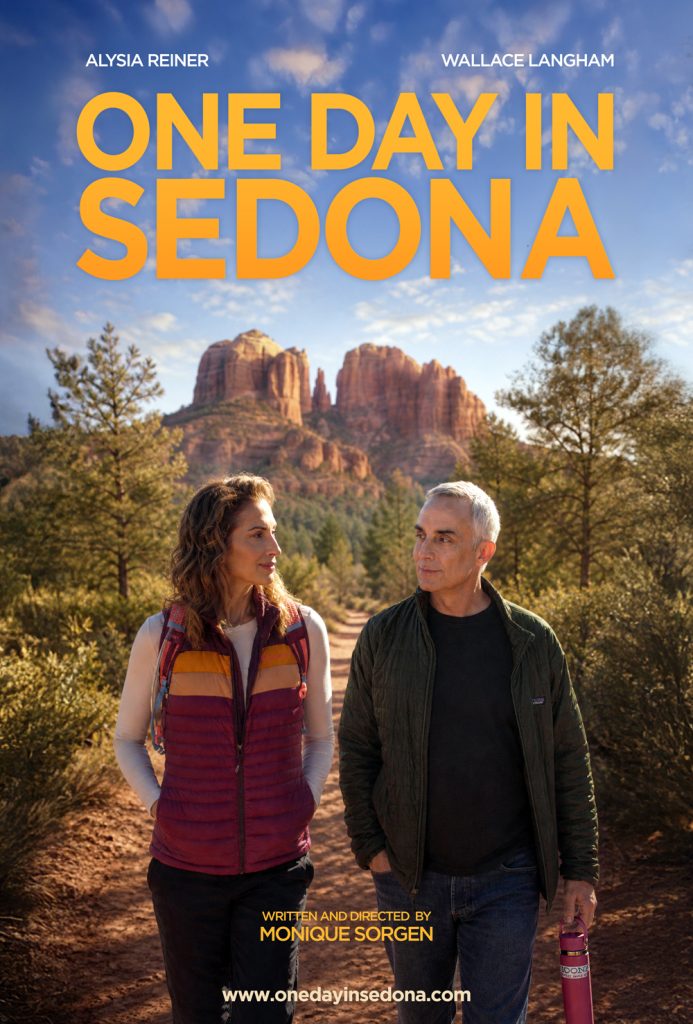
There is an undeniable excitement in meeting someone for the first time and gradually discovering the person behind the initial impression. Likes and dislikes emerge, histories are exchanged, similarities are discovered and differences become apparent. Perhaps most exciting is the uncertainty over whether this chance encounter could become something more. Writer and director Monique Sorgen builds almost the entirety of One Day in Sedona around that process, allowing two strangers in their fifties to spend a day walking, talking and discovering an unexpected connection.
The 89-minute feature opens with Jules (Alysia Reiner) driving through Sedona while recording a voice memo concerning her late father’s legacy. After passing through the Arizona surroundings, she arrives at the starting point for a hiking trail, where Will (Wallace Langham) has also just arrived on a motorcycle. He has made the trip spontaneously but has managed to forget something fairly important for a hike: water.
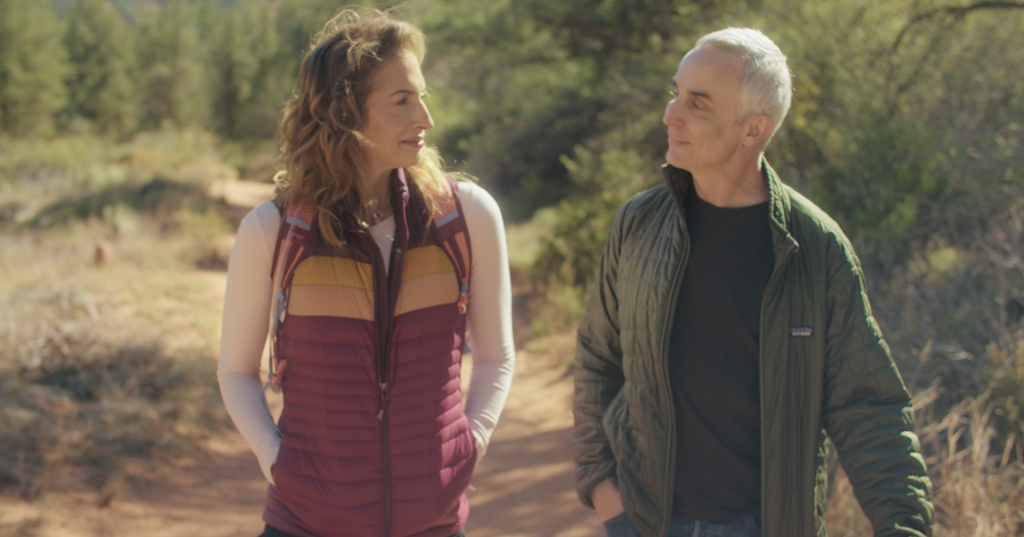
Jules offers him her pink water bottle, having brought several litres for herself, and the pair immediately begin talking. Will explains that he woke that morning, rented the motorcycle and decided to make the journey, while Jules quickly notices a tan line where his wedding ring once sat. He explains that he removed the ring following his divorce and the remarriage of his former wife. It is a considerable amount of personal information for two people who have known one another for only a few minutes, but that openness establishes the rhythm Sorgen maintains throughout the film.
After initially beginning the trail separately, Jules suggests that they walk together. She also introduces Will to the Gratitude Game, in which each names something for which they are thankful. What begins with relatively simple answers soon develops into increasingly personal conversation as the miles pass beneath their feet.
Two Strangers and Five Miles
One Day in Sedona is primarily a two-hander, and consequently its success depends heavily upon the audience wanting to remain in Jules and Will’s company. Reiner and Langham make that possible by creating two mature characters whose attraction develops through conversation rather than the heightened romantic mechanics usually associated with the genre.
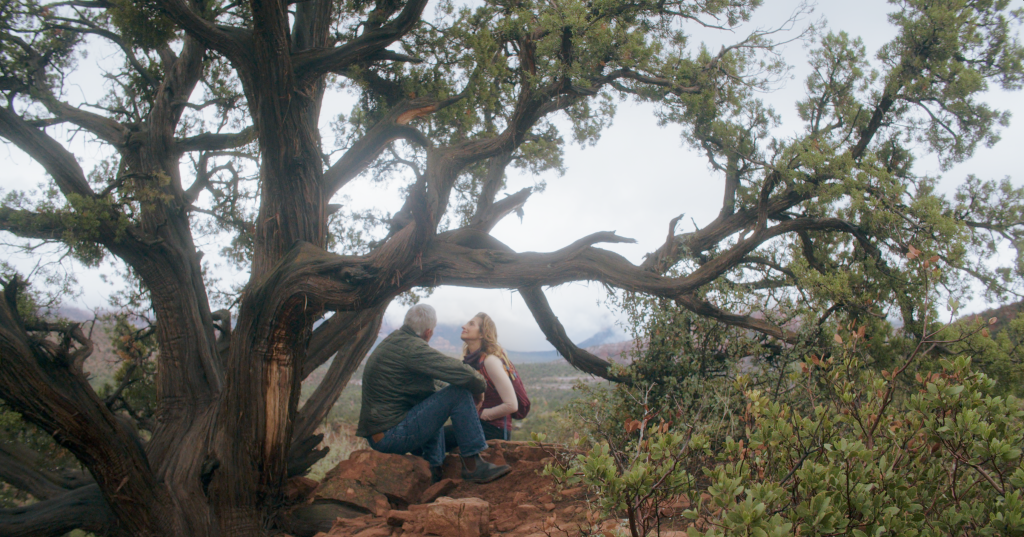
Their ages are significant without becoming the film’s sole defining feature. Will has recently emerged from a marriage that began after meeting his former wife at college, leaving him unfamiliar with contemporary dating and the technology surrounding it. Jules has a very different perspective on relationships and has never wanted to marry. When Will struggles with the idea of a committed relationship that isn’t necessarily progressing towards marriage, Jules explains that love doesn’t require it.
The distinction provides one of many areas in which the pair can disagree without becoming incompatible. They discuss relationships, ageing, parenthood, artificial intelligence, creativity, spirituality and their respective ideas about what gives a life meaning. Jules believes in angels and an afterlife, while Will is considerably more sceptical. Their differing outlooks allow the film to explore whether compatibility requires agreement or simply a willingness to listen.
One of the most important discoveries arrives when Will reveals that he is a civil rights lawyer. Jules explains that her father had the same profession, only for the coincidence to become considerably more significant when Will realises who her father was. He knew him, once worked as his intern and regarded him as an inspiration. Jules then tells Will that her father died only a month earlier, news that visibly overwhelms him.
It gives their developing relationship an emotional foundation beyond immediate attraction. Jules is attempting to understand how she should carry forward the legacy of a father whose work meant a great deal to others, while Will is dealing with the collapse of a marriage and the resulting changes to his own identity. Their encounter therefore arrives at a point when both are reconsidering what comes next.
Walking and Talking
The film’s structure is deliberately simple. For much of its running time, Jules and Will walk while the camera moves with them, either tracking from behind or retreating ahead as their conversation continues. Cinematographer Avi Kaye has the considerable advantage of Sedona itself, with the sandy trails, surrounding greenery and mountainous landscape creating an attractive backdrop without distracting from the characters.
Sorgen and Kaye’s approach also makes the audience feel as though they are accompanying the pair. There is little conventional action because the journey is predominantly emotional and conversational. Anyone expecting dramatic twists every few minutes is unlikely to find them here, but that isn’t what One Day in Sedona is attempting to provide.
There are moments when the film’s naturalism becomes less convincing. Jules and Will occasionally share remarkably personal information considering how recently they have met, and some encounters along the trail feel more deliberately constructed than others. A couple they meet discuss Sedona’s spiritual qualities and give them a quartz stone, while a long-haired musician known as the “Fiddler on the Rock” performs for the hikers. Later, Jules and Will encounter a group of people dancing and swaying together on the rocks and decide to join them.
These episodes reinforce Sedona’s spiritual character and Jules’ openness to experiences that Will might instinctively question, although some work more naturally than others. The central relationship is strongest when Sorgen simply allows Reiner and Langham to talk.
Will’s children provide another important subject. Jules is surprised to discover he is a father, and he admits to difficulties in his relationship with his daughter, particularly as she becomes closer to his former wife’s new husband. Jules has never wanted children herself, but nevertheless offers an outside perspective on his attempts to compete for his daughter’s attention. Their conversation demonstrates how the accumulated experiences of middle age shape a new relationship differently from one beginning in youth.
The attraction between them gradually becomes unmistakable. Their flirting becomes more direct and eventually they kiss on the trail, drawing comments from passing hikers. The scene works because the film has spent considerable time allowing attraction to develop through conversation rather than simply announcing that these two people should become romantically involved.
One Day In Sedona – Romance Beyond Youth
That is ultimately where One Day in Sedona finds much of its appeal. Cinema frequently concentrates romantic stories around people in their twenties and thirties, but the excitement of unexpectedly connecting with somebody doesn’t disappear with age. If anything, Jules and Will arrive carrying considerably more history with them. There have been marriages, relationships, children, bereavement, professional achievements, disappointments and firmly established beliefs about what they want from the remainder of their lives.
Reiner and Langham are therefore essential to making the film work. Reiner gives Jules an openness and curiosity that suits someone prepared to invite a stranger into both her hike and her thoughts, while Langham makes Will’s more cautious worldview a useful counterbalance. The performances need to sustain lengthy exchanges without the benefit of constant changes in location or supporting characters, and their chemistry makes the extended conversations engaging.
There is something reminiscent of Richard Linklater’s Before Sunrise in the basic pleasure of watching two strangers walk and talk while gradually discovering an attraction, although Sorgen’s film approaches that idea from a distinctly different stage of life. Instead of young adults wondering what their futures might become, Jules and Will are people with decades behind them, considering whether there is still room for something unexpected ahead.

The film’s 89-minute running time inevitably asks viewers to invest heavily in conversation. Some passages could be tightened, and not every subject they discuss carries equal dramatic weight. Yet the leisurely pace is also fundamental to the experience. We are supposed to feel that we have spent a significant portion of the day alongside them, watching familiarity replace the uncertainty of their first meeting.
Sorgen also deserves credit for allowing the spectacular location to complement rather than overwhelm the story. Sedona provides mountains, vegetation and expansive views, but One Day in Sedona remains focused on the two people travelling through that landscape. The physical hike becomes an uncomplicated framework for two individuals deciding what they believe, what they have lost and what they might still want.
One Day in Sedona is therefore less concerned with where Jules and Will are walking than with what happens between them along the way. It understands the simple excitement of meeting someone unexpectedly and realising, conversation by conversation, that you would like to know more. For viewers willing to spend an unhurried day with two mature characters getting to know each other, Sorgen’s feature offers an attractive and thoughtful journey through one of Arizona’s most striking landscapes.
| Acting | |
| Direction | |
| Cinematography | |
| Writing | |
| Sound | |
| Screen Critix Rating |