
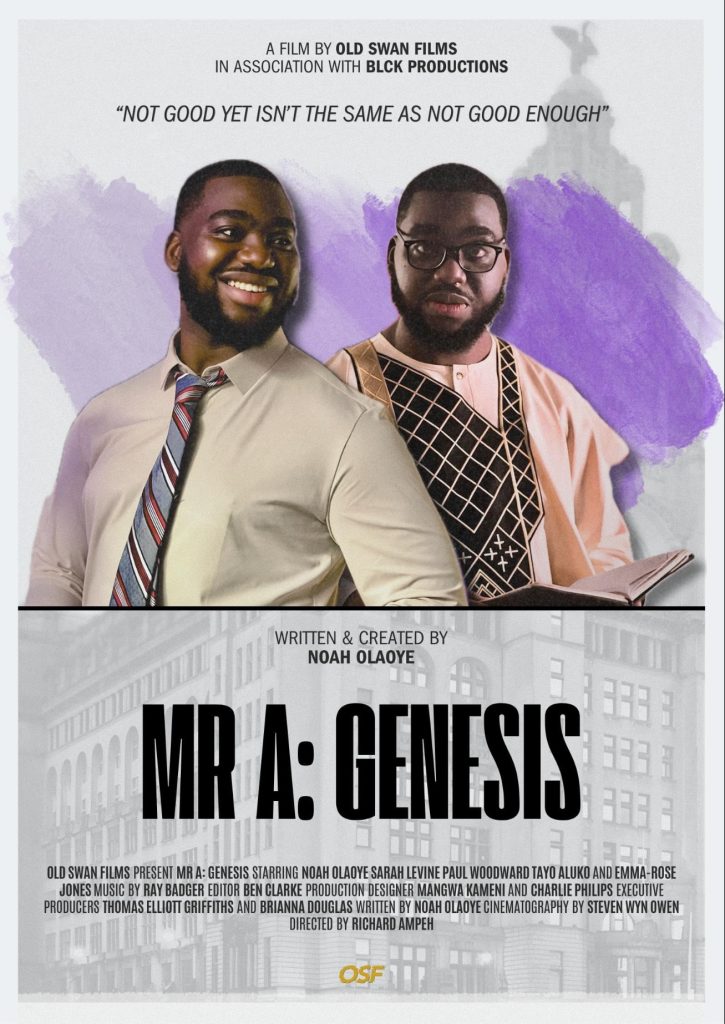
Old Swan Films are no strangers to the pages of Screen Critix, having previously brought us a number of impressive short films and documentaries. Their latest production, Mr A: Genesis, is a warm 13-minute comedy drama about confidence, self-doubt and discovering that the advice we readily give to other people can sometimes be considerably harder to follow ourselves.
Directed by Richard Ampeh and created by lead actor Noah Olaoye, the film introduces us to 27-year-old English teacher Ayotunde “Mr A” Akinlade. Ayo divides his time between teaching secondary school students in Liverpool and his role as a teens pastor at Grace Point Assembly. In the classroom he appears comfortable, inventive and capable of connecting with young people, but the prospect of delivering an important sermon exposes a very different side of his personality.
That contrast provides Mr A: Genesis with its central idea. Ayo is good at encouraging other people to take chances, yet struggles to extend the same generosity towards himself. The film isn’t particularly interested in creating a major dramatic crisis around this contradiction. Instead, it finds its story in a recognisable insecurity: the fear that stepping outside the environment in which you feel comfortable will expose all the things you secretly suspect you aren’t very good at.
We first meet Ayo preparing for his sermon in the pastor’s room, practising in front of a mirror before his friend Bo interrupts him. Their interaction quickly establishes the film’s gentle sense of humour, particularly when Bo mocks Ayo’s clothing by suggesting he looks like a Nigerian senator. It also allows Olaoye to make Ayo immediately likeable. There is an easy humour to the character, but the private rehearsal makes it clear that beneath it sits genuine nervousness.
Those nerves aren’t helped when his first attempt to address the congregation is greeted by a burst of microphone feedback. It is a simple comic moment, but an effective one because it makes an already uncomfortable situation considerably worse. Ampeh then moves away from the church and into Ayo’s other life, allowing the film to reveal why this particular man should theoretically be perfectly equipped to stand in front of an audience.
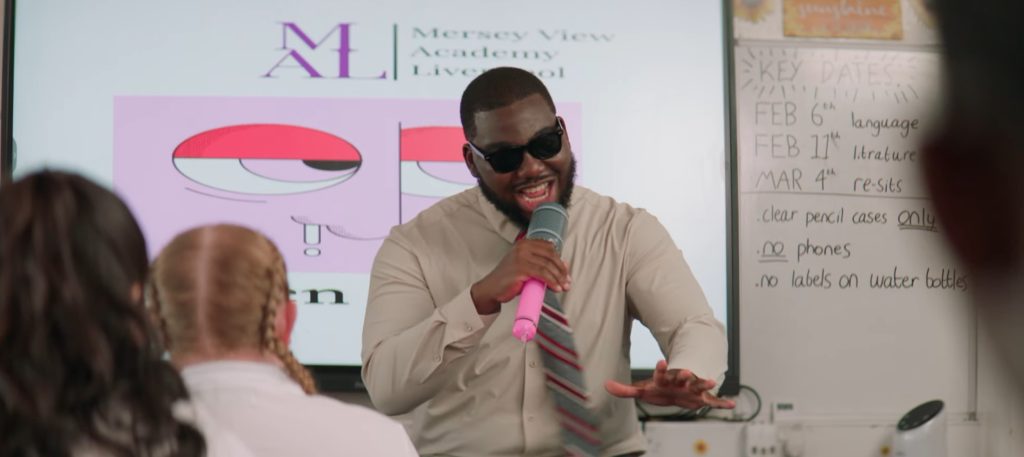
In his classroom, Ayo is almost a different person. He incorporates rap into his English lessons, performing into a pink microphone before asking his students to create their own. There is an informality to his teaching style that appears to help him connect with the class, although the film is careful to show that not every adult considers his methods appropriate.
This becomes a recurring source of comedy and mild conflict. One student’s mother angrily confronts Ayo after discovering that her son has been listening to music recommended by him, dismissing the Christian rapper involved and accusing Ayo of being a “cultist”. Meanwhile, fellow teacher Mr Barker, played by Paul Woodward, is similarly unimpressed by the unconventional classroom approach, suggesting there should be “less Drake and more Shake…speare.”
The humour throughout Mr A: Genesis is generally understated rather than constructed around large punchlines. Much of it comes from personality, awkwardness and the differences between the people surrounding Ayo. This is one reason the film arguably sits more comfortably as a light comedy drama than an outright comedy. There are amusing moments throughout, but they support the character and story rather than becoming the film’s primary purpose.
The classroom material also provides the film with its most important dramatic connection. A student named Sam, played by Emma Rose Jones, struggles with the assignment and finds herself staring at a blank page after the other students have begun to leave. Ayo recognises what is happening and talks to her about the pressure she is placing upon herself, encouraging her to stop worrying about immediately getting everything right and simply begin.
It is a modest interaction, but structurally it is the key to the entire short. Ayo can immediately recognise Sam’s lack of confidence because he is experiencing a version of exactly the same problem. The difference is that he can see her situation clearly while being too close to his own fears to recognise the similarity.
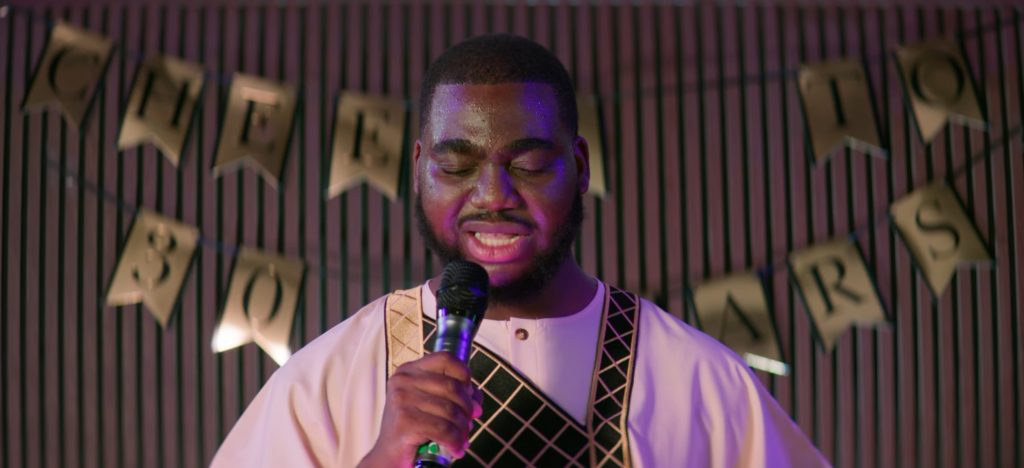
This gives the eventual return to the church greater meaning. Ayo’s sermon becomes less about demonstrating that he can suddenly transform himself into a perfect preacher and more about accepting the possibility that he doesn’t need to be perfect in the first place. His discussion of confidence and self-doubt grows naturally from what we have seen in the classroom, allowing the two sides of his life to complement one another.
It also prevents the religious setting from making the film exclusively about religion. Faith is clearly an important part of Ayo’s life and the world of the story, but the central message is broader. The fear of not being ready, worrying about how other people will judge you and discovering the confidence to move beyond your comfort zone are experiences that don’t require any particular religious background to understand.
Olaoye handles that accessibility well. He has an easygoing screen presence and makes Ayo someone whose uncertainty feels genuine without turning him into a bundle of exaggerated nervous mannerisms. The character is at his most comfortable around his students, and that distinction helps the audience recognise how much the sermon is troubling him without requiring the screenplay to repeatedly explain it.
The supporting cast also contribute to the relaxed quality of the production. Tayo Aluko plays Pastor Femi, while Woodward’s Mr Barker provides a more traditional counterpoint to Ayo’s teaching methods. Emma Rose Jones gives Sam’s classroom difficulty enough vulnerability for the exchange with Ayo to work without overstating it, and the young performers surrounding them help create a classroom environment that feels lively rather than excessively staged.
Visually, Mr A: Genesis begins strongly with aerial views establishing Liverpool, including the cityscape and River Mersey, before moving above the church itself. Steven Wyn Owen’s cinematography is particularly effective during the sermon material, where purples and pinks give the church a much richer visual identity. The coloured lighting around the pulpit and congregation has the appearance of illumination spilling through stained glass, helping those scenes feel considerably more cinematic.
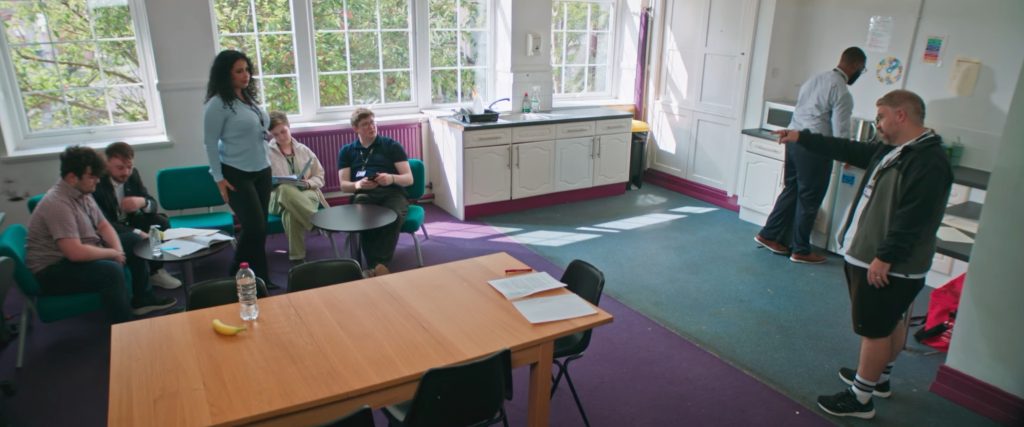
Some of the other interiors are less visually interesting. Rooms dominated by plain white walls can occasionally appear somewhat flat compared with the carefully lit church sequences, creating a noticeable difference between the film’s strongest images and its more functional coverage. It isn’t a major distraction, but the sermon demonstrates what the production can achieve when lighting and colour are given a more prominent role.
Ray Badger’s music accompanies a film that generally knows the tone it wants to achieve. Mr A: Genesis isn’t attempting to turn Ayo’s crisis of confidence into an enormous emotional ordeal. The stakes are deliberately personal, and the film’s sweetness comes from recognising that something which might appear relatively minor from the outside can feel enormous to the person experiencing it.
There is also an appealing circularity to the screenplay. A teacher helps a student understand that uncertainty shouldn’t prevent her from beginning, only to realise that the same principle applies to the challenge waiting for him. It is straightforward storytelling, but there is nothing wrong with simplicity when the characters and message are handled sincerely.
At 13 minutes, Mr A: Genesis doesn’t overcomplicate what it wants to say. There is room for humour, cultural identity, Ayo’s relationship with his students and the differing attitudes towards his teaching style, but everything ultimately returns to the same question of whether feeling unprepared should prevent somebody from stepping forward.
The result is a sweet and likeable short film with an encouraging message at its centre. Its classification as a comedy drama is appropriate, although the dramatic and character elements ultimately leave the stronger impression, with the humour providing warmth rather than dominating proceedings.

Old Swan Films continue to demonstrate an encouraging range of talent, and Mr A: Genesis gives Richard Ampeh and Noah Olaoye a modest but engaging story through which to explore confidence without becoming overly sentimental about it. Ayo spends much of the film believing he needs to find the right words before stepping forward, only to discover that sometimes stepping forward is how you find them.
Mr A: Genesis may be small in scale, but its message is an appealing one: being uncertain doesn’t necessarily mean being incapable. Sometimes the person who needs to hear your best advice is you.
| Acting | |
| Direction | |
| Cinematography | |
| Writing | |
| Sound | |
| Screen Critix Rating |