
Conflict is often discussed through borders, governments, armies and statistics, but those living between opposing forces rarely have the luxury of viewing it from such a distance. Line of Control, Travis Hodgkins’ 117-minute adaptation of Mirza Waheed’s novel The Collaborator, approaches the Kashmir conflict through the experiences of a teenager whose friendships, family and future become entangled in circumstances far beyond his control.
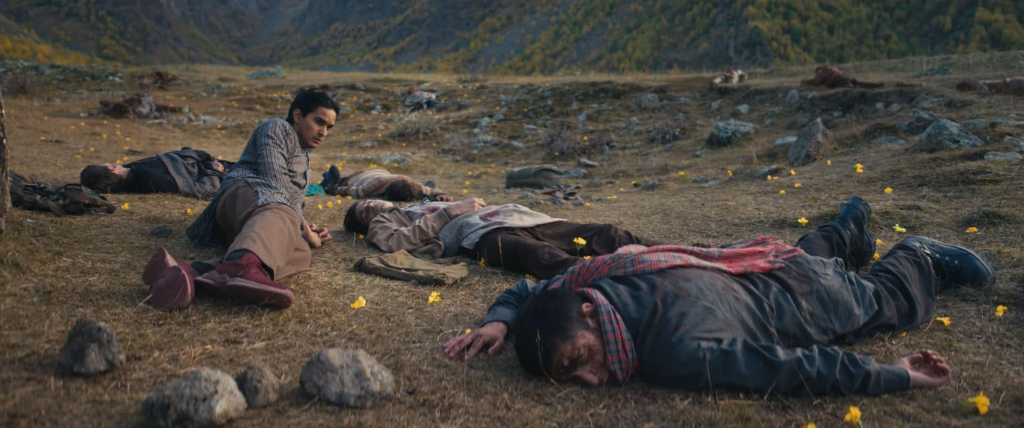
Set in 1993, the film immediately establishes a bleak and unsettling tone. A young man moves through a mountainous landscape littered with corpses, searching their pockets and removing identification cards and weapons while a sniper observes him from a distance. There is something particularly disturbing about the methodical nature of the task. These are human beings reduced to bodies, documents and objects to be collected, while the person carrying out the work has become accustomed enough to the horror to continue moving between them.
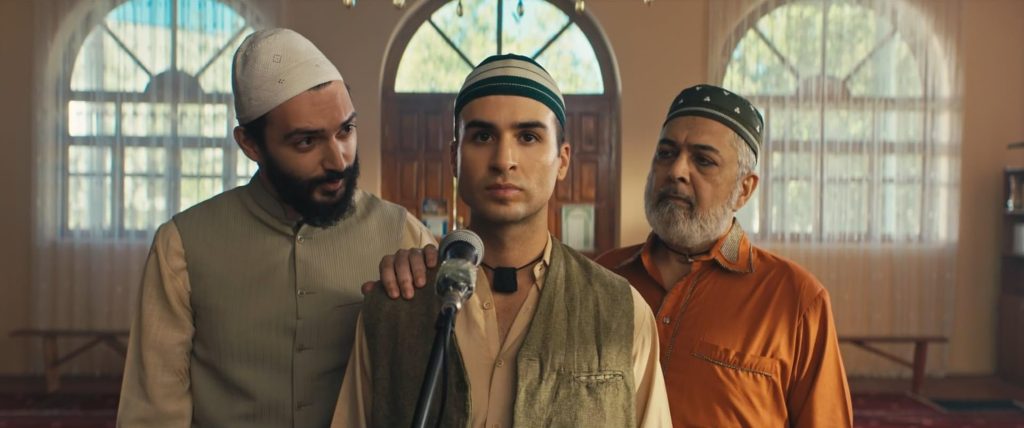
Hodgkins then takes the story back three months. The contrast is striking as a group of young men splash around in a stream, laughing and talking about their futures. Their conversation includes military groups and marriage, while the distant sound of explosions provides an ominous reminder that the wider conflict is never particularly far away. One of the boys begins singing and the others fall silent to listen, giving the sequence a tenderness that becomes increasingly important once the lives of these young men begin to change.
The film provides historical context through an introductory title card explaining the establishment of the ceasefire line following the conflict between India and Pakistan after the end of British rule in 1947, its later formalisation as the Line of Control and the insurgency affecting Kashmir during the period in which the story takes place. It is a substantial amount of information to introduce at once, but Hodgkins subsequently narrows his focus considerably. Rather than attempting to explain an extraordinarily complicated geopolitical conflict in its entirety, the drama concentrates on what happens when that conflict reaches into the lives of ordinary people.
At its centre is a teenager identified simply as The Boy, played by Nikhil Singh Rai. His friends Hussain, Gul and Ashfaq gradually disappear from the life he knows, with some believed to have crossed the Line of Control into Pakistan. Their disappearance has consequences extending beyond the missing young men themselves, placing families and communities under increased scrutiny while leaving The Boy uncertain about what has happened to the people with whom he once imagined a future.

His own situation becomes increasingly precarious through Captain Kadian, an Indian Army officer played by Rudi Dharmalingam. The Boy is forced into the horrifying task glimpsed during the opening sequence, entering areas containing dead fighters and retrieving their weapons and identification cards. Every body potentially carries another terrible discovery, because one of the unidentified dead could be someone he knows.
That premise gives Line of Control an effective dramatic centre. The Boy isn’t a soldier willingly entering battle, nor is he positioned safely outside it. He exists somewhere between the different forces surrounding him, compelled to perform work for the army while remaining emotionally connected to a community that increasingly has reason to question what he is doing. Survival itself begins to resemble collaboration depending upon who is observing him.
This moral uncertainty is considerably more interesting than reducing the story to conventional heroes and villains. The Boy’s choices are constrained by circumstances and by people with far more power than he possesses. Whatever decision he makes carries consequences, and the film is particularly interested in what happens when the freedom to choose is gradually removed while responsibility for those choices remains.
His relationship with Asma, played by Anastasia Jairath, also provides a glimpse of the ordinary adolescence that might have existed under different circumstances. Friendship, romance, education and plans for adulthood should dominate the lives of these characters, yet the conflict repeatedly intrudes upon them. The tragedy isn’t simply that violence occurs, but that an entire generation is forced to make decisions shaped by it.
Line of Control is particularly impressive as a visual production. Johan Holmqvist’s cinematography gives the film a scale that is immediately striking, with the wide aspect ratio used extremely well to capture mountains, valleys, villages and expansive landscapes. There are some genuinely beautiful vistas here, but their beauty exists alongside images of death, military presence and uncertainty, creating an uncomfortable contrast between the natural landscape and the human conflict occurring within it.
The framing is consistently accomplished, while the controlled camera movement gives the film a polished appearance that exceeds what might ordinarily be expected from an independent production. The colour grading is similarly impressive, producing rich, cinematic images without overwhelming the environments or performers. It is unsurprising that the cinematography has already received recognition on the festival circuit, including the Flame Award for Best Cinematography at the UK Asian Film Festival and Best Cinematography, Feature Film at the Culver City Film Festival.
Wayne Sharpe’s score adds significantly to that sense of scale. The orchestral music gives certain passages an almost epic quality, but it also works alongside the quieter moments to reinforce the emotional seriousness of the material. Combined with Holmqvist’s photography, it gives Line of Control the visual and sonic confidence of a considerably larger production.
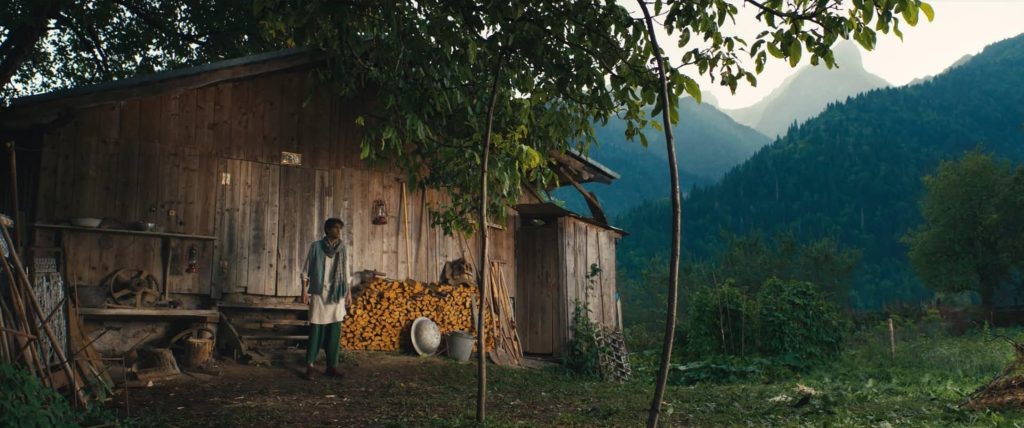
The performances are generally convincing, with Rai carrying much of the film’s emotional burden as The Boy. The character needs to communicate fear and uncertainty without becoming passive, since his predicament depends upon understanding that even apparent inaction represents a choice within this environment. Rai gives the character an appropriately youthful quality that makes the responsibilities being imposed upon him feel particularly cruel.
Dharmalingam provides an effective counterweight as Captain Kadian. The power imbalance between Kadian and The Boy is essential to the drama because the captain doesn’t need to be screaming or firing a weapon for his presence to represent a threat. Authority itself becomes coercive when the person on the receiving end has so few realistic alternatives.
Nitin Ganatra plays The Boy’s father, the village Sarpanch, while Meera Ganatra appears as his mother. Vikram Kapadia plays Khadim Hussain, with Serdar Altan as Hussain, Reiss Kershi as Gul and Shamail Ali as Ashfaq. The supporting characters are important because Line of Control is ultimately concerned with more than one young man’s predicament. His situation exists within families and a wider community in which the decisions made by one person can place others in danger.
Hodgkins and editor Jamie Kirkpatrick adopt a deliberately measured approach to the material. At 117 minutes, Line of Control is in no hurry, allowing the landscapes, conversations and uncertainty surrounding the characters considerable room. This sometimes works to the film’s advantage because the atmosphere of apprehension needs time to develop, particularly when the audience understands where The Boy will eventually find himself.
There are nevertheless stretches where that patience becomes a little too pronounced. The pacing occasionally loses momentum, and a somewhat tighter edit could have maintained the contemplative quality while giving certain sections greater dramatic urgency. The screenplay also has occasional moments where dialogue feels less natural than the impressive visual presentation surrounding it.
Those weaknesses don’t undermine the considerable ambition on display. Hodgkins is attempting to adapt a novel concerned with friendship, complicity, coercion and survival against an extremely sensitive historical backdrop, while resisting the temptation to transform it into a straightforward war thriller. The violence matters, but so does waiting for news, wondering what happened to a friend and recognising that the people around you may now perceive you differently.
The opening sequence becomes increasingly meaningful within that context. What initially appears to be the grim image of someone scavenging a battlefield is actually the culmination of pressures that have gradually narrowed a young man’s options. The identification cards he retrieves aren’t merely pieces of intelligence. Each one represents a person, and every journey among the dead carries the possibility that friendship and memory will suddenly acquire a name and a body.
That human perspective is where Line of Control is strongest. The film doesn’t require the viewer to arrive with an extensive understanding of Kashmir’s history in order to recognise the horror of being trapped between competing forces. Political circumstances may be specific, but fear for friends, loyalty to family and the desire simply to have a future are immediately understandable.
There is also something powerful about the landscape continuing to look magnificent while terrible things happen within it. Holmqvist repeatedly allows the environment to occupy significant space within the frame, making the characters appear small against mountains and valleys that existed long before the political divisions surrounding them. Beauty and brutality are permitted to coexist rather than one visually cancelling out the other.
Line of Control is an ambitious, handsome and thoughtful independent drama that benefits enormously from its cinematography, orchestral score and commitment to viewing conflict through an individual caught within it. Its deliberate pacing and occasional weaknesses in the dialogue prevent every moment from landing with equal force, and some tightening across its 117 minutes would have strengthened the overall rhythm.
Even so, Travis Hodgkins has created a visually impressive adaptation that finds its greatest power away from military spectacle. Line of Control is ultimately concerned with what happens when political conflict reaches into friendships, families and communities, turning decisions that should be simple into questions of loyalty and survival. Against the extraordinary beauty of Kashmir, The Boy’s increasingly impossible position gives the film its tragedy, reminding us that lines drawn across maps eventually have to be lived with by real people.
| Acting | |
| Direction | |
| Cinematography | |
| Writing | |
| Sound | |
| Screen Critix Rating |