
There is a moment early in Live and Die in East L.A. when the film suddenly switches to a beautifully rendered black-and-white animation about a caterpillar trying to reach a forest so it can become a butterfly. Coming from a feature promising gangs, drugs and street violence in Los Angeles, it’s unexpected. By this stage, however, we’ve already watched a grieving family discussing the death of their son and footage of that same family apparently watching the movie we’re about to watch, so it quickly becomes apparent that writer-director Attila Korosi isn’t particularly interested in making a conventional crime thriller.
Running for approximately 84 minutes, Live and Die in East L.A. is an ambitious mixture of crime drama, social commentary, documentary material, animation and alternative timelines. Korosi also stars as Attila, an emergency-room doctor who becomes increasingly entangled with the criminal world surrounding several of the film’s characters. It’s a feature containing considerably more ideas than most independent productions operating with limited resources. Not all of those ideas fit comfortably together, but there’s something admirable about a first-time feature director willing to take this many chances.
Before the main narrative even begins, we’re presented with a title card quoting a former gang member saying they wished they’d seen the film when they were 15. Children ride bicycles through the night before we briefly see two men forcing another person, whose head is covered by a black bag, into a room. Another title card then makes the striking claim: “We didn’t cast actors, we cast the truth.”
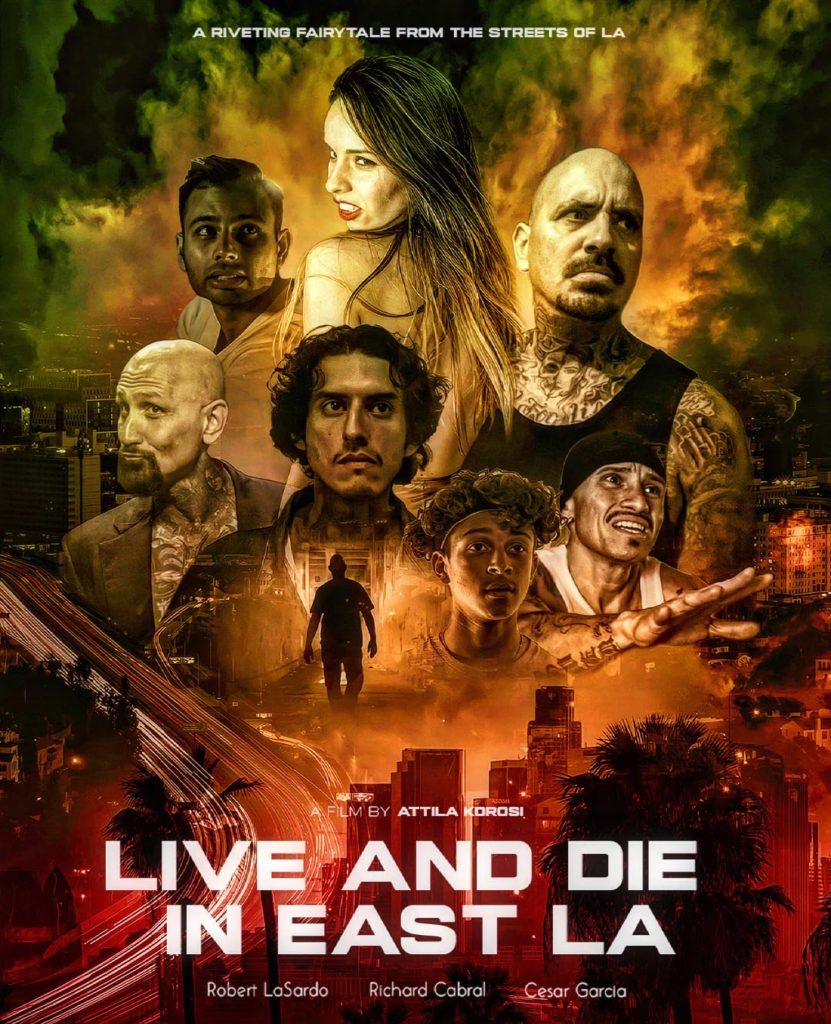
It’s an unusual statement because Live and Die in East L.A. does contain professional performers, including some very experienced ones. Robert LaSardo, Richard Cabral and Cesar Garcia appear alongside less familiar faces, creating an unusual mixture that becomes part of the film’s identity.
Before getting properly into the fictional story, Korosi introduces a family talking about Alberto, a son they lost to the streets. They remember a boy who wanted to become a firefighter despite being afraid of fire, and the conversation becomes understandably emotional. Korosi sits alongside the family while they’re filmed in their living room, and the footage has a deliberately or necessarily raw quality, with camera handling audible at points and zooms occurring during the conversation.
We then see the family sitting together watching the film we’re about to see, reacting to events on screen with Korosi among them. It’s almost like placing part of the making-of documentary at the beginning of the feature rather than saving it for the Blu-ray extras. Whether that works dramatically is another question, but it certainly announces that Live and Die in East L.A. isn’t going to follow an ordinary structure.
The aforementioned animation follows, directed by Mio Yamanaka, introducing the caterpillar and its dangerous journey towards transformation. It’s visually attractive and initially seems completely disconnected from the gritty material surrounding it, but its significance becomes clearer as the film develops. Live and Die in East L.A. is ultimately concerned with choices, consequences and whether someone heading down a destructive path can change direction before it’s too late.
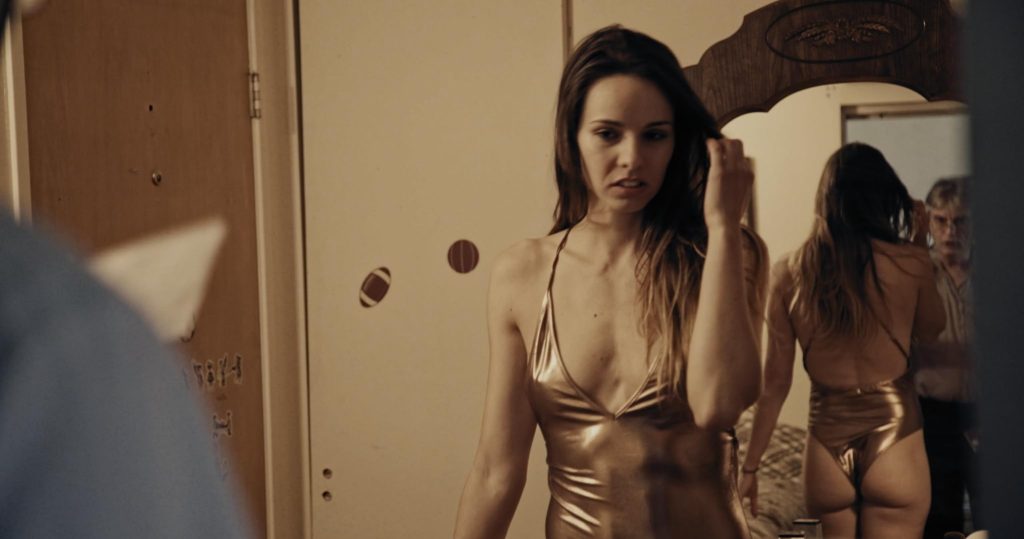
We then meet Anita (Anita Korosi), posing in a gold swimsuit before a mirror and imagining herself arriving at a poolside photoshoot. Her daydream is interrupted when her father discovers a collection of pirated discs and, furious with her, prevents her planned trip to Los Angeles by cancelling her flight.
Meanwhile, Los Angeles delivers the gang drama audiences might have expected from the title. Carlos (Michael Flores) has a gang member sitting nervously inside his home while money from a deal is counted elsewhere. When the count comes up $2,000 short, the atmosphere changes rapidly and guns are pointed at the man’s head as he insists he hasn’t stolen anything.
It appears he’s about to pay for the missing money with his life until Carlos’s sons enter the room. Carlos doesn’t want to carry out the killing in front of them and lets the man leave, albeit with a less-than-gentle send-off. Having escaped almost certain death, the sensible response would presumably be to drive away and reconsider some recent career choices.
Instead, he runs over Carlos’s son.
That decision becomes one of the pivotal events around which the film is constructed.
Live and Die in East L.A. Takes an Unexpected Turn
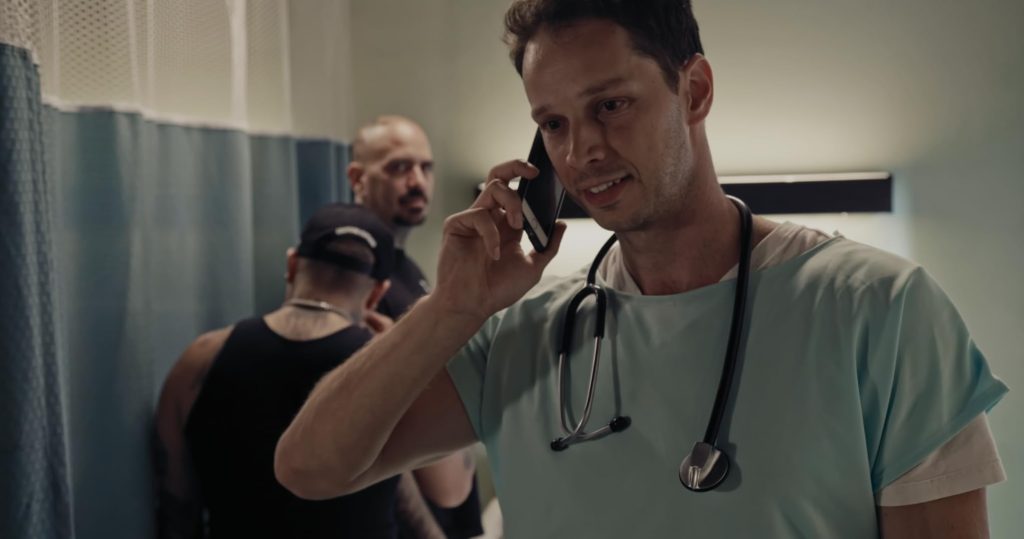
At the hospital, Attila is working as a doctor when the injured boy is rushed in. He assures Carlos that he’ll do everything possible to save his son before taking a telephone call from his sister Anita, who explains that their father has cancelled her flight.
Then Live and Die in East L.A. does something we certainly weren’t expecting from an East Los Angeles gang movie.
It effectively becomes Sliding Doors.
The animation returns, accompanied by material we’ve already witnessed, as the film asks us to consider what might have happened if earlier choices had been different. We return to the moment when Carlos’s son walks from the house, only this time he isn’t hit by the car. One decision changes, and the consequences begin moving in another direction.
Without the emergency operation occupying Attila, his day changes too. He still receives Anita’s call, but events unfold differently and a video conversation with their father results in him changing his mind and allowing Anita to travel to Los Angeles.
It’s a bold structural idea. The official synopsis describes the film as rewinding to explore how a single different choice can alter the lives of everyone involved, and the butterfly imagery now has a clear purpose. Korosi is using the conventions of the crime thriller to examine cause and effect, showing how seemingly isolated decisions can ripple outwards into other people’s lives.
That doesn’t mean the approach always works smoothly. Live and Die in East L.A. contains documentary material, a fictional gang narrative, animation, family drama and an alternative timeline, and the transitions between these different forms can make the film feel fragmented. The opening in particular takes some time to establish exactly what kind of film we’re watching.
The documentary introduction is heartfelt, but placing footage of people watching the movie before we’ve watched it ourselves is a peculiar structural choice. The animated fable is attractive and thematically relevant, yet it creates another significant stylistic shift immediately afterwards. By the time the conventional crime narrative gets moving, we’ve already experienced several completely different filmmaking approaches.
Still, we’d rather see an independent filmmaker take risks than simply imitate whatever successful crime movie happens to be easiest to reproduce. Korosi is clearly trying to do more than provide 84 minutes of guns, gangsters and violence.
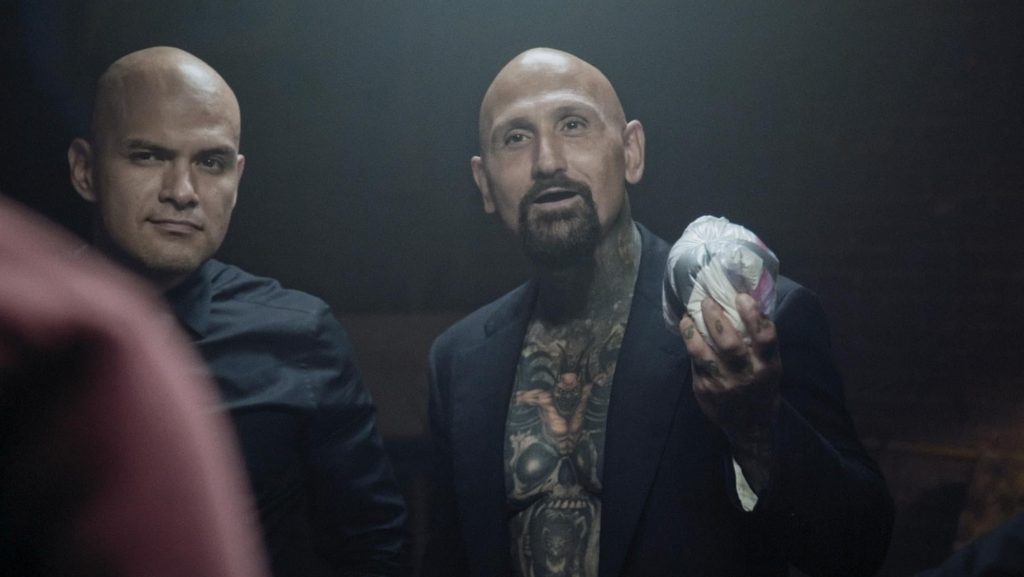
The intention behind the film becomes increasingly apparent as its characters are drawn further into the criminal world. Attila and his friend Ishaan (Ishaan Bahri) become involved as drug couriers for Tony, played by veteran character actor Robert LaSardo, while the effort to help Anita places them increasingly close to people capable of serious violence. Richard Cabral appears as Sado, Corina Calderon as Bianca and Cesar Garcia as Sanchez, forming part of a surprisingly extensive ensemble.
The film’s message is hardly hidden. Choices matter. One apparently small action can redirect multiple lives, while entering a world of gangs and drugs can have consequences extending well beyond the person who initially makes that decision. Given the opening material concerning Alberto and the film’s stated community purpose, the crime narrative is being used as a warning rather than simply presenting gang life as exciting entertainment.
Ambition Sometimes Works Against the Film
For a low-budget feature from a first-time director, Live and Die in East L.A. is frequently more accomplished than expected. Gareth Taylor’s cinematography is one of its stronger technical elements, particularly because the camera rarely feels completely lifeless. There is regular movement around the performers and locations, with the framing adjusting alongside blocking rather than relying entirely on static coverage.
That movement helps give the street material energy. The film also benefits enormously from having access to numerous locations, preventing an 84-minute independent production from feeling as though everything has been staged in the same couple of rooms. Hospitals, homes, streets and other environments contribute to a larger sense of scale than the production’s independent origins might suggest.
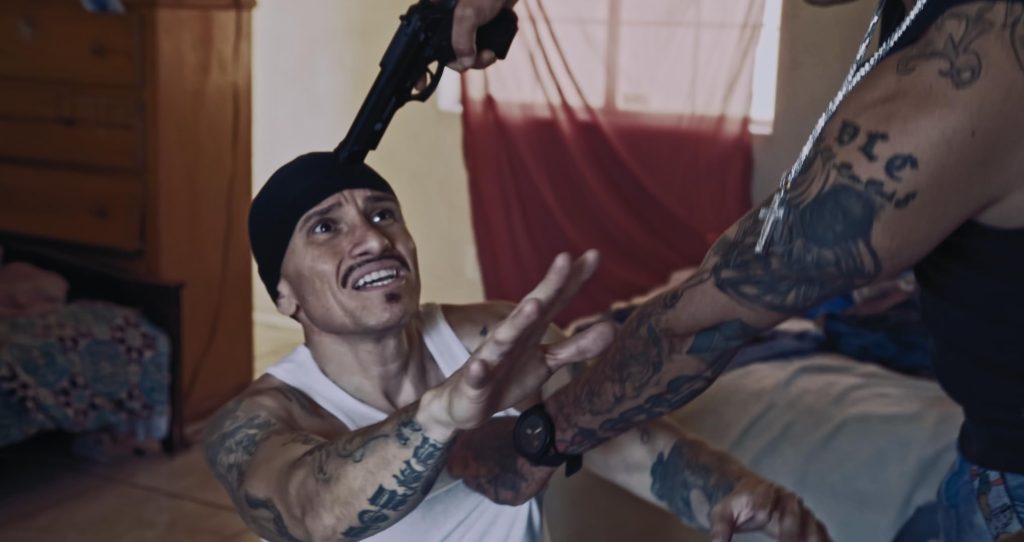
It isn’t completely polished. Some of the earlier documentary footage is noticeably rougher than the dramatic material, and the mixture of professional performers and less experienced participants naturally creates variations in performance style. Yet there’s also something interesting about that combination. Familiar character actors occupy the same world as people who don’t necessarily possess the same polished screen presence, sometimes giving scenes an unusual semi-documentary texture.
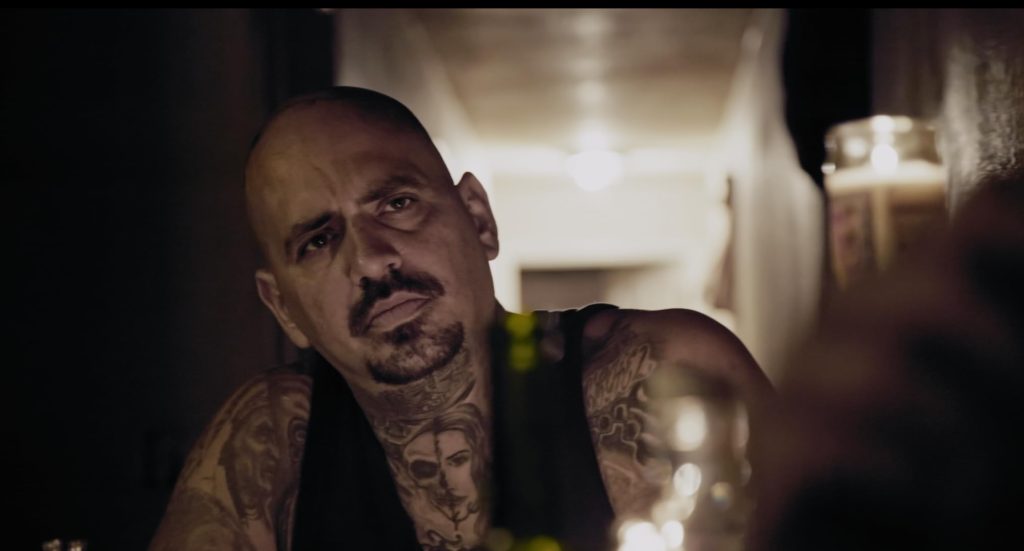
LaSardo is particularly well suited to this material. Anyone who has spent enough time watching American crime, action and horror cinema will probably recognise him immediately, and his extensive screen experience gives Tony an established presence without requiring the film to spend excessive time building it.
Korosi faces a different challenge because he’s occupying several roles simultaneously. As writer, director, producer and leading performer, he’s attempting to hold together a story with a large cast, multiple narrative strands and a fairly unconventional structure. Even if the finished film doesn’t completely reconcile all of those elements, the scale of what he’s attempted deserves acknowledgement.
Cece Wen provides the score, while Itai Levin handles the editing and Seth Tonk is credited as colourist. The film also has a substantial sound department, stunt personnel, special-effects makeup artists and visual-effects contributors, further illustrating that this isn’t simply a couple of people running around Los Angeles with a camera despite its independent production.
The film’s greatest issue remains the sheer number of concepts competing for attention. Any one of them could potentially sustain a feature: an ER doctor drawn into gang activity, a young woman becoming trapped within that environment, a social drama about choices and consequences, a quasi-documentary examination of real experiences, or a Sliding Doors-style exploration of an alternative path.
Live and Die in East L.A. wants to be all of them.
Sometimes that produces something genuinely distinctive. At other points it creates the impression that the film is interrupting itself. The animation is perhaps the clearest example because it’s attractive and conceptually relevant, yet every return to it creates a significant tonal departure from the street-level realism Korosi is simultaneously trying to establish.
The same applies to the material preceding the main story. Seeing a bereaved family discussing Alberto immediately establishes that the subject has consequences beyond fictional entertainment, and the credits specifically include an “in loving memory of Alberto Guerrero” dedication. That gives the project an emotional context that a straightforward fictional opening wouldn’t possess. Pasted markdown
Yet dramatically, placing the family discussion and their reactions to the movie at the beginning makes the opening feel more like a featurette accompanying the film than part of the film itself. It’s sincere material, but sincerity and narrative momentum aren’t necessarily the same thing.
Live and Die in East L.A. Has Something to Say
What ultimately makes Live and Die in East L.A. easier to forgive for its rough edges is that there is clearly a reason Korosi wanted to make it. The film isn’t using gang culture purely as colourful background for an action movie. Its entire alternative-timeline device exists to reinforce the possibility that another decision might produce another outcome.
That purpose extends beyond the screen. The production materials state that the film has been recognised by the City and County of Los Angeles for its impact and by Gang Reduction and Youth Development for its community impact. Those claims are supplied as part of the film’s festival and production information, and they align with the anti-gang message Korosi places throughout the feature. Pasted markdown
It also explains that unusual opening quotation from the former gang member. The intended audience isn’t necessarily just somebody looking for an independent crime thriller on a Friday night. Korosi wants younger viewers who might recognise elements of this environment to consider where particular decisions could lead them.
As pure cinema, the results are mixed. The narrative is sometimes messy, the shifts between documentary, animation, crime thriller and alternative reality don’t always sit comfortably together, and certain directorial decisions left us wondering whether simplifying the film might actually have strengthened its message.
But there is plenty here that works. The cinematography is frequently strong, the production makes impressive use of numerous locations, the larger cast gives the world scale, and combining experienced performers with less conventional casting creates a texture quite different from many independent crime films. Once the various narrative threads begin connecting, the central idea about consequences becomes considerably clearer.
Perhaps most importantly, Korosi hasn’t made the obvious version of this story. Nobody watching a low-budget gang drama set in East Los Angeles is likely to predict that a black-and-white caterpillar fable and an alternative timeline are waiting around the corner. Whether those choices entirely succeed is debatable, but they demonstrate a filmmaker attempting to find his own way of communicating something he clearly cares about.
Live and Die in East L.A. isn’t Training Day, nor does it need to be. It’s a rough but ambitious independent feature attempting to combine street-level crime with a positive message about escaping the cycle that creates it. The execution is inconsistent and some of its ideas collide rather than complement one another, but there is enough solid filmmaking underneath the experimentation to make it an interesting debut.
If the film reaches even a handful of young people who recognise something of their own circumstances within it and makes them think twice about where a particular decision might lead, then Korosi’s stranger creative choices become rather less important. As entertainment, Live and Die in East L.A. is uneven. As an independent filmmaker trying to use cinema for something beyond entertainment, Korosi deserves credit for aiming considerably higher than the familiar gang movie its title initially suggests.
| Acting | |
| Direction | |
| Cinematography | |
| Writing | |
| Sound | |
| Screen Critix Rating |