
There are films that carefully explain their worlds, films that deliberately leave audiences with questions, and films that appear to have arrived from another dimension with absolutely no intention of explaining themselves. Hard Powers sits very comfortably in that final category. Written and directed by James Ristas, this 2026 American science-fiction/fantasy short runs for just over 12 minutes and is one of the strangest films we’ve encountered in quite some time.
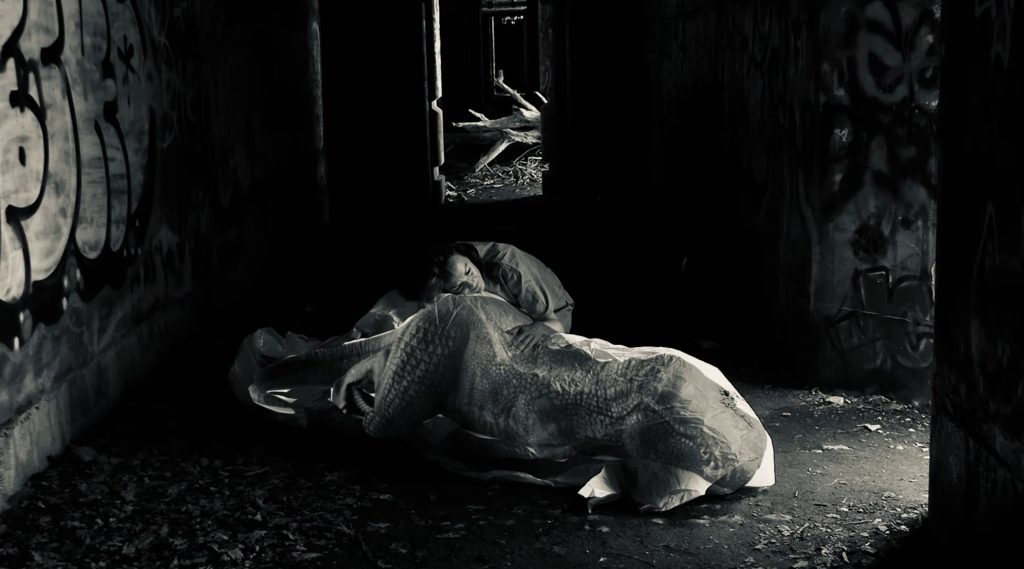
That strangeness is apparent immediately. Hard Powers opens in black and white with a woman leaning over what appears to be a relatively small dinosaur covered by a sheet, her head resting against the creature as we hear its heartbeat. They occupy a dilapidated space covered with graffiti, giving the scene the appearance of some forgotten bunker or abandoned industrial building. Music begins, but eventually the dinosaur’s heartbeat stops.
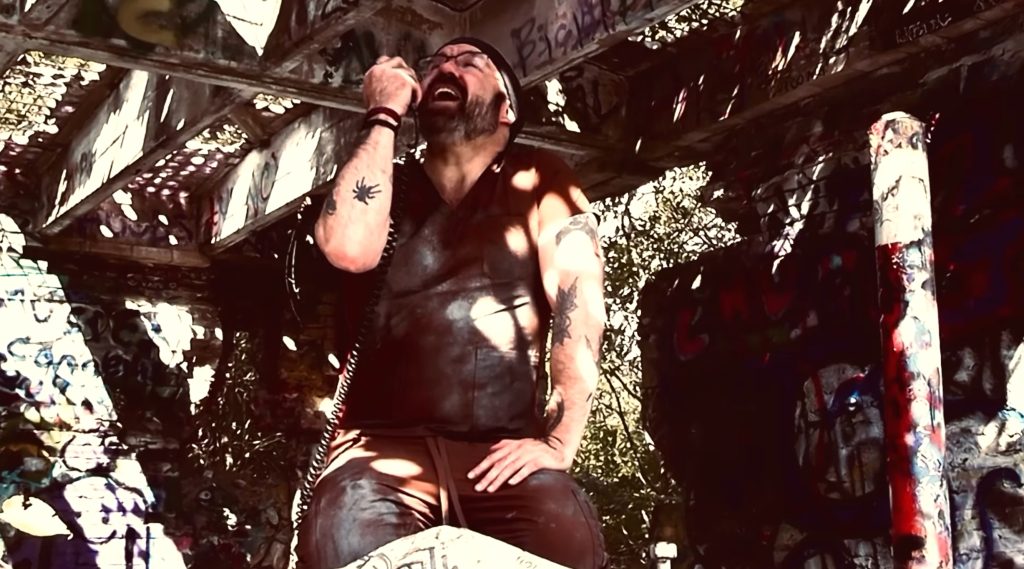
We then meet Horn (Kevin Geezil), kneeling on a rock with the microphone of a CB radio held to his mouth. “Hard Powers is dead. Slain in battle by me. Bellsaur is safe for landing,” he announces. There isn’t much context for any of this, but it’s certainly an effective way of making us wonder what on Earth we’ve just started watching.
Horn relocates to another rundown building and continues broadcasting the same message. Ristas then cuts away from Earth entirely, showing the stars as Horn’s transmission apparently travels out into space. The film’s supplied synopsis describes Horn as a “radio prophet” attempting to persuade extraterrestrials to visit the planet, which at least provides some explanation for his repeated broadcasts. The short itself, however, is far less interested in making its world immediately comprehensible.
Back with the woman and the dinosaur, something unexpected happens. The heartbeat returns.
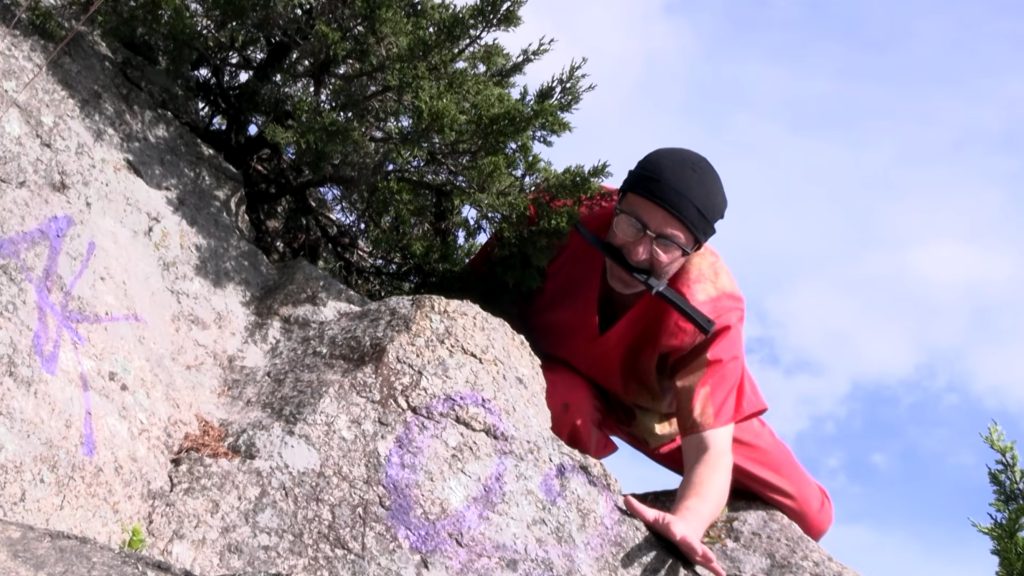
Smallbone (Stevie Heart), dressed in red and wearing a beanie, is also present, but he soon leaves the bunker-like location and eventually joins Horn at the rocks. He begins participating in the proclamation that Hard Powers is dead, despite the audience having just received some fairly compelling audio evidence to the contrary. Images resembling UFOs appear in the sky as the strange broadcast continues.
It’s around this point that any attempt to approach Hard Powers as conventional narrative cinema becomes increasingly difficult. According to the official synopsis supplied with the film, its central idea involves “a surface dweller and a cave dweller” playing tug-of-war with a man’s soul, while the only other person in their world travels between them while attempting to discover the origins of the human race. That provides a framework for what Ristas is attempting, but the finished film communicates those ideas in a highly abstract fashion.
Hard Powers Is Certainly Unlike Anything Else
Smallbone eventually finds himself among some rocks while the unmistakable sound of a rattlesnake can be heard. We never actually see the snake, so we can only judge what happens through the editing and sound. Smallbone climbs above its apparent location with a knife held in his mouth, jumps down and, following a cut, is shown chewing. The implication appears to be that he has killed the unseen snake and is now eating it, although the film leaves the actual event off screen.
It’s a sensible solution if the filmmakers didn’t have access to a snake effect, but it’s also completely consistent with the homemade surrealism of everything surrounding it. Hard Powers doesn’t appear particularly concerned about convincing us that this is a literal reality. Instead, objects, sounds, locations and characters are assembled into something closer to an experimental science-fiction fever dream.
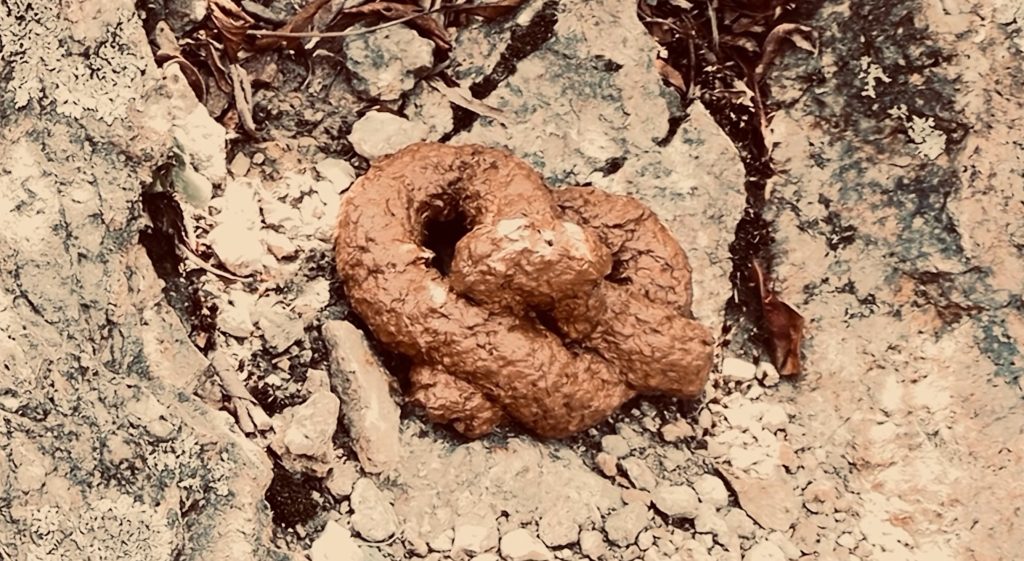
Smallbone and Horn discuss whether they actually believe Hard Powers is dead, raising questions about the very message they’ve been broadcasting. They subsequently head outside, where the film introduces perhaps its most unexpected visual obsession yet: a large piece of excrement sitting on the ground.
The camera doesn’t merely acknowledge it and move on. It creeps towards it. And keeps creeping towards it. For what feels like a surprisingly long time, the humble turd becomes one of the most important objects in the film.
We’ve watched some exceptionally strange independent cinema over the years. We’ve seen deliberately abstract films, experimental films, movies designed to confuse their audience and others that seem to achieve confusion entirely by accident. Hard Powers still manages to find its own peculiar corner of that landscape.
That’s both its greatest strength and biggest problem.
There is absolutely no sense that Ristas has looked at what other low-budget filmmakers are doing and attempted to replicate it. Hard Powers isn’t another zombie short, serial-killer thriller or familiar science-fiction scenario dressed up with slightly different character names. Whatever else one might think about it, this film has an identity.
Its official description becomes increasingly useful when trying to make sense of that identity. We know there is supposed to be a surface dweller, a cave dweller and a struggle involving a man’s soul. We know Horn is calling out to extraterrestrials and that another character moves between these figures while seeking answers concerning human origins. The difficulty is that much of this isn’t communicated clearly enough through the images and dialogue for an audience to necessarily arrive at those ideas without additional information.
Ambiguity itself isn’t a problem, and experimental filmmaking certainly doesn’t need to provide conventional exposition. There is a difference, however, between asking an audience to interpret a film and leaving them without enough information to form that interpretation. Hard Powers occasionally crosses that line, becoming so determined to follow its own bizarre logic that viewers may struggle to find anything solid to hold onto.
Originality Battles Rough Production Values
The production itself has an extremely low-budget appearance. The abandoned buildings and rocky exterior locations provide Ristas with visually interesting spaces, and their deteriorating surfaces actually suit the peculiar post-apocalyptic atmosphere. The film doesn’t need elaborate sets to create an unusual world because the locations already possess character.
Visually, though, the cinematography is extremely rough. There is little evidence of a deliberate lighting design in many sequences, while compositions and camera placement frequently have the immediacy of filmmaking created with whatever equipment and resources were available. That can occasionally complement the anarchic material, but it also limits the atmosphere that might otherwise have been extracted from those locations.
The sound is another noticeable weakness. Audio ambience occasionally appears to stop abruptly between scenes or shots, creating the impression that the soundtrack hasn’t been completely smoothed during the final mix. Consistent room tone and environmental ambience would have helped considerably, particularly because the film’s unusual world relies heavily upon sound, from the dinosaur’s heartbeat to the rattlesnake and Horn’s repeated radio transmissions.
The performances are similarly rough around the edges. Geezil and Heart don’t deliver polished, naturalistic performances, but judging Hard Powers entirely according to conventional realism would probably be missing what the film is attempting. Both performers commit wholeheartedly to the material, which is important when that material involves radio prophecies, extraterrestrial communication, supposedly dead dinosaurs and implied consumption of rattlesnakes.
James Ristas himself is credited as Brother Sin, although based solely on the material provided and our viewing notes, we don’t have enough information to confidently identify where that character fits into every element of the story. Rather than invent an explanation that the film hasn’t clearly provided, it’s better to acknowledge that Hard Powers deliberately leaves much of its mythology unexplained.
That commitment to strangeness deserves some respect. There is something refreshing about watching a filmmaker who clearly isn’t trying to reverse-engineer a short according to festival trends or familiar genre formulas. Ristas has an idea, however bizarre it may be, and pursues it without apparent concern about making it conventional.
The downside is that originality doesn’t automatically create engagement. Hard Powers is so cryptic and so technically unpolished that its 12-minute running time can occasionally feel considerably longer. The prolonged attention given to certain images, including that memorable piece of excrement, might be deliberate absurdism, but viewers who haven’t connected with the film’s wavelength are unlikely to suddenly discover it during those moments.
Hard Powers May Find Its Own Peculiar Audience
There will almost certainly be people for whom Hard Powers is precisely the kind of independent filmmaking they enjoy. Experimental cinema has always provided space for work that rejects conventional storytelling, and some viewers actively seek out films that make them wonder whether they’ve understood anything correctly.

For those audiences, the sheer unpredictability could be part of the appeal. You genuinely don’t know what Ristas is going to show you next, and that’s becoming increasingly rare in a filmmaking landscape where so many stories follow familiar structures. Even when Hard Powers isn’t working for us, we’re curious about what strange direction it will take next.
For a broader audience, however, that same unpredictability is likely to prove challenging. The film’s underlying ideas about extraterrestrial contact, human origins and the struggle described in its synopsis potentially offer plenty to explore, but the storytelling is so abstract that those concepts struggle to emerge clearly from what we’re watching. Technical shortcomings in the cinematography and sound further distance the viewer from a world that is already intentionally difficult to understand.
Hard Powers therefore leaves us in an unusual position. We can’t pretend the film completely worked for us because much of it is simply too obscure, and its technical limitations are clearly visible and audible. At the same time, we’d rather see filmmakers attempt something genuinely peculiar than endlessly reproduce the same ideas because they know they’re safe.
Ristas certainly hasn’t played it safe. Hard Powers is rough, confusing, occasionally funny and completely committed to its own strange universe. Greater technical polish and a few more narrative footholds might have helped audiences enter that universe rather than simply observe it from the outside, but nobody can accuse the filmmakers of lacking imagination.
We’ve seen better-made shorts, clearer shorts and considerably more accessible shorts. What we haven’t seen many of lately are films involving a radio prophet broadcasting the death of a dinosaur into outer space, an apparently resurrected heartbeat, an invisible rattlesnake dinner and a camera seemingly fascinated by a turd. Hard Powers may not always make cinematic sense to us, but originality is one accusation from which James Ristas is entirely safe.
| Acting | |
| Direction | |
| Cinematography | |
| Writing | |
| Sound | |
| Screen Critix Rating |