
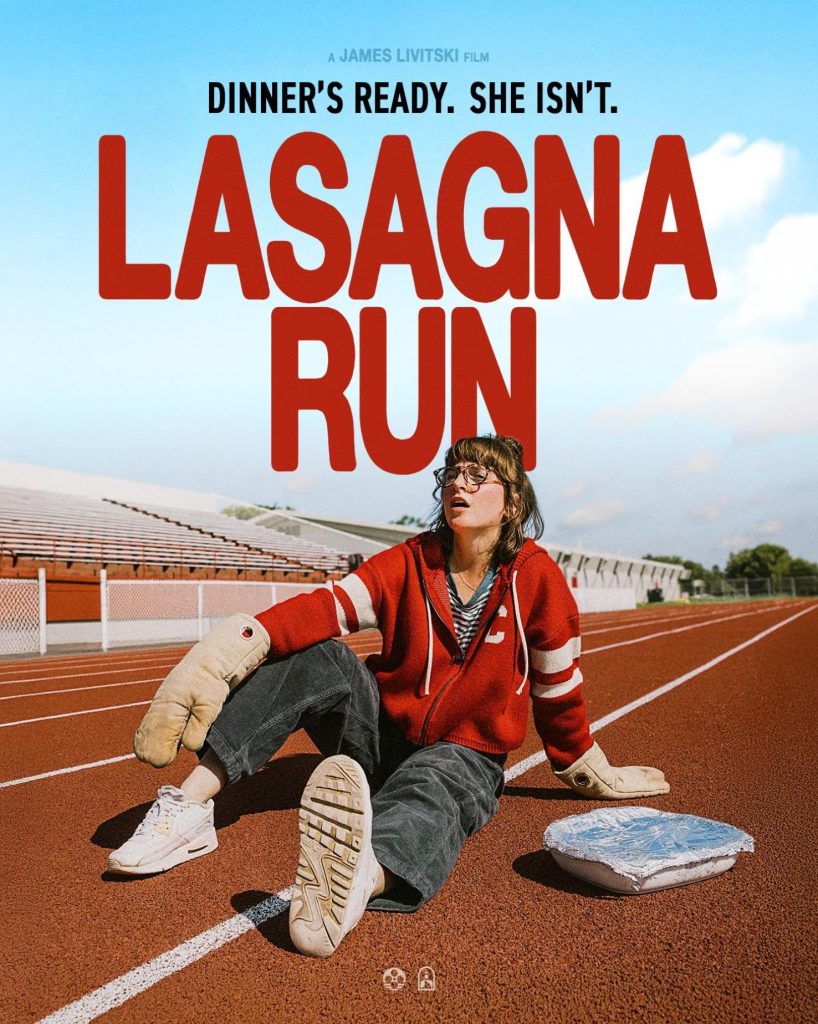
Three minutes and 28 seconds. That is all the time James Livitski needs to establish a character, turn the delivery of a lasagna into an absurd cross-country odyssey, explore the overwhelming nature of anxiety and produce several genuine laughs along the way. Lasagna Run may be tiny, but there is more imagination packed into its brief running time than some films manage across an entire feature.
It begins with a declaration of intent: “A love letter to anxiety.” Connie, played by Danielle Pollari, is standing in her bathroom when a terrible realisation suddenly hits her. The lasagna.
What should follow is simple. Retrieve lasagna from oven. Cover lasagna. Carry lasagna to neighbourhood potluck. Instead, Livitski transforms this most ordinary of errands into something approaching an epic adventure, where Connie’s anxiety appears to stretch the distance between her home and her destination into an increasingly ridiculous physical ordeal.
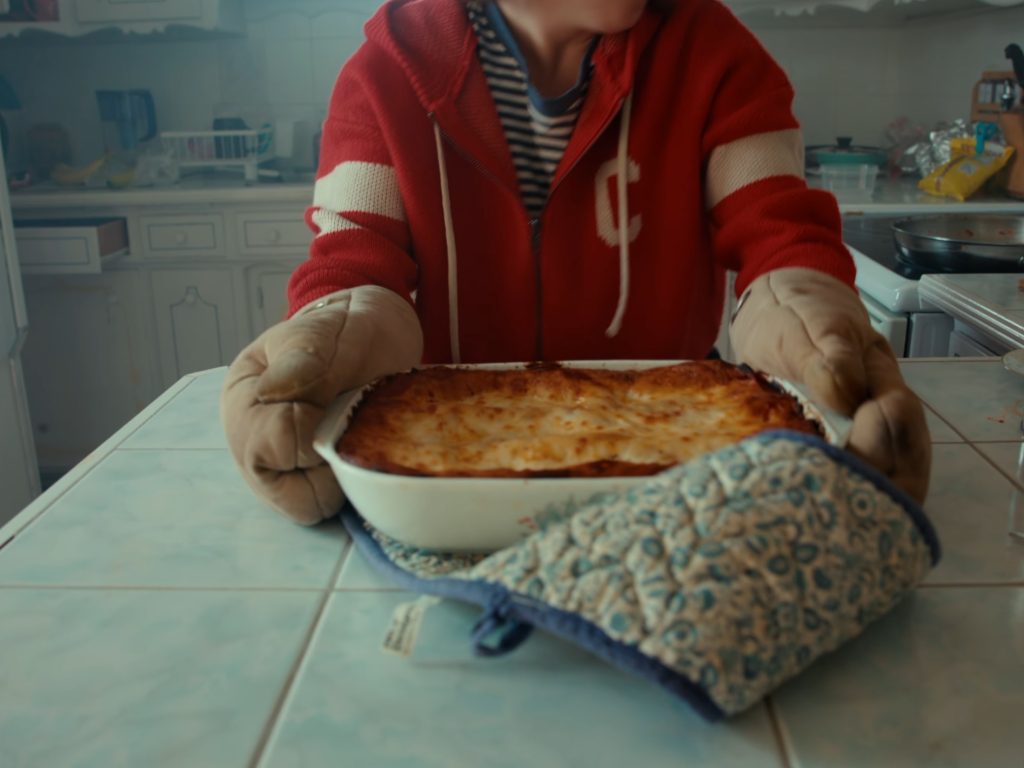
The first frantic dash downstairs immediately establishes the film’s rhythm. Drums and cymbals drive Connie towards the kitchen as though the fate of civilisation might depend upon whether her dinner has survived the oven. Fortunately, the lasagna has escaped cremation, but there is little time for celebration. Connie hurriedly covers it with foil, grabs the dish and races from the house, shedding objects and eventually a shoe as she goes.
It is ridiculous, and that is precisely why it works. Lasagna Run understands that committing completely to an absurd premise is considerably funnier than constantly reminding the audience that everybody involved knows it is a joke.
Livitski then makes a particularly clever visual decision. The domestic opening is presented in the tighter 4:3 aspect ratio, but once Connie escapes the house, the frame expands into widescreen. Suddenly the world itself seems to open up around her, providing the filmmakers with a much larger canvas upon which to escalate the joke.
And escalate it they do.
Connie isn’t merely running down the street. Her increasingly impossible journey takes her across railway tracks and open fields, past industrial landscapes and through snow-covered terrain. She tumbles through the snow, continues through woodland and encounters imagery that becomes progressively stranger, including women appearing between the trees before seemingly disappearing again.
All the while, Connie is still carrying the lasagna.
The visual joke becomes funnier through repetition because Livitski understands escalation. Every new environment raises the question of where on earth Connie could possibly end up next, while the continued presence of that foil-covered dish provides the wonderfully mundane constant holding everything together. Mountains, snow, forests or railway tracks don’t matter. The lasagna has somewhere to be.
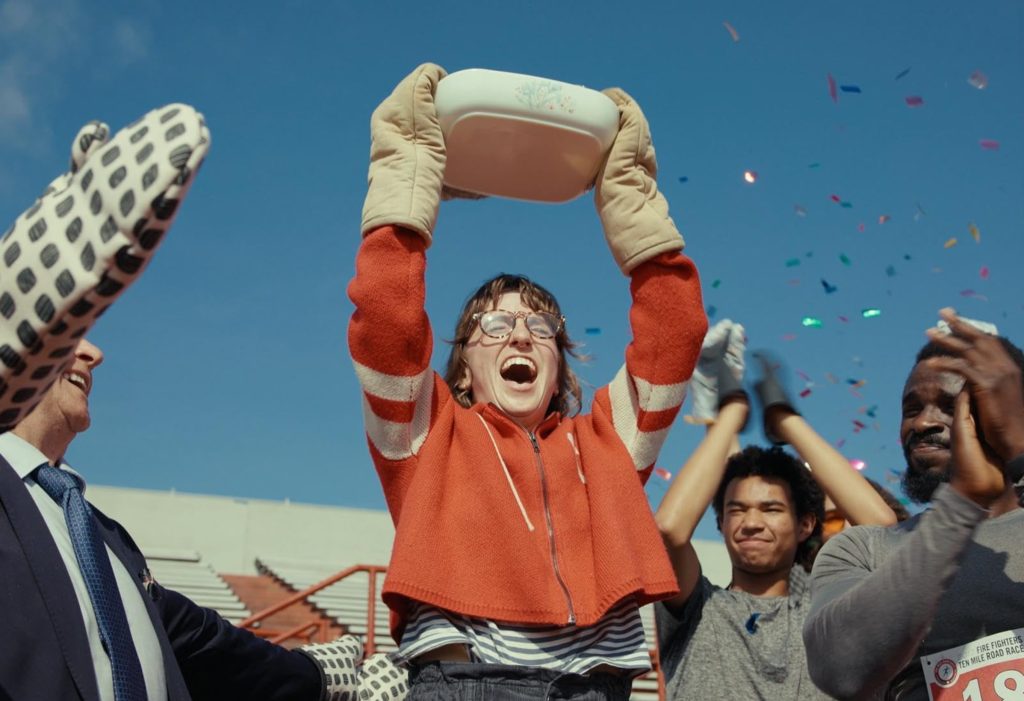
The film’s finest escalation may come when Connie suddenly finds herself on a running track alongside competitive sprinters. She doesn’t merely join the race while carrying an entire lasagna. She wins it.
There is something beautifully silly about the image, but it is also indicative of how efficiently Lasagna Run constructs its comedy. There is no need to explain how Connie got there or why a woman carrying dinner has suddenly entered an athletics event. The film has established its own surreal logic by this point, and Pollari’s complete commitment allows the audience to accept each increasingly ludicrous development.
Pollari is crucial to making the entire exercise work. Playing exaggerated physical comedy without looking as though you are desperately attempting to be funny is more difficult than it appears, particularly when the film provides virtually no conventional dialogue or character development upon which to rely. Connie instead exists through movement, expression, urgency and the increasingly exhausting determination to complete her apparently simple task.
Pollari throws herself into that physicality. The running, stumbling and frantic movements communicate the character’s escalating panic while maintaining the lightness required for the comedy. Most importantly, she never seems to be standing outside the joke. Connie treats this journey with absolute seriousness, which makes what is happening around her considerably funnier.
Matt Popowich’s cinematography is another major reason Lasagna Run feels so accomplished. This isn’t merely a collection of amusing situations edited together at high speed. The short is beautifully photographed, with carefully composed images giving each new environment its own visual impact while retaining a coherent aesthetic across the rapidly changing locations.
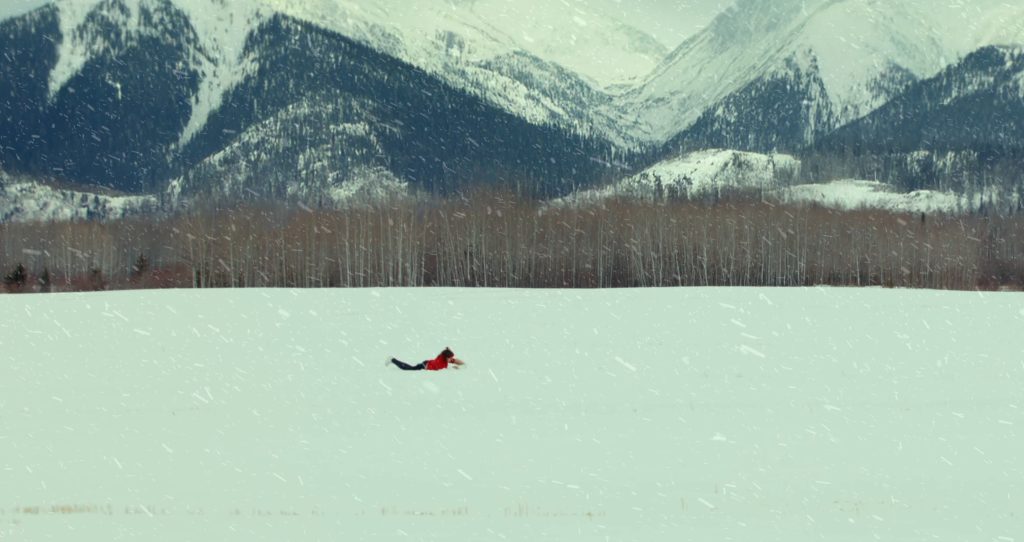
The widescreen landscapes are particularly effective because their scale makes Connie and her lasagna appear simultaneously heroic and completely ridiculous. She is undertaking the kind of journey cinema traditionally reserves for enormous adventures, except her precious cargo is tonight’s dinner.
Popowich also edited the film, and the precision of that work cannot be overstated. With only three and a half minutes available, a few seconds of unnecessary material could significantly damage the rhythm. Lasagna Run never encounters that problem. It moves rapidly without becoming incoherent, allowing each visual gag enough time to register before propelling Connie towards the next one.
Ethan Myers’ music and sound work contribute enormously to that momentum. The percussion accompanying Connie’s initial panic turns domestic forgetfulness into an emergency, while the soundtrack continues to complement the increasingly heightened nature of her journey. Sound, image and editing work together rather than competing for attention, which is essential in a film relying so heavily upon audiovisual rhythm.
Then there is the structure itself. After taking Connie across what feels like half the planet, Lasagna Run brings her back onto her own street and returns the image to 4:3. The vast adventure collapses back into the confined everyday world from which she started.
That aspect-ratio reversal is more than a visual gimmick. It provides a neat cinematic expression of what the film has been doing throughout. An objectively ordinary task has become enormous inside Connie’s experience of it. The physical world expands to accommodate the scale of her anxiety before contracting again once the journey reaches its destination.
The film’s humour prevents that idea from becoming heavy-handed. Anxiety can be debilitating, exhausting and irrational, but Lasagna Run doesn’t need to become miserable in order to communicate something recognisable about it. Instead, it takes the sensation of a small responsibility feeling disproportionately enormous and translates that feeling into physical geography.
It is a wonderfully cinematic solution because the film doesn’t have to explain the concept to us. Connie doesn’t stop to deliver a speech about what she is experiencing. We simply watch a woman attempt to deliver a lasagna while the journey becomes increasingly impossible around her.
There is also admirable discipline in knowing when to stop. Lasagna Run could easily have extended the central joke for another five or ten minutes, adding increasingly strange locations until the original idea had been exhausted. Livitski instead keeps the film at exactly the scale it requires.
That economy makes the short particularly well suited to the festival circuit, where its combination of accessibility, visual invention and extremely brief running time should make it easy to programme. It has already received recognition, including Best Comedy at the 2026 New York Indie Shorts Awards and Outstanding Director, Short Format at the 2026 Northern Ontario Music and Film Awards, alongside festival selections including Fantasia International Film Festival. Those achievements are easy to understand after watching the finished film.
There really isn’t an obvious weak link here. The photography is accomplished, the editing is sharp, the sound and music drive the action beautifully, Pollari gives the central performance exactly the physical commitment it requires, and Livitski demonstrates an ability to take one extremely simple idea and continually find inventive ways of expressing it.
Perhaps most impressive is how effortless the finished film feels. A viewer can simply watch Connie running through increasingly ridiculous environments with a lasagna and enjoy the joke. Behind that apparent simplicity, however, is a considerable amount of filmmaking craft.
That distinction matters. Short films sometimes mistake brevity for simplicity, presenting a single gag and assuming the running time will excuse a lack of development. Lasagna Run does the opposite. It takes a single gag and develops it through framing, editing, performance, music, geography, aspect ratio and escalation.
It also manages the increasingly rare trick of being quirky without becoming irritating. The film knows it is strange, but never seems desperate to demonstrate how strange it is. Its personality comes naturally from the execution rather than from piling self-conscious eccentricity onto the premise.
By the time Connie has crossed fields, railway tracks, forests, snow-covered landscapes and a running track while protecting a tray of pasta, Lasagna Run has transformed one woman’s neighbourhood errand into something absurdly monumental. Yet underneath the comedy is an immediately understandable idea: sometimes the smallest responsibility can feel like the most enormous task in the world.
Lasagna Run is an outstanding example of how much can be achieved in an extremely short running time. Funny, beautifully photographed, expertly paced and performed with complete commitment by Danielle Pollari, it takes an ordinary domestic panic and turns it into a wonderfully inventive cinematic adventure.
Three minutes and 28 seconds might not sound like enough time to do very much. James Livitski and his collaborators use virtually every second of it. Lasagna Run is fast, funny, technically accomplished and delightfully ridiculous, proving that sometimes all a filmmaker really needs is a strong idea, complete commitment and one very important lasagna.
| Acting | |
| Direction | |
| Cinematography | |
| Writing | |
| Sound | |
| Screen Critix Rating |