
Music videos have always provided filmmakers with an opportunity to experiment in ways that conventional narrative cinema sometimes cannot. In just four minutes and 25 seconds, director Adrien Lhoste takes full advantage of that freedom with Iridescence, an animated music video for Massive Dub Corporation that combines science fiction, environmental commentary and an impressive amount of visual imagination.
Produced in France by Partir à deux Production, Iridescence was written and directed by Lhoste and combines 2D and 3D animation. Pauline Chrétien handled the 2D animation, Judith Wahler the 3D modelling and animation, while Théo Higel served as director of photography and Manon Colin as production director. Lhoste also edited and colour graded the project. Those credits are confirmed by the production company, which also confirms that the film was made with support from France’s Centre national du cinéma et de l’image animée, better known as the CNC.
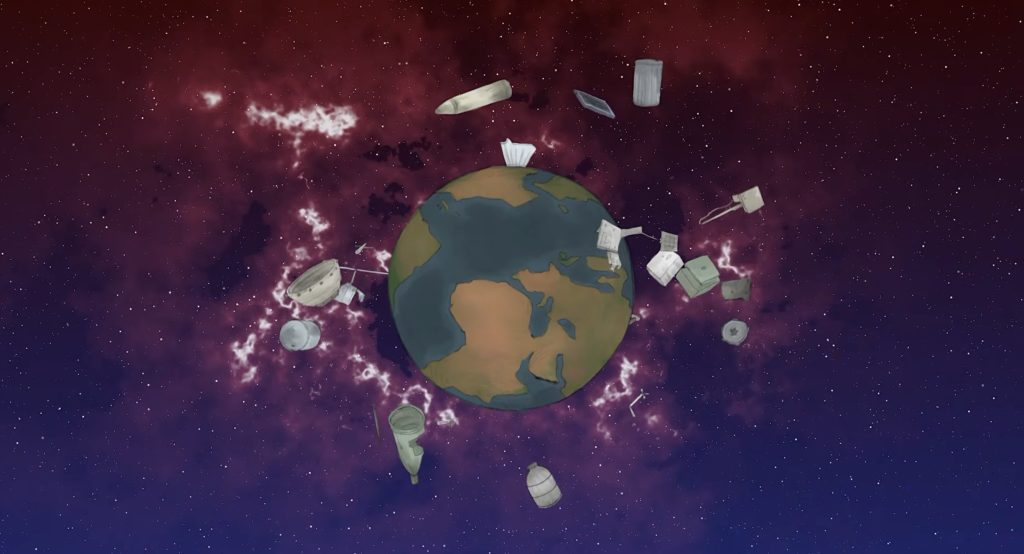
The story begins on a suitably enormous scale, looking down upon Earth and the satellites surrounding it before introducing the unusual little protagonist that will carry us through this strange future. A drone resembling a glass box fitted with propellers is transporting bottles of water across a world where something as fundamental as a drink has apparently become a valuable commodity.
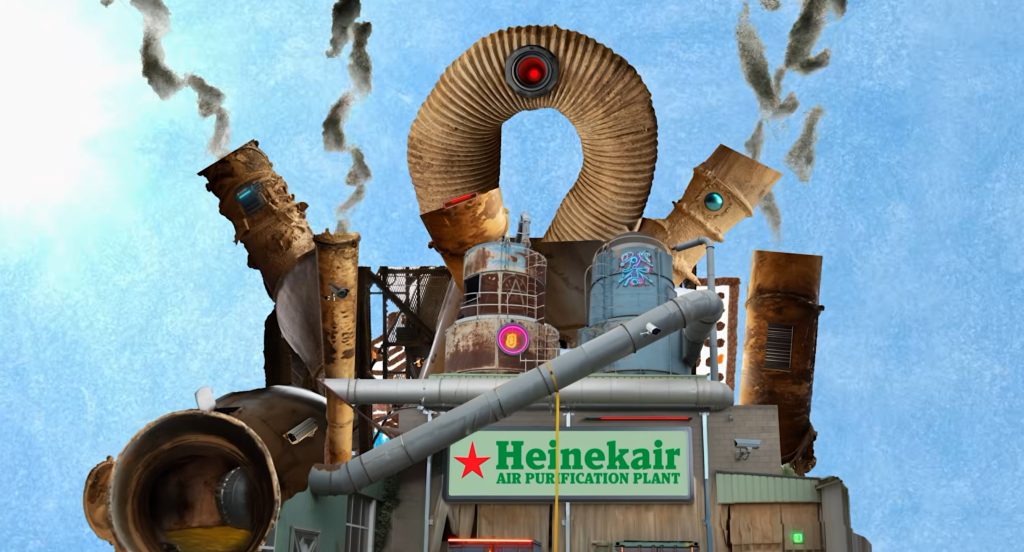
The drone’s journey provides Lhoste and his animation team with an excuse to continually change the scenery. It passes across slums, mining areas, wastelands and enormous rubbish tips before travelling through industrial facilities concerned with air purification. Even corporate branding becomes part of the joke, with familiar-looking advertising imagery twisted to fit this increasingly commercialised future.
Things become stranger when the drone heads beneath the water. Among the sights waiting below is a submerged Sydney Opera House, an immediately recognisable landmark now sitting underwater. Giant jellyfish subsequently attack the drone, costing it almost all of its precious cargo and leaving it to continue its journey with a single bottle.
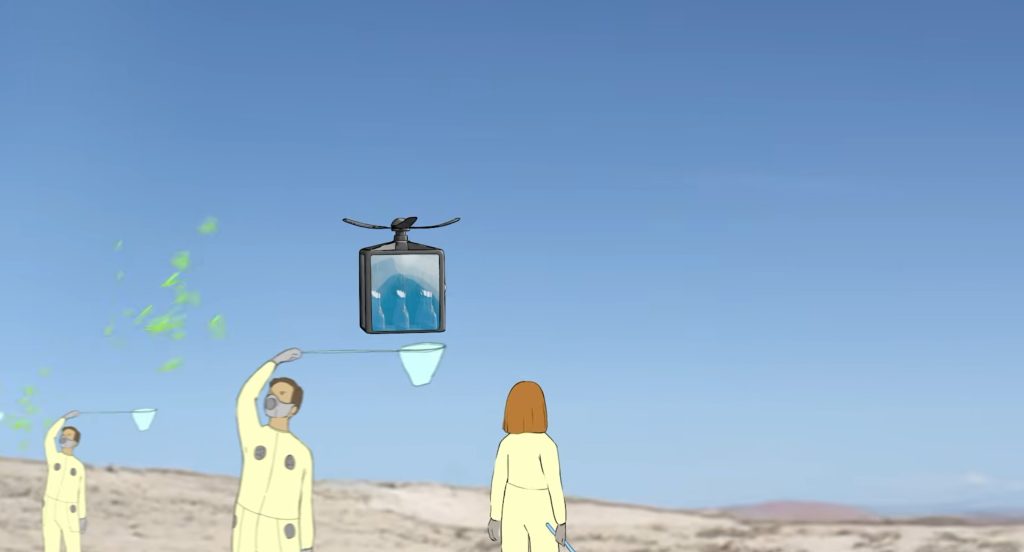
There are plenty of additional oddities packed into the film’s short running time, including a man armed with a net and, according to the film’s official synopsis, a boxing kangaroo. That synopsis describes the setting as a scorching futuristic desert world in which the journey becomes progressively more dangerous. The destination eventually reveals another layer to the story: the surviving water isn’t being transported to somebody desperately struggling to survive, but to a billionaire’s social gathering.
Once the drone finally reaches the home, the last bottle is taken from it and opened, releasing the drop of water that has survived this bizarre journey. It’s a simple conclusion, but one that gives context to everything we’ve just watched.
Iridescence Creates an Entire World in Four Minutes
The environmental and social message behind Iridescence isn’t particularly difficult to identify, nor does it need to be. Lhoste imagines a future in which essential natural resources have increasingly become commercial products. Water is delivered to the wealthy by drone while the world through which it travels appears environmentally devastated, and even the air has become associated with industrial infrastructure and corporate branding.
There is an obvious exaggeration to all of this, and Iridescence frequently embraces absurdity rather than attempting to present a realistic prediction of the future. The kangaroo, giant jellyfish and strange visual jokes keep it playful, while the central idea remains clear underneath them. Things people fundamentally require to survive, including water, food and clean air, can become commodities, and the film pushes that idea towards a deliberately ridiculous extreme.
What makes the video particularly enjoyable, though, is the animation itself. There is always something happening on screen and frequently something unusual hidden within the environment. The combination of 2D and 3D techniques prevents the film from settling into a single visual rhythm, while the contrast between the illustrated world and the more dimensional drone is especially effective.
There is something slightly reminiscent of the animated video for Radiohead’s Paranoid Android in the willingness to use strange cartoon imagery to accompany music with something darker happening underneath. Iridescence is visually quite different and considerably less crude in its presentation, so the comparison only goes so far, but it produces a similar feeling that almost anything might appear next as the journey continues.
The amount of work involved is particularly noticeable considering how quickly everything passes. Animation can take an extraordinary amount of time to create, and Iridescence keeps introducing new locations, characters and environmental details despite lasting little more than four minutes. There is enough happening that a second viewing reveals things that can easily pass by unnoticed the first time.
The project also received significant institutional support. CNC records show that Iridescence was awarded €20,000 through its pre-production support programme for music videos in May 2025, with Massive Dub Corporation listed as the performer, Lhoste as director and Partir à deux Production as producer. The finished film has subsequently travelled internationally, including appearances at the Athens Film Festival and environmental film festival FREDD, while the Berlin Indie Film Festival named it Best Music Video in its January 2026 awards.
Of course, a music video needs music worth accompanying, and Massive Dub Corporation more than deliver on that front. Iridescence is driven by substantial beats alongside prominent brass and wind instrumentation, giving the track an energetic sound that complements the constant movement of the animation. The official production credits identify Bruno Berthier on bass, Antoine Lancereau on machines and dub mixing, Thomas Boyer on guitar, Julien Guilloux on trombone, Louis Genoud on trumpet and Léo Margue on saxophone.
There are shades of the atmospheric, bass-heavy territory associated with acts such as Massive Attack, although Massive Dub Corporation certainly have their own identity. More importantly for the video, the track and imagery feel as though they belong together. The drone’s movement through the environments, the constantly changing animation and the beat create a strong audiovisual rhythm rather than leaving the impression that somebody has simply placed unrelated animation over a song.
For us, the music may actually create another problem entirely. Having reached the end of Iridescence, there’s a very good chance we’re going to be searching for more Massive Dub Corporation and pulling up a playlist. We may just have discovered a new soundtrack for the Screen Critix office.
Iridescence Packs Imagination Into Every Frame
Lhoste and his collaborators have managed to fit an impressive amount into something shorter than many films’ opening credit sequences. Iridescence has a beginning, journey and destination, but it also establishes an entire dystopian world without stopping to explain how that world works. We understand it through what we see: environmental destruction, submerged landmarks, industrialisation, branded resources and a bottle of water valuable enough to require its own airborne delivery system.
It is also a good example of why music videos remain such an interesting home for animation. Nothing here has to obey the physical rules of live-action filmmaking. A glass drone can cross a devastated landscape, dive beneath the ocean, encounter giant jellyfish and continue towards a billionaire’s party without the video needing to explain itself. The format allows Lhoste to concentrate upon visual ideas and movement while Massive Dub Corporation’s music supplies the momentum.
The film has already picked up considerable recognition. Partir à deux Production currently lists 22 awards for Iridescence, including music-video prizes at festivals in Berlin, Folkestone and Le Cannet, alongside directing awards elsewhere. That festival success isn’t particularly surprising because this is precisely the kind of short-form animation that can make an immediate impression without requiring much time from its audience.
Iridescence may technically be a music video, but there is more than enough filmmaking involved for it to work as an animated short in its own right. Its environmental concerns are delivered through imagination rather than a lecture, the combination of 2D and 3D animation gives the journey a distinctive visual identity, and the music from Massive Dub Corporation is excellent.
At four minutes and 25 seconds, it is over almost as quickly as it begins, but Lhoste and his animation team make those minutes count. Iridescence is strange, colourful, energetic and packed with ideas, transforming the journey of a single bottle of water into a miniature science-fiction adventure while leaving us with something to think about once the final beat has finished.
| Acting | |
| Direction | |
| Cinematography | |
| Writing | |
| Sound | |
| Screen Critix Rating |