
There is something wonderfully recognisable about the kind of night depicted in High Voltage. Four young people, alcohol, flirting, jealousy, stupid decisions and a game of truth or dare that inevitably causes more trouble than anyone anticipated. Writer and director Hannah Whisenant takes those familiar ingredients and uses them to tell a small, beautifully observed coming-of-age story about Maya and Eliza, two teenage girls attempting to understand feelings that neither appears entirely ready to put into words.
Running approximately ten minutes, High Voltage opens with Maya (Joyitha Mandal) sitting quietly in the back of a car while Eliza (Joelle Schwedland) and Ryan (Julien Gray) chat in the front. Ryan places his hand on Eliza’s leg and she leaves it there. Maya notices, and without anybody needing to explain why that matters, Mandal’s reaction immediately establishes an emotional undercurrent that will gradually become clearer.
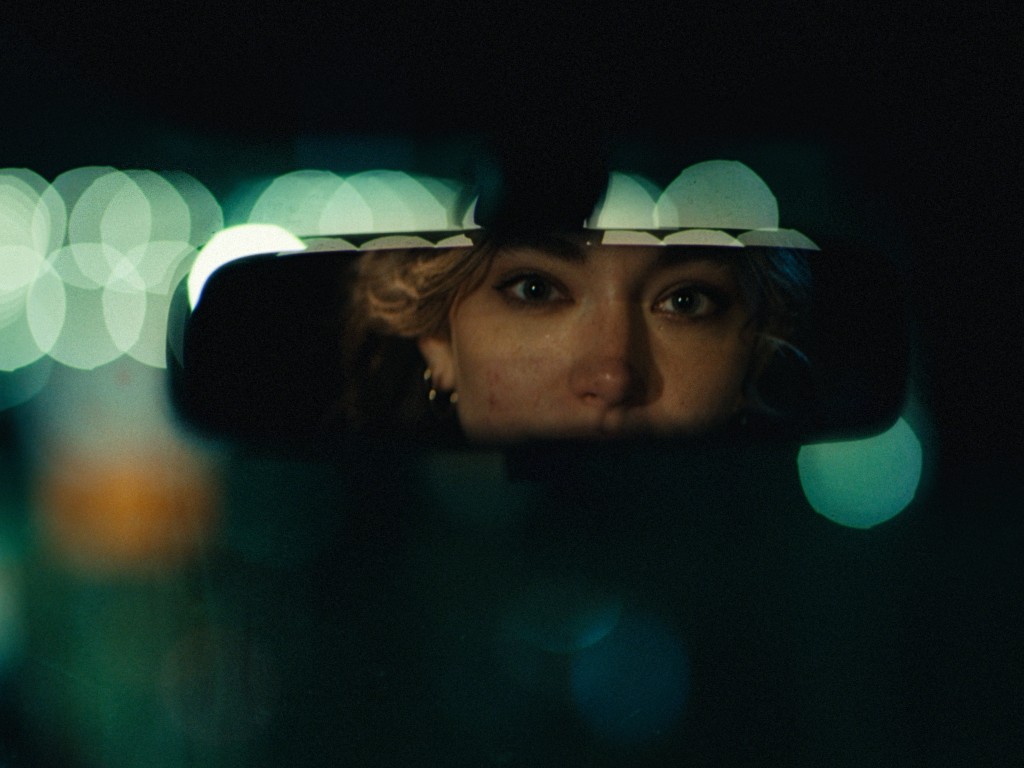
Whisenant continues to communicate through looks and gestures rather than excessive exposition. Maya, Eliza and Ryan are soon joined by Cody (Elijah Fernandez) as the group walks beside a road and across a bridge at night. Cody spots a taser protruding from Maya’s pocket, grabs it and begins teasing her about carrying it. At this stage they’re simply four young people messing around together, and High Voltage allows us to spend enough time in their company for the friendships to feel natural.
They eventually reach a beach in the Far Rockaways, where the group drinks beer and spirits, laughs and becomes progressively more intoxicated. Cody attempts to flirt with Maya while joking about her height, but her attention repeatedly drifts towards Eliza and Ryan as they laugh together near the water. Cody and Ryan eventually begin wrestling on the sand while the girls watch, another little snapshot of the chaotic energy surrounding the evening.
What High Voltage does particularly well is allow Maya’s feelings to become apparent before she acknowledges them herself. She isn’t given a convenient speech explaining her sexuality or exactly how she feels about Eliza. Instead, we watch where her attention goes, notice her discomfort when Ryan becomes physically affectionate towards Eliza and gradually understand the situation alongside her.
Things finally come to the surface when somebody suggests truth or dare. Maya is chosen first and opts for a dare, only for Ryan to tell her to kiss Cody. She refuses, prompting Ryan to joke that she’d probably rather kiss Eliza. Maya’s reaction suggests that his attempt at teasing has landed much closer to the truth than he realises.
Ryan subsequently dares Eliza to kiss Maya, and Eliza accepts. Maya doesn’t pull away either. The two move towards one another and, for a moment, the drunken game creates an opportunity for something genuine to happen between them.
Then a bright light hits their faces. Ryan is filming them on his phone.

The moment changes immediately. What could have been a private discovery between Maya and Eliza has become entertainment for somebody else, and Maya angrily demands that Ryan delete the recording. The resulting argument draws everybody into the conflict, with Maya eventually throwing a particularly personal insult at Eliza by accusing her of kissing anything with a pulse.
It’s an ugly remark, and importantly the film doesn’t pretend otherwise. Later, when Maya and Eliza are alone, Maya specifically apologises for slut-shaming her. That acknowledgement matters because High Voltage is interested in characters who are still figuring themselves out and occasionally hurting one another while doing so, rather than presenting its teenagers as unusually articulate adults who always know exactly what they’re feeling.
Before they have much opportunity to resolve the argument, however, the four are illuminated again, this time by the torch of a park ranger (Robert Ravenscroft). He calls after them and everyone runs, splitting the group in two as Maya and Eliza escape together while Ryan and Cody head in another direction.
High Voltage Lets Its Characters Behave Like Teenagers
The escape provides the short with one of its funniest moments. Maya and Eliza hide among the overgrowth, trying to remain quiet while they wait for the ranger to pass. When they suddenly hear him approaching from behind, Maya instinctively spins around and fires the taser directly into his crotch.
It isn’t Maya’s finest contribution to park ranger relations, but it certainly solves the immediate problem.
The girls flee again and, once they’re far enough away to feel safe, panic gives way to laughter. It is a lovely little transition because the film captures that peculiar teenage ability to turn something potentially serious into a story that becomes hilarious approximately thirty seconds after surviving it.
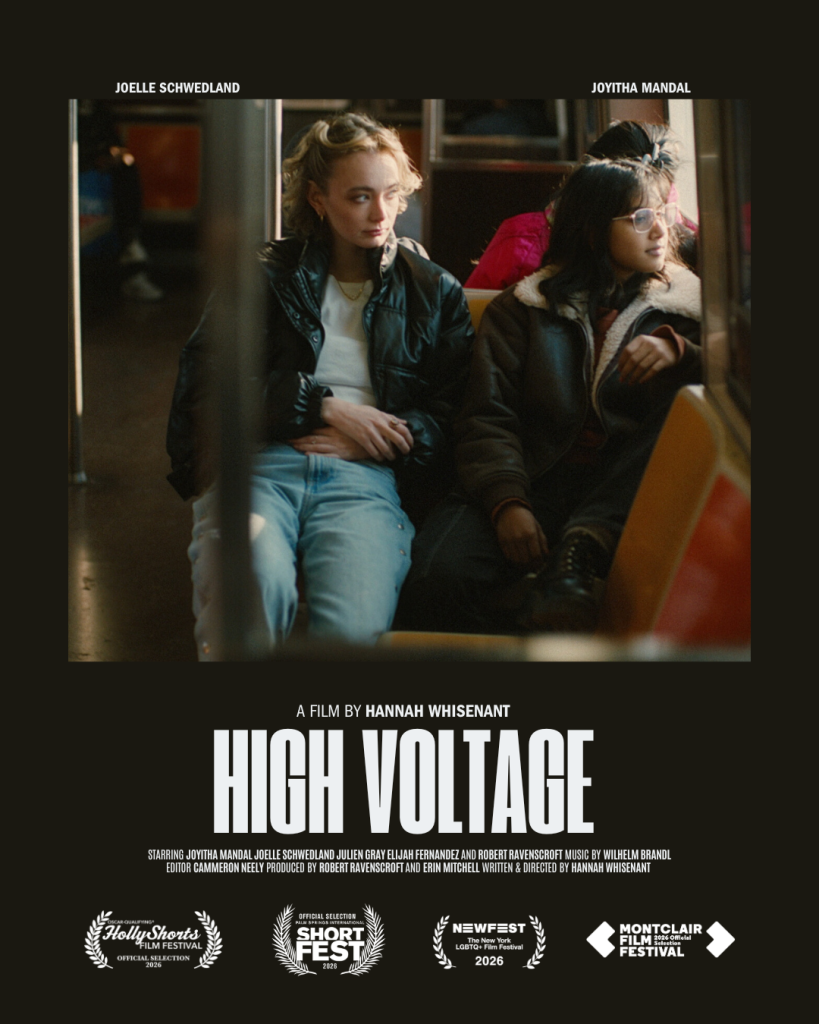
As morning begins to break, the energy changes. Without Ryan and Cody around, Maya and Eliza can finally talk without the expectations, jokes and masculine posturing that surrounded them on the beach. Maya apologises for what she said during the argument, and the film begins moving away from the chaotic group dynamic towards something quieter and considerably more intimate.
They eventually reach a train station, where the conversation becomes the kind of seemingly insignificant small talk that suddenly feels enormously important when two people are beginning to realise they like one another. Maya asks Eliza where she would go if she could travel anywhere in the world. Eliza chooses New Zealand, although not because of The Lord of the Rings, which is probably worth clarifying given that Peter Jackson’s films have spent more than two decades making that one of the country’s most famous cinematic associations.
High Voltage concludes with the pair travelling together on the train, tired after the events of the night and sitting close to one another. Maya places her hand on Eliza’s leg, deliberately echoing the opening image of Ryan’s hand resting on Eliza in the car. This time, however, Maya is no longer watching somebody else occupy that position.
It’s an elegant visual bookend. In ten minutes, Maya has moved from sitting silently behind Eliza and Ryan, watching and trying to understand her feelings, to sitting alongside Eliza with the possibility of something developing between them. Whisenant doesn’t need to tell us exactly what happens next because that isn’t really the point. The important development is that Maya has crossed an emotional distance over the course of one messy night.
The film’s official synopsis describes High Voltage as exploring the space between connection, uncertainty and the pressure of masculinity, and those elements are all visible without overwhelming the characters themselves. This is an LGBTQ+ story, but it is equally recognisable as a coming-of-age story about attraction, jealousy, friendship and that confusing period when relationships begin changing faster than you’re necessarily equipped to understand them.
Joyitha Mandal is particularly effective because Maya spends much of the film communicating through reaction rather than dialogue. A glance towards Eliza, discomfort around Ryan and the embarrassment surrounding the truth-or-dare game do much of the storytelling. Joelle Schwedland complements her well as Eliza, while Julien Gray and Elijah Fernandez give Ryan and Cody the easy confidence required for the group dynamic to work.
The performances across the four central roles feel natural, which is essential for a film operating within such a short running time. The dialogue doesn’t feel as though it exists purely to deliver information to the audience, and the beach scenes have the loose quality of young friends becoming increasingly drunk and increasingly likely to say something they’ll regret.

High Voltage Looks Beautiful
Where High Voltage particularly distinguishes itself is visually. Cinematographer Sophia Feuer has photographed the film with a textured, filmic quality that gives the imagery the appearance of 16mm, while the near-square aspect ratio adds to that impression. Whether we’re inside the car, walking beside the road or sitting on the beach, the visual approach gives the short a distinctive identity.
The nighttime photography is especially impressive. Shooting exterior scenes at night while retaining faces, backgrounds and atmosphere is challenging, yet High Voltage handles the low-light material beautifully. The road and beach sequences are dark without becoming visually muddy, while practical and motivated sources within the environment contribute to the feeling that we’re genuinely spending a night outside with these characters rather than watching actors standing beneath obvious film lights.
The composition is similarly thoughtful. Whisenant and Feuer frequently allow Maya’s position within the frame to tell us something about her relationship with Eliza, particularly when Ryan is nearby. This isn’t a short that needs aggressive camera movement or elaborate visual tricks. Its strongest images are often the simplest, allowing body language and proximity to carry the emotional information.
Feuer is supported by first assistant camera Jack Lewandowski and second assistant camera Marianna Kaihmakliotis, with additional cinematography credited to Pete Quandt. Kevin Deming served as gaffer and Liam Podos as key grip, and the work of the camera and lighting departments is one of the film’s greatest strengths. Jack Tashdjian’s colour work further contributes to the cohesive appearance.
The editing by Cameron Neely and Whisenant keeps the film moving while still allowing the quieter moments between Maya and Eliza room to breathe. That’s important because High Voltage effectively contains two different energies within its brief running time. The first half is noisy, social and increasingly chaotic, while the latter section becomes quieter and more intimate once the group separates.
Wilhelm Brandl’s music is another highlight. There is a delicate quality to parts of the score that reminded us somewhat of Arcade Fire and Owen Pallett’s music for Spike Jonze’s Her. That’s an observation about the feeling it created for us rather than suggesting the compositions are identical, but both use music particularly effectively to accompany tentative human connection and emotional uncertainty.
Sound design and mixing are credited to Curtis Henderson, and the soundtrack works especially well alongside the nighttime visuals. Conversations remain clear while the surrounding environments retain enough presence to prevent the locations from feeling artificially silent.
Robert Ravenscroft and Erin Mitchell produced the film, with Mitchell also serving as associate producer. Whisenant wrote and directed in addition to sharing editing duties, and there is an impressive level of cohesion between the different departments. High Voltage feels carefully designed without losing the spontaneity required for a story about teenagers stumbling through an unpredictable night.

High Voltage Finds Something Universal in a Personal Story
Perhaps the nicest thing about High Voltage is that it doesn’t treat Maya’s emerging feelings as though they need to become a grand dramatic revelation. There is no enormous declaration and no attempt to resolve her identity within ten minutes. There is attraction, embarrassment, jealousy, uncertainty and eventually the possibility of something new.
That makes the story accessible beyond any particular audience. Maya’s experience is specifically an LGBTQ+ one, but the emotions surrounding it are familiar to anybody who remembers being young and discovering that friendship, attraction and jealousy can suddenly become hopelessly tangled together. The short doesn’t require a specialist festival context for those ideas to connect with an audience.
There is also a satisfying progression hidden underneath what initially appears to be little more than a drunken night out. Maya begins isolated in the back of a car, watching Eliza with somebody else. The group gets drunk, boundaries become blurred, an almost-kiss is turned into a joke, feelings are hurt, everybody runs from a park ranger and two of them emerge on the other side with a slightly better understanding of each other.
Most importantly, High Voltage is simply very well made. The cinematography is gorgeous, the low-light photography is particularly accomplished, the performances feel convincing and Whisenant directs the emotional progression with considerable restraint. It looks and sounds like a production created by people who have thought carefully about how every department can contribute to a very small story.
Ten minutes isn’t much time to capture friendship, attraction, jealousy, coming out, teenage recklessness and the excitement of discovering that somebody you like might actually like you back. High Voltage manages it without feeling overloaded, and it leaves Maya and Eliza exactly where they need to be: exhausted on a train after a ridiculous night, sitting close together and wondering what might happen next.
| Acting | |
| Direction | |
| Cinematography | |
| Writing | |
| Sound | |
| Screen Critix Rating |