
There are plenty of films about friendship, but considerably fewer about people who have absolutely no idea how friendship is supposed to work. Hands Up Who’d Like a Hug?, an 84-minute Australian comedy from writer, director and producer Mick Connolly, takes four very different men and ties them together through loneliness, jealousy, alcohol, insecurity and some spectacularly poor social skills. Shot on an iPhone 13 for a reported budget of around AUD $40,000, it is unmistakably an independent production, but it has enough charm, amusing ideas and committed performances to overcome many of its rougher edges.
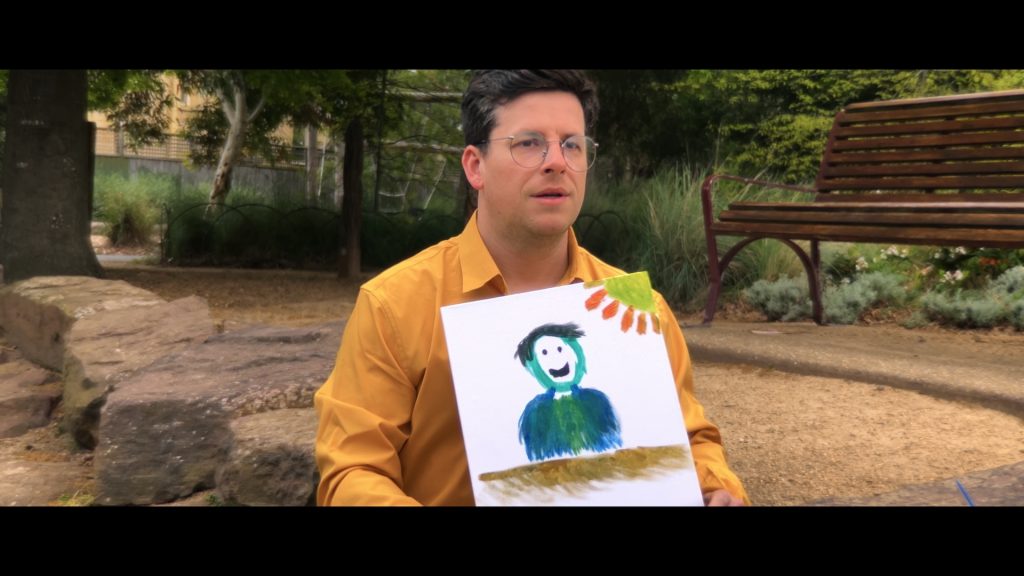
Thomas (Kyle McCallion) establishes himself as an unusual character almost immediately. Standing outside his new home while removalists carry his possessions inside, he helpfully explains that boxes marked “kitchen” should go in the kitchen and those marked “bedroom” should go in the bedroom. The men humour him, but Thomas isn’t deliberately being patronising. As we’ll quickly discover, he simply doesn’t possess the social filter that would tell most people that these instructions probably aren’t necessary.
Flashbacks to his childhood offer some explanation for the man he has become. Thomas grows up with a mother who is hardly a model parent, at one point presenting him with a plate of roses and calling it a salad while spending what little money they have on going out. He later lives with his grandmother, who has dementia, and her interpretation of a salad is an entirely empty plate. It’s a deliberately absurd way of establishing a childhood lacking much in the way of conventional stability, and Thomas responds by setting himself a very specific objective. He will become rich enough to retire while he’s still young.
At 29 years old, he succeeds.
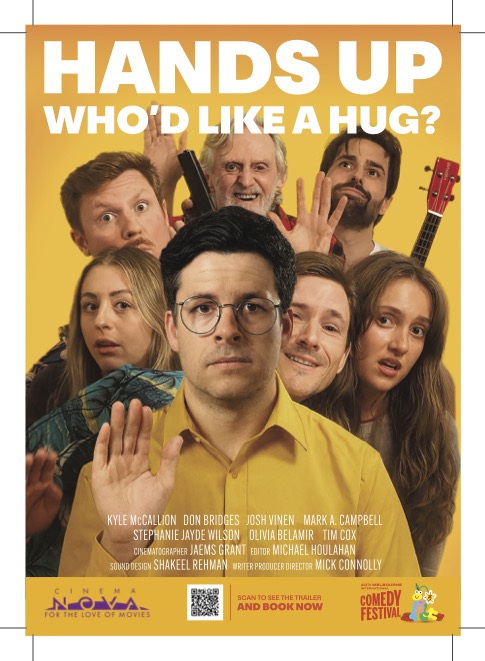
Thomas has accumulated enough money to stop working and suddenly finds himself in the enviable position of never having to worry about employment again. There’s only one problem. He doesn’t have any friends. Having achieved the financial ambition that has driven much of his life, Thomas decides his next project will be something most people don’t regard as a project at all: making a friend.
For Thomas, however, even that requires research. He signs up for an online friendship course taught by a relentlessly upbeat instructor (Nat Taylor), whose advice includes smiling more and appearing approachable. McCallion is very good at playing Thomas completely straight. The humour doesn’t come from Thomas believing himself to be funny, but from the enormous gulf between how he understands social interaction and how everybody else experiences it.
His neighbour Blake (Josh Vinen) seems like an obvious candidate for friendship, but Thomas is quickly informed that the position has already been filled. Blake has Logan (Mark A. Campbell), his best mate and someone he knows so intimately that the pair can apparently close their eyes and perfectly mimic one another’s movements. It’s a ridiculous party trick they use while trying to impress women, but it establishes the closeness of a friendship that is about to spectacularly implode.
Thomas instead encounters Deacon (Don Bridges), a homeless busker who sings to him before presenting his cap and expecting some money. Thomas responds rather rudely and sends Deacon away angry, only to spend the night thinking about what happened. His conscience eventually wins. The following day he tracks Deacon down and arrives with two sleeping bags and ten dollars as payment for the song.
Deacon appreciates the gesture but points out that what he could really use is a shower and a decent meal. Thomas invites him home, where Deacon showers, borrows Thomas’s robe and joins him for pasta and an old black-and-white film. It’s an unexpectedly sweet sequence because for a short while these two lonely men appear to have stumbled into precisely the companionship each of them needs. When it’s time for Deacon to leave, the rain and thunder persuade Thomas to let him stay overnight.
Naturally, it goes horribly wrong.
Thomas wakes to a noise downstairs and discovers a drunken Deacon sprawled on the living room floor. When Deacon manages to stand, he promptly begins urinating in the corner of the room. Thomas throws him out, apparently ending his first significant attempt at friendship almost as quickly as it began. Once again, though, his conscience starts bothering him, and he eventually tracks Deacon down and makes an extraordinary offer. Deacon can come and live with him while getting his life back together.
There is, however, some small print. Thomas intends to make Deacon spend his first few weeks living in the garage while he comes off alcohol.
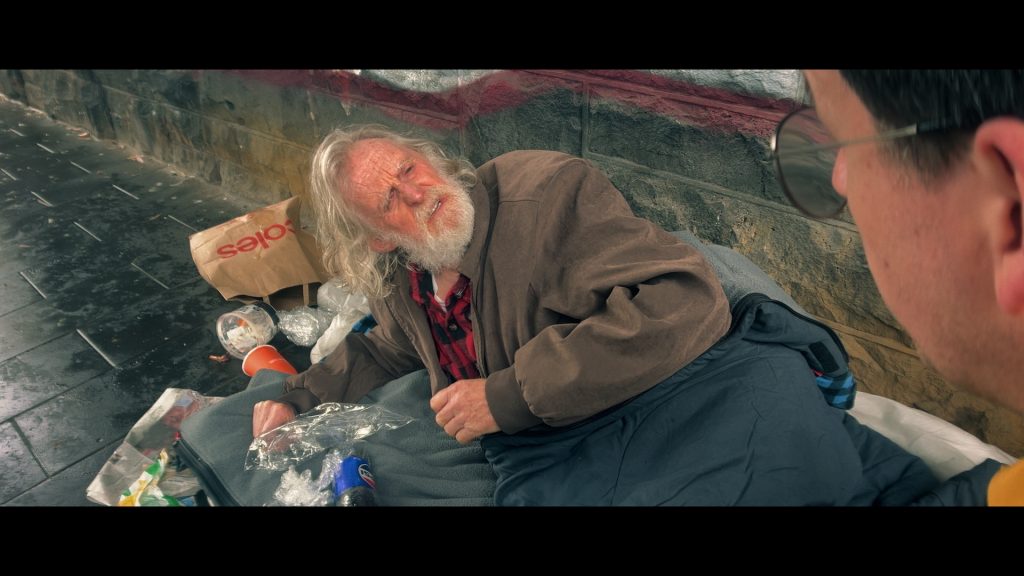
Deacon is understandably less than delighted to discover what Thomas actually meant by offering him somewhere to live, but compared with sleeping rough, a dry garage suddenly doesn’t seem quite so terrible. His rehabilitation subsequently becomes one of the more unexpectedly warm elements of Hands Up Who’d Like a Hug?. Once sober, Deacon cuts his hair, trims his beard, begins cooking meals and starts thinking seriously about what he might do with the opportunity Thomas has given him. Having heard stories about buskers becoming millionaires, he decides he could potentially do the same.
Don Bridges handles the character well because Deacon could easily have become nothing more than the film’s drunken wild card. Instead, there’s genuine sadness and vulnerability beneath the comedy. Thomas may believe he’s rescuing Deacon, but the relationship isn’t entirely one-sided. Deacon is also giving Thomas something he has spent his life without, even if neither man is particularly good at expressing what that means.
Meanwhile, Blake’s seemingly indestructible friendship with Logan falls apart for one of the most wonderfully ridiculous reasons imaginable. Blake discovers that, before his current relationship began, Logan had a marathon sexual encounter with the woman who would eventually become Blake’s girlfriend. Despite it happening before Blake and his girlfriend were together, he simply cannot cope with the information. His solution is to end his friendship with Logan.
Logan isn’t having it.
What follows plays almost like a romantic breakup story with friendship substituted for romance. Logan turns up at Blake’s house holding signs and pleading for another chance, while Blake becomes increasingly desperate to escape him. Eventually Blake calls the police and reports that he’s being stalked, only for the attending female officers to hear what’s happened and prove considerably more sympathetic towards Logan than Blake expected.
It’s very silly, but that’s largely the point. Hands Up Who’d Like a Hug? takes male friendship and applies some of the conventions normally reserved for romantic relationships: jealousy, betrayal, breakups, possessiveness and attempts at reconciliation. Beneath the exaggerated comedy is the recognisable idea that male friendships can be emotionally important while the men involved may be spectacularly bad at discussing those emotions.
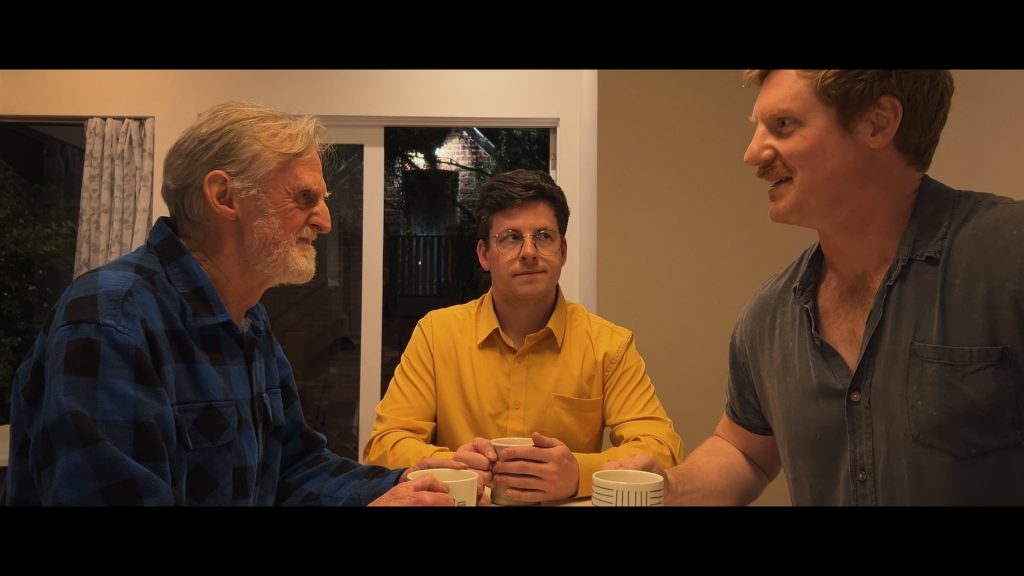
Eventually the two strands collide. Blake decides the best way to upset Logan is to strike up a friendship with Thomas, reasoning that replacing his former best mate will make Logan jealous. Thomas, completely unaware that he’s being used as ammunition in somebody else’s friendship war, is delighted. After spending so long trying to find one friend, people suddenly appear to be competing for the position.
Deacon is considerably less enthusiastic. Having formed a bond with Thomas during his recovery, he becomes jealous and increasingly possessive when other potential friends enter Thomas’s life. The arrangement becomes even more complicated when Deacon finally admits that the story he’s told Thomas about his past isn’t true. He wasn’t a successful businessman who simply encountered hard times. His life has always been troubled, and that history includes prison after killing a former friend.
That revelation gives the film’s second half a slightly darker edge, although Connolly never abandons the comedy at its centre. More importantly, it forces Thomas to confront something more complicated than the rules supplied by his online friendship coach. Making friends isn’t simply a matter of smiling, being approachable and following the correct sequence of social behaviours. Friendship involves trust, forgiveness, boundaries and accepting that other people arrive carrying histories and problems you cannot control.
Hands Up Who’d Like a Hug? Finds Comedy in Male Friendship
The film belongs primarily to its four central performers, and Kyle McCallion, Don Bridges, Josh Vinen and Mark A. Campbell make an entertainingly mismatched group. McCallion wisely avoids turning Thomas into a walking collection of comic mannerisms. His literal interpretation of language and difficulty understanding other people’s intentions provide plenty of humour, but there is an innocence to him too. Thomas genuinely wants human connection. He just approaches finding it with the same methodical mentality he presumably used to achieve financial independence.
Bridges gives Deacon considerably more weight than we initially expect, while Vinen and Campbell embrace the absurdity of Blake and Logan’s collapsing bromance. The performers understand that much of Connolly’s humour requires absolute commitment. Characters frequently behave ridiculously, but the actors generally play their grievances as though they are matters of enormous importance. That seriousness is what allows some of the sillier material to work.
Not every joke lands equally well. The film’s humour is deliberately broad and awkward, and there are moments where a gag is pushed beyond the point at which we’ve already understood it. There are also stretches where the screenplay could have benefited from tightening, particularly when the basic joke of a situation has already been established. Still, the comedy produces enough amusing moments to maintain a likeable atmosphere, and there are occasions where the sheer stupidity of the characters’ behaviour becomes genuinely funny.
Visually, Hands Up Who’d Like a Hug? is an unusual proposition. Cinematographer Jaems Grant shoots at a very wide 2.35:1 aspect ratio, an interesting choice for this kind of dialogue-driven comedy. It gives the film a broader visual canvas than you might expect, although the production’s limited resources remain obvious. Locations can look plain, and there isn’t a great deal of elaborate production or art design dressing the environments. The film never consistently achieves the visual polish of a larger Australian comedy, but considering the reported AUD $40,000 budget and the fact that it was produced using an iPhone 13, the finished feature is certainly commendable.
Shooting on a phone is no longer the novelty it once was, of course, and shouldn’t automatically earn a film additional praise. What matters is whether the resulting images serve the story. Here, the technology appears to have allowed Connolly and his team to actually get the feature made rather than becoming the entire reason for its existence. There are occasions when the inexpensive nature of the production is visible, but there are also plenty where you simply settle into the story and stop thinking about what captured the image.
The limited budget on Hands Up Who’d Like A Hug? is arguably more apparent in the environments than the camerawork. Some locations feel sparse, and a little more production design could have helped distinguish the characters’ worlds and give the film additional visual personality. Thomas in particular is an unusual enough individual that his home could potentially have told us considerably more about him. These aren’t fatal shortcomings, but they are among the areas where additional resources could have elevated the production.
Michael Houlahan’s editing keeps the various relationships moving towards their eventual collision, while sound editor Shakeel Rehman, colourist Edel Rafferty and the wider post-production team help give this extremely modest production a finished feature presentation. Additional music is credited to Alejandro Florez, and Connolly deserves credit for assembling the necessary team around a project made on such limited resources.

At 84 minutes, the film also understands that this sort of comedy doesn’t need to hang around forever. There are individual scenes we’d trim, but the feature as a whole doesn’t massively overstay its welcome. The competing friendship storylines give it enough movement, while Thomas’s relationship with Deacon provides an emotional backbone beneath Blake and Logan’s increasingly ridiculous feud.
What ultimately makes Hands Up Who’d Like a Hug? work as well as it does is its sincerity. Underneath all the sex marathon arguments, friendship tutorials, drunken disasters and absurd misunderstandings is a film that genuinely likes these characters. It doesn’t ridicule Thomas for wanting a friend, nor does it treat Deacon solely as a joke because he’s homeless and struggling with alcohol. Even Blake and Logan’s ludicrous falling out originates from the fact that their friendship actually matters to them.
That warmth prevents the film from becoming mean spirited. Connolly is making fun of these men, certainly, but he’s also interested in why they need one another. Thomas has achieved the financial security he dreamed about as a child and discovers it hasn’t solved the problem of being alone. Deacon needs an opportunity to rebuild his life. Blake’s jealousy blinds him to the value of a friendship he already possesses, while Logan’s increasingly desperate attempts to preserve it demonstrate how important that relationship has become.
It’s not a particularly sophisticated examination of male loneliness or companionship, and Hands Up Who’d Like a Hug? isn’t pretending to be one. This is first and foremost a quirky Australian comedy that wants to entertain. Some jokes work considerably better than others, its micro-budget origins are visible and the presentation lacks the polish that greater resources might have provided. Nevertheless, there’s an appealing film underneath those limitations.
Most importantly, it has personality. We’d rather watch a small independent comedy with its own peculiar sense of humour than something technically immaculate that leaves absolutely no impression. Connolly has taken a simple idea about people desperately trying to make, keep and replace friends and built an entire feature around it, while his cast commit themselves to the ridiculous situations he gives them.
Hands Up Who’d Like a Hug? might look inexpensive, but it doesn’t feel cynical or half-hearted. There is genuine affection behind it, and that goes a long way. With a little more money, tighter control of some of the comedy and greater visual refinement, it’s easy to imagine this material operating on a larger scale. As it stands, though, this is an enjoyable, occasionally hilarious and surprisingly warm independent comedy about four men discovering that finding a good friend can be considerably harder than becoming a millionaire.
| Acting | |
| Direction | |
| Cinematography | |
| Writing | |
| Sound | |
| Screen Critix Rating |