
A group of sisters attempt to break free from a rigid and suffocating world in Hooroo Jackson’s groundbreaking artificial intelligence feature Strings.
Cinema is constantly evolving, but every so often a project arrives that feels less like a film and more like a glimpse into what may come next. Strings is one of those rare examples. Billed as the first fully photoreal artificial intelligence generated live action feature, the film is as much an experiment in technology as it is a piece of storytelling, and it is impossible to watch without considering what it represents for the future of filmmaking.

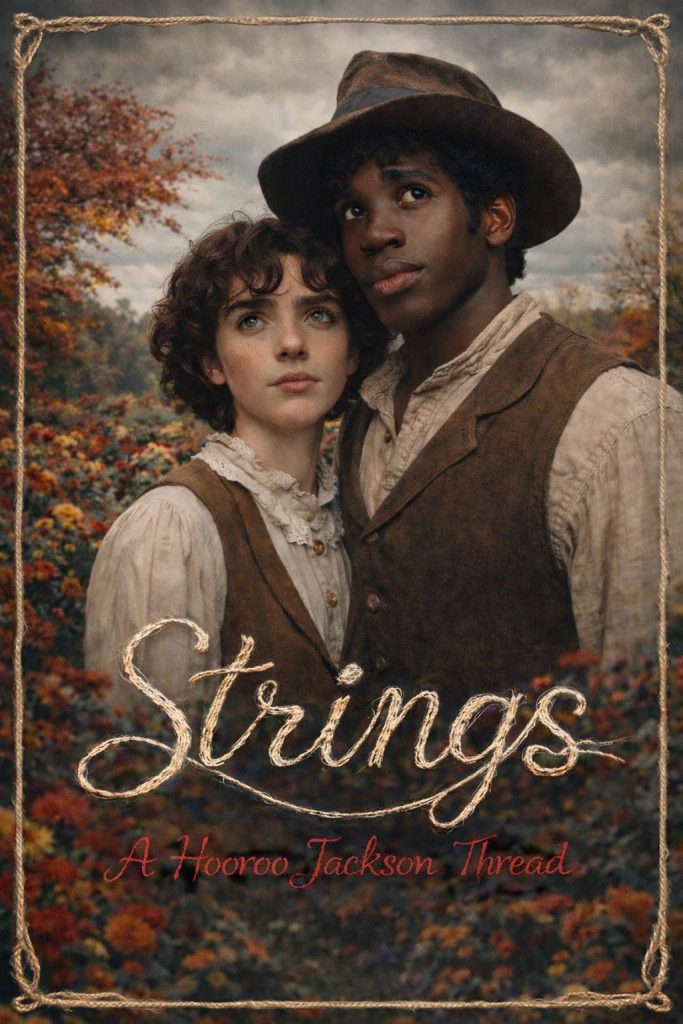
Set in the Antebellum South, the story centres on the Beaufort sisters, who live under the strict expectations of a patriarchal household. At the heart of it all is Nellie Beaufort, a young woman drawn to creativity and performance through her fascination with puppetry. Her artistic curiosity leads her into the orbit of travelling performers, where she meets Daniel Brock, a talented Black puppeteer. Their shared passion for storytelling develops into a quiet and secret relationship, one that stands in contrast to the rigid social rules surrounding them.
Before the narrative properly begins, the film opens with a staged theatrical performance, with figures dressed as a king, a wizard and other characters delivering lines on a bare stage. It is an unusual introduction, but one that signals the film’s interest in performance, artifice and storytelling from the outset. Once the main plot unfolds, the pace is immediate and unrelenting, with scenes moving quickly between conversations and encounters inside the Beaufort home and beyond.
What stands out instantly is the visual achievement. Jackson has managed to create a feature length film populated entirely by photoreal artificial intelligence characters that remain consistent in appearance from beginning to end. It is not flawless, but it is undeniably impressive, especially considering the film was produced on a minimal budget by a single filmmaker. There is a clear sense that this project is about pushing boundaries and solving technical challenges as much as it is about telling a story.
The film also introduces a unique narrative device in the form of a randomised ending. Viewers are presented with either a hopeful or tragic conclusion, selected by an algorithm rather than the filmmaker. It is a bold idea that adds an extra layer of unpredictability, and reinforces the experimental nature of the entire project.
However, while Strings succeeds in demonstrating what artificial intelligence can achieve visually, it also highlights where the technology still falls short. The dialogue is delivered at a relentless pace, often without natural pauses, making it difficult at times to fully absorb what is being said. Combined with rapid editing, where shots move quickly from one line to the next, the film rarely allows moments to breathe. This can make the narrative feel overwhelming and occasionally hard to follow.
Lip synchronisation and emotional delivery also remain areas where the illusion struggles. Although the characters look convincingly human, the performances do not always carry the emotional weight expected from traditional actors. As a result, it can be difficult to form a deep connection with the characters, even as the story explores themes of love, control, race and artistic expression.
That said, there are elements that work particularly well. The sequences involving puppetry are among the most effective in the film, blending the themes of performance and identity in a way that feels natural within the story. These moments offer a glimpse of how artificial intelligence can be used creatively, rather than simply as a replacement for traditional filmmaking techniques.

Strings breaking new ground
There is no denying the ambition behind Strings. This is not a case of a filmmaker relying on automation for convenience, but rather a carefully constructed project that has clearly required significant time and effort. Jackson’s body of work has steadily explored the possibilities of artificial intelligence, and this film represents another step forward in that journey.
Ultimately, Strings is a fascinating and important piece of cinema, even if it is not a perfect one. It raises serious questions about the role of artificial intelligence in storytelling and challenges audiences to consider what they value in film. While it may not fully replace the emotional depth of traditional performances, it proves that the technology is advancing at a remarkable pace.
As an experiment, it is essential viewing. As a film, it is intriguing, ambitious and occasionally frustrating. Either way, it is impossible to ignore.
| Acting | |
| Direction | |
| Cinematography | |
| Writing | |
| Sound | |
| Screen Critix Rating |