
There is something undeniably romantic about the idea of meeting a complete stranger while travelling and discovering, almost immediately, that you simply enjoy being around them. No dating apps, no carefully constructed profiles and no weeks of messages before finally deciding whether to meet. Two people cross paths, circumstances give them nowhere particularly urgent to be, and for a brief period the rest of the world seems to disappear.
Writer and director Carter Ward builds his feature debut, Step Back, Doors Closing, around exactly that idea. Running for approximately 96 minutes and set largely across Washington, D.C., it is a warm, funny and occasionally bittersweet romantic drama that succeeds primarily because Ward finds two leads capable of making a film dominated by conversation genuinely engaging.
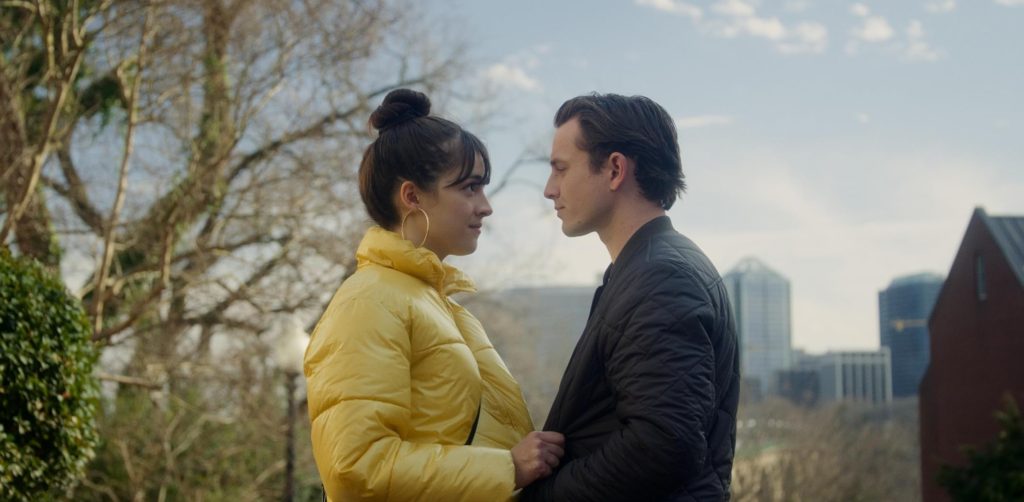
We first meet Julisa (Carmen Berkeley) aboard a flight to Washington, D.C., where she is unfortunate enough to be seated beside the kind of irritating passenger who won’t even move properly when she needs to use the toilet. Her journey doesn’t improve much after she accidentally drops her phone down the toilet, leaving her arriving in an unfamiliar city with limited means of contacting the friend she has travelled to see. Ryan (Reilly Walters), meanwhile, has returned from Boston for a funeral and is supposed to meet a friend, only for that plan to collapse when said friend decides he’d rather spend the evening with his girlfriend.
Their paths cross on the D.C. Metro. Julisa is struggling with her damaged phone, Ryan notices and offers to let her use his so she can contact her friend through Facebook. It’s a simple interaction, but Ward doesn’t rush their connection. More importantly, he gives Julisa a legitimate reason to begin trusting this complete stranger.
When the train travels underground, Julisa begins experiencing a panic attack. Ryan recognises what is happening and calmly talks her through breathing exercises until it passes. Afterwards, they move towards the end of the carriage where they can talk more privately. With neither having anywhere they desperately need to be, Ryan offers to show Julisa around Washington while she waits to hear from her friend.

And so begins their unexpected adventure together.
Anyone with even a passing familiarity with Richard Linklater’s Before Sunrise will immediately recognise the basic framework. Ethan Hawke and Julie Delpy famously played strangers who meet while travelling and spend their limited time together wandering Vienna, talking about their lives and gradually forming an intimate connection. Step Back, Doors Closing operates in very similar territory, but simply sharing that structure doesn’t make Ward’s film a carbon copy. The contemporary setting, the personalities of Ryan and Julisa and the extensive use of Washington, D.C. give the film an identity of its own.
Ryan takes Julisa around the city, including a trip to a vantage point overlooking the White House. A house party follows, although the noise eventually sends them into the kitchen where they can actually hear one another, and conversations begin turning towards former relationships, heartbreak and where they currently find themselves in life. Julisa eventually hears from Sierra (Michelle Macedo), the friend she came to visit, and the pair head to a bar to meet her. Understandably, a drunken Sierra is initially rather suspicious of this strange man her friend has picked up on the Metro.
Later, Ryan and Julisa find themselves eating together in the same restaurant booth reportedly once occupied by John F. Kennedy and Jacqueline Bouvier around the time of their engagement. It’s the kind of detail that could easily feel forced in another film, but here it fits with Ward’s decision to turn Washington into more than just a convenient backdrop.
In fact, Washington, D.C. becomes almost a third major character. This isn’t the Washington of political thrillers, presidential motorcades, government conspiracies and spies running around with briefcases. Instead, Ward presents the city through restaurants, bars, Metro trains, streets, parties and conversations. The film is interested in what Washington might feel like to a young visitor experiencing it alongside somebody who knows the place intimately.
What really makes everything work, though, is Carmen Berkeley and Reilly Walters.
Berkeley is excellent as Julisa. There’s a vulnerability to the character that never becomes helplessness, and she gradually reveals someone uncertain about where her life is going. She has dropped out of graduate school, is inexperienced when it comes to relationships and arrives in Washington already feeling somewhat lost. Berkeley handles those qualities naturally, and the quieter moments are often amongst her strongest.
Walters is equally impressive. Ryan has recently emerged from a four-year relationship and is carrying his own emotional baggage, but he isn’t presented as the brooding romantic lead waiting for a woman to repair him. He’s charming, confident and funny, yet there is enough woundedness beneath the surface to prevent him from becoming too perfect.

Most importantly, Berkeley and Walters have chemistry.
That is absolutely essential for a film like this. If we don’t believe these two people would choose to continue walking, talking, drinking and eating together rather than politely saying goodbye after twenty minutes, the entire movie collapses. Thankfully, we do. Very quickly, you find yourself wanting Ryan and Julisa to stay together because you enjoy their company as much as they enjoy each other’s.
Ward’s screenplay deserves considerable credit for that. Step Back, Doors Closing is enormously dependent upon dialogue, and the conversations generally feel like conversations rather than screenwriters desperately trying to make characters sound profound. They talk about relationships, families, mistakes, ambitions and the uncertainty of entering proper adulthood, slowly learning things about each other at roughly the same rate we do.
There are also moments of humour throughout. Michelle Macedo’s Sierra brings additional energy when she arrives, particularly because her initial suspicion of Ryan is entirely reasonable. From Sierra’s perspective, her friend has arrived in an unfamiliar city and immediately started wandering around with some bloke she met on public transport. We’d probably be asking a few questions too.
Step Back, Doors Closing Finds Romance in the Everyday
Technically, the film is also considerably stronger than many independent romantic dramas that arrive on our desks. Jimmy Ferguson’s cinematography makes excellent use of Washington without turning the film into a tourism advertisement. There are some lovely shots throughout, but the camera remains focused primarily on the characters and their evolving relationship. Ferguson also served as colourist, while Gordon Antell handled editing.
The audio is another major positive. That might sound like faint praise until you’ve watched enough independent films to realise just how frequently poor location sound can destroy otherwise good performances. Here, conversations remain clear and professionally presented, which is particularly important for a film where dialogue carries so much of the story.
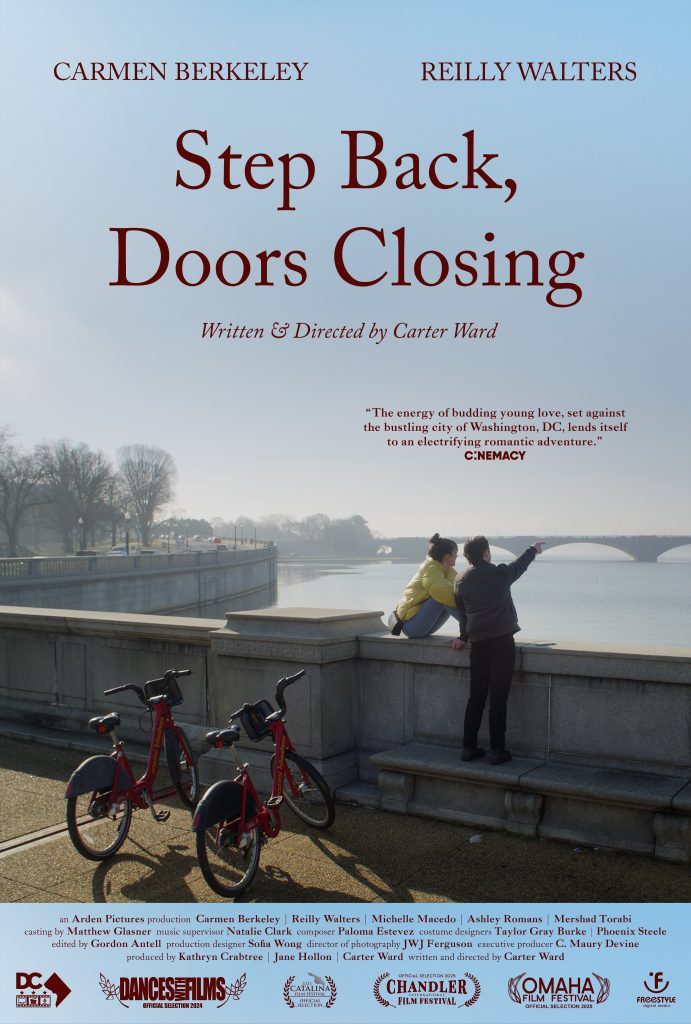
Paloma Estevez’s original music complements the film nicely without trying to dictate every emotional response. Music is used effectively throughout, contributing to the warmth of the story and giving some of the quieter sequences additional emotional weight. Alongside Ferguson’s cinematography, it helps give Ward’s low-budget feature a polished identity without overwhelming the intimate nature of the story.
The film isn’t completely without problems. At 96 minutes, there are points where conversations linger slightly longer than necessary, and the deliberately low-stakes nature of the story means some viewers may find themselves waiting for a major dramatic event that never arrives. The film doesn’t have the same sense of an impending deadline that makes Before Sunrise so urgent, meaning its middle section occasionally feels more relaxed than dramatically compelling.
We didn’t find that particularly damaging, though. Step Back, Doors Closing isn’t trying to manufacture enormous obstacles simply to keep Ryan and Julisa apart. Its pleasures are smaller and more recognisable. It’s about meeting someone unexpectedly, discovering you can talk to them effortlessly and wondering whether this strange little pocket of time might become something more.
There’s also something increasingly nostalgic about the concept despite the film featuring young contemporary characters. In an era where people can research someone online before they’ve even finished their first drink together, there’s an appealing simplicity to watching two strangers discover one another primarily by talking.
That requires patience from the audience, but Ward trusts his characters enough to give them that space. He also resists the temptation to constantly interrupt their conversations with artificial drama. The film lives or dies on whether we want to remain in Ryan and Julisa’s company, and for the overwhelming majority of its running time, we do.
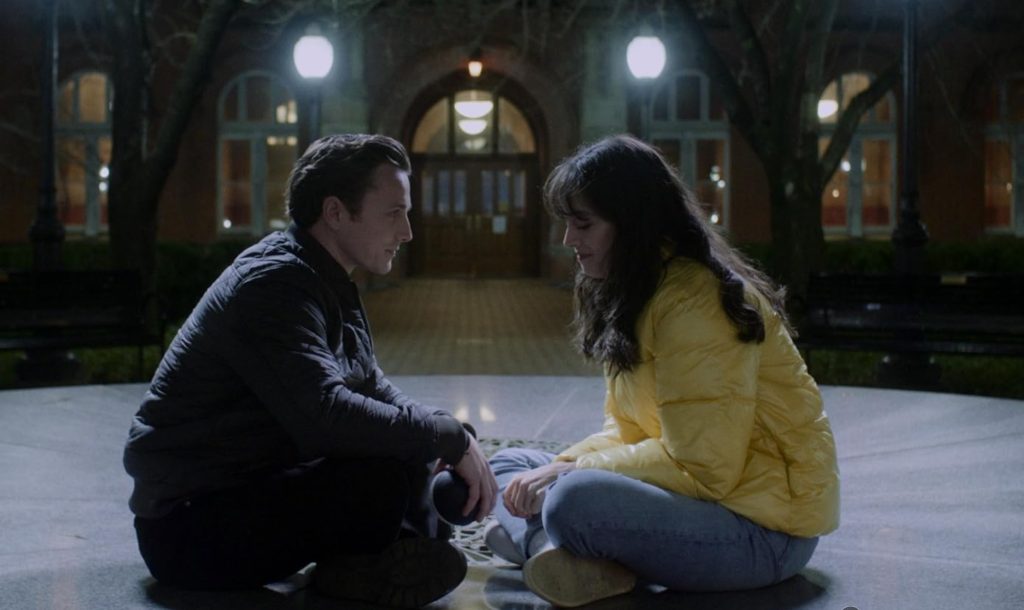
It also helps that the film doesn’t abandon reality in pursuit of an easy romantic fantasy. There is always an awareness that Ryan and Julisa have lives beyond this unexpected meeting. Whatever happens between them, this brief period together cannot exist in isolation forever. The story ultimately understands that sometimes a meaningful connection doesn’t have to follow the conventional movie path to have been worthwhile.
For a feature debut, Step Back, Doors Closing is an impressive piece of work. Carter Ward demonstrates considerable confidence with actors and dialogue, while Berkeley and Walters give the film the chemistry it absolutely requires. Ferguson’s cinematography, Estevez’s music and the strong technical presentation elevate it further, resulting in an independent production that feels carefully considered rather than simply thrown together.
Yes, the shadow of Before Sunrise hangs heavily over it, and Ward’s film doesn’t quite reach the extraordinary heights of Linklater’s classic. That’s hardly much of a criticism. Very few romantic films do. More importantly, Step Back, Doors Closing understands what makes this particular kind of story work. The locations can be beautiful and the dialogue can be clever, but if you don’t believe in the two people at the centre of it, none of that matters.
What Step Back, Doors Closing does achieve is something deceptively difficult. It makes us enjoy spending time with two strangers. It makes us care about what they reveal to each other, hope that their connection is genuine and wonder where their lives might take them after this brief encounter ends.
Warm, romantic and extremely likeable, Step Back, Doors Closing is a beautifully acted independent drama about those rare moments when an ordinary journey unexpectedly changes direction. Sometimes you don’t need a huge plot twist, a villain or an enormous dramatic revelation. Sometimes you just need two good actors, strong dialogue and the possibility that getting on the right train at precisely the right moment might introduce you to somebody you’ll never forget.
| Acting | |
| Direction | |
| Cinematography | |
| Writing | |
| Sound | |
| Screen Critix Rating |