
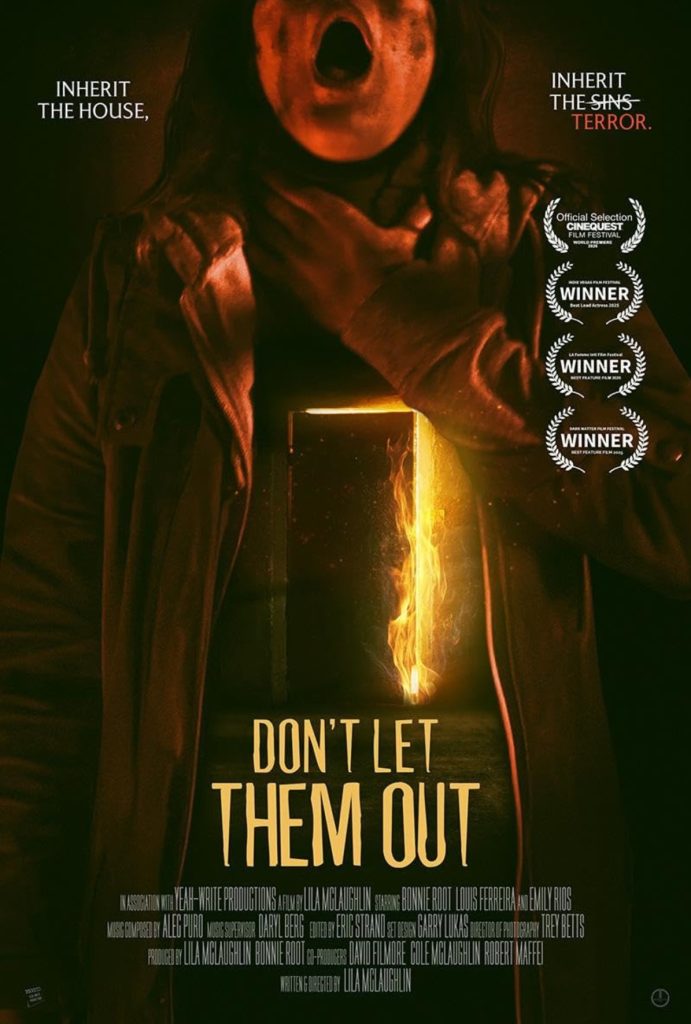
There is something immediately appealing about a horror film that places one person in an isolated location and gradually suggests that they may not be alone. It is a familiar foundation, but one that can still be remarkably effective when atmosphere, performance and sound are working together. Don’t Let Them Out, the feature directorial debut of writer-director Lila McLaughlin, understands those fundamentals surprisingly well, delivering a polished independent chiller that makes intelligent use of its limited resources.
Rachel (Bonnie Root) is grieving, broke and desperate for a fresh start. Following the death of her mother, she travels into the Californian desert to inspect an old property that has been left to her, having previously belonged to her grandfather. The inheritance could hardly have arrived at a more important time. Rachel has spent what money she had on her mother’s funeral, has outstanding debts and hopes that selling the property will provide a way out of her financial problems.
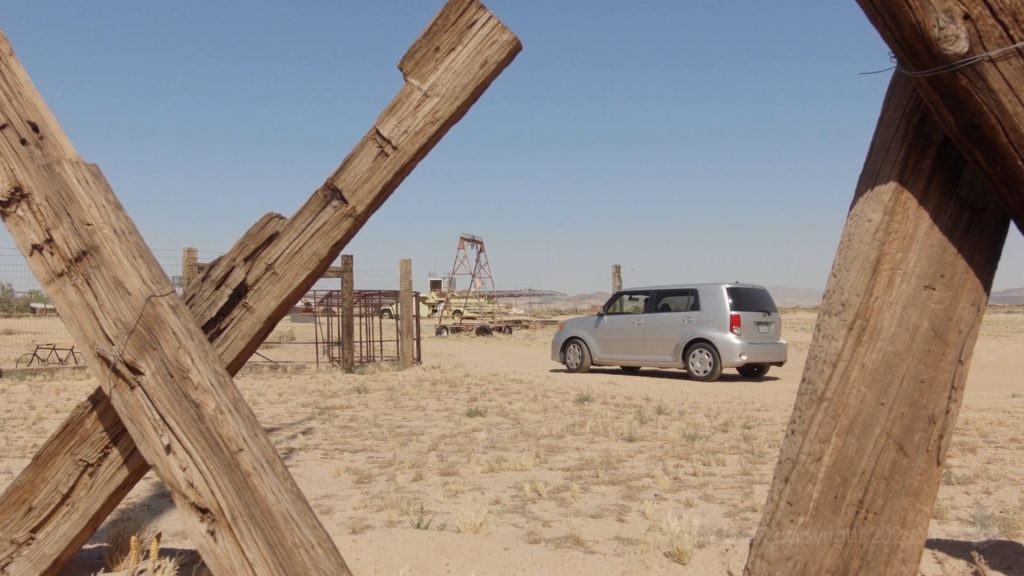
What she discovers isn’t exactly prime real estate. The old building is dusty and cluttered with remnants of the past, including books, a piano, old furniture and various objects scattered around the property. Outside are further curiosities, including an old car, a water pump and a large animal cage. It is while investigating the latter that Rachel discovers a sign revealing that her grandfather, Gene, once operated a circus.
The cage provides McLaughlin with an early opportunity to suggest that something isn’t right. Rachel steps inside and the door begins to close behind her, forcing her to struggle to prevent herself from becoming trapped. Nothing particularly elaborate happens, but it establishes the sort of restrained uneasiness upon which Don’t Let Them Out frequently relies.
McLaughlin doesn’t have an enormous budget with which to construct her horror, so much of the film depends upon suggestion. Strange sounds come from places Rachel can’t see. Doors appear to move when they shouldn’t. Animal noises emerge from the darkness. The property itself becomes a collection of spaces in which something might be waiting just outside the frame.
The sound design is particularly important in making that work. During Rachel’s first night, a kitchen door appears to be pushed from the opposite side while an animalistic growl can be heard behind it. Rachel cautiously approaches, listens against the wood, secures the door and arms herself with a cleaver. It isn’t a sequence dependent upon an expensive creature effect or elaborate set piece. The possibility of something being there is enough.
That approach runs throughout the film. There are jump scares, but many are constructed from loud bangs, unseen movement and noises from somewhere around the property rather than something suddenly being thrown directly at the camera. It means Don’t Let Them Out is more successful as an atmospheric ghost story than as something genuinely frightening. We were rarely scared by it, but we remained interested in discovering exactly what Rachel had inherited.
Don’t Let Them Out Makes the Most of Its Desert Setting
The arrival of Jimmy (Louis Ferreira) gives Rachel a connection to the outside world. He deals in property and has actually been here before, having travelled to the same house approximately ten years earlier to conduct an appraisal. Rachel’s grandfather never arrived for the appointment, so that appraisal was never completed. Now Rachel wants Jimmy to help her arrange a quick sale, only to learn that the poor condition of the property means she isn’t likely to receive the financial windfall she needs.
Then Rachel discovers something that gives her a very good reason not to leave immediately.
Her grandfather’s diary points towards money hidden around the property. A map suggests that as much as $250,000 could be waiting to be found, turning Rachel’s stay into a scavenger hunt. She follows one marked location near an old stagecoach and uncovers a bag containing money. Other messages begin appearing too, including the unsettling instruction, “don’t act surprised, look behind you”, while strange voices appear to repeat the written words.
This treasure-hunt element is a clever solution to a common horror-film problem. When a character is experiencing disturbing events in an isolated house, the obvious question is why they don’t simply leave. Rachel has compelling financial motivation to stay. She needs the money, and once she has proof that at least some of it genuinely exists, walking away becomes considerably more difficult.
It also allows McLaughlin to gradually expose the history of the property rather than simply having somebody explain everything to Rachel. Each discovery leads her further into her family’s past, while her own uncertainty increases as the strange occurrences become harder to dismiss.
One excavation produces something far less appealing than cash when Rachel uncovers numerous animal bones. Combined with the old circus paraphernalia, cage and increasingly disturbing noises, these discoveries allow the film’s different threads to begin connecting without giving everything away immediately.
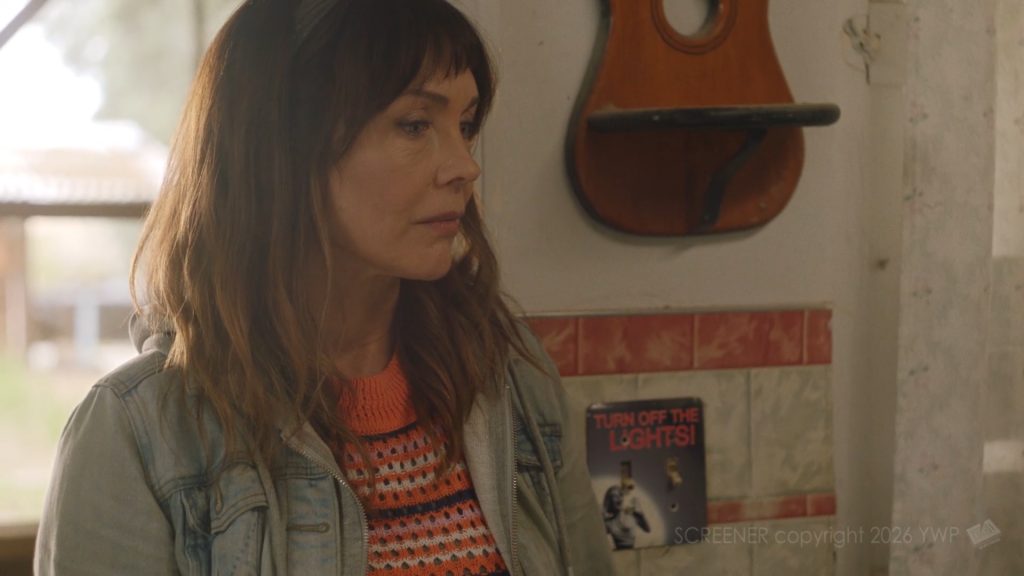
Bonnie Root carries an enormous amount of the film as Rachel and handles the responsibility very well. With her character alone for significant stretches, Root doesn’t have another performer constantly available to generate energy through dialogue. Instead, much of the film depends upon Rachel reacting to things she hears, sees or thinks she has seen, while becoming increasingly unsure whether she can trust her own perception.
Root sells that uncertainty. Rachel isn’t simply wandering around waiting for the next scare. She’s grieving, financially desperate and increasingly questioning what is happening around her. Root gives those different pressures enough weight that we remain invested in Rachel even during the quieter stretches.
One consequence of having a protagonist alone for so long is that Rachel frequently talks to herself. Sometimes that feels natural enough, but the screenplay occasionally uses it to verbalise information we’ve already seen or read. We don’t always need Rachel to tell us what she has just discovered when the film has already communicated it visually. Trusting the images a little more would have made some of those sequences stronger.
Visually, however, Don’t Let Them Out consistently impresses. Trey Betts’ cinematography is one of the production’s strongest assets. The daytime desert naturally provides striking surroundings, but the nighttime photography is arguably more impressive. Exterior sequences maintain suitably low light levels without sacrificing the ability to understand what is happening, and there are numerous carefully composed shots alongside some effective camera movement.
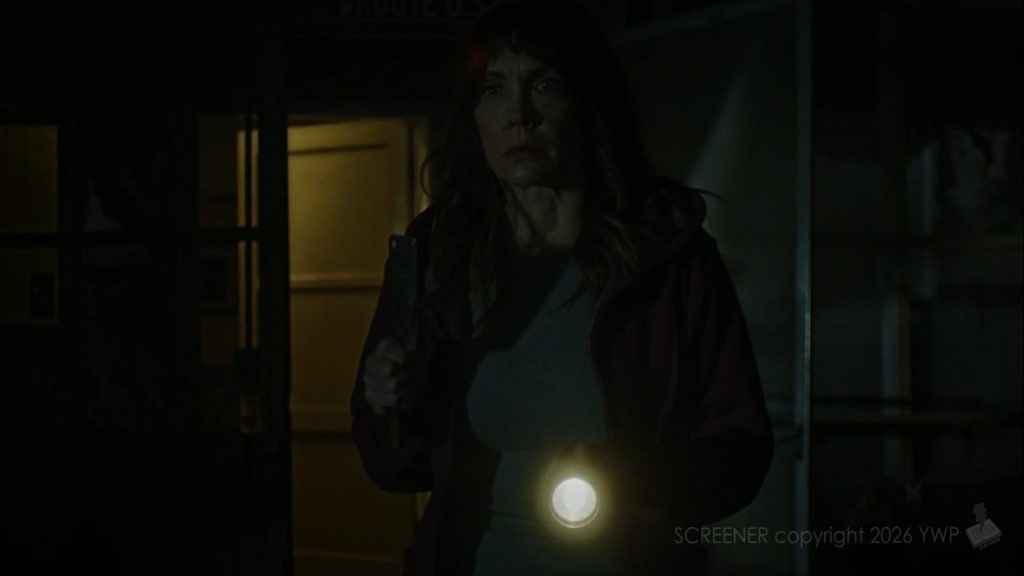
That polish matters enormously on an independent production. This clearly isn’t a film operating with blockbuster resources, yet it rarely looks cheap. McLaughlin and Betts understand what they have available and photograph it effectively rather than attempting to imitate something beyond the production’s means.
The same applies to the audio. Joseph Fiorillo is credited as boom operator and sound mixer, Aaron Morgan as dialogue editor, while Robert Reider handled foley, re-recording mixing and supervising sound editing. Their work becomes a significant component of the horror because so much of Rachel’s fear originates outside the frame. Footsteps, bangs, animal sounds and other disturbances create an environment that feels occupied even when Rachel appears to be completely alone.
Alec Puro’s score complements that atmosphere, helping McLaughlin create unease without requiring something frightening to be visible in every scene. The combination of music, environmental sound and controlled nighttime photography is often more effective than the actual jump scares.
Editor Eric Strand also deserves credit for helping the film maintain a professional finish. Strand comes to the production with credits including Donnie Darko and Deep Blue Sea, and his experience is another indication of the calibre of crew McLaughlin assembled around her feature debut.
The film does have some pacing issues. Its structure repeatedly moves between Rachel discovering something about the property and another unsettling incident occurring later, and eventually the pattern becomes noticeable. At around 88 minutes it never becomes excessively long, but there are stretches where tightening the repetition could have increased the tension.
What keeps it moving is the central mystery. The hidden money gives Rachel something concrete to pursue while the circus history, animal remains, strange messages and disturbing noises gradually suggest that whatever happened here extends considerably further into her family’s past than she initially realised. McLaughlin doesn’t need to rush towards overt horror because there is enough curiosity surrounding the property to keep us following Rachel.
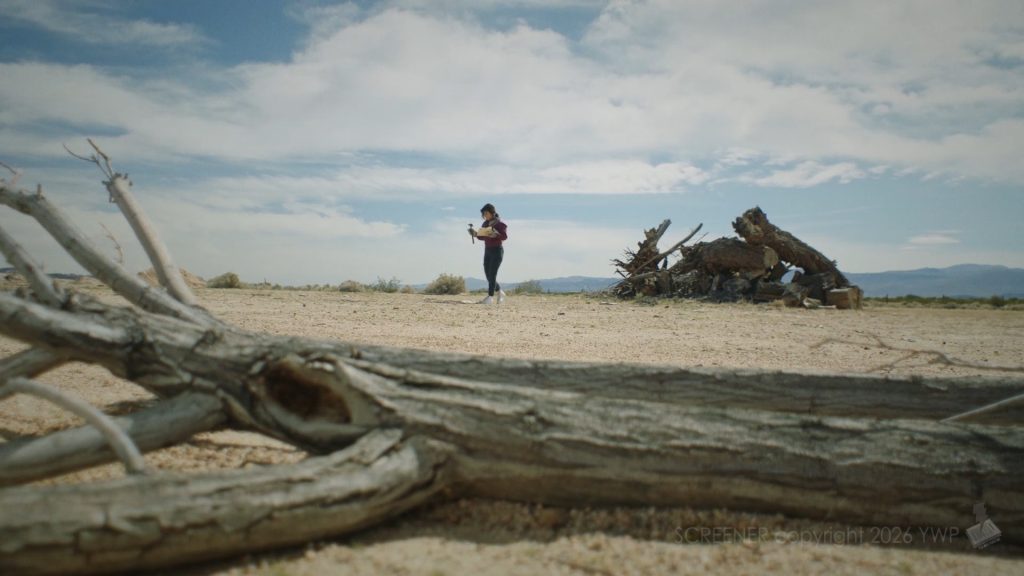
There is an interesting contrast between the scale of the landscape and how trapped Rachel increasingly feels within it. The property sits surrounded by an enormous desert, yet isolation means that all that open space offers little comfort. McLaughlin makes good use of the location, which was filmed at a desert compound near Barstow, California.
The supporting cast includes Emily Rios as Shay and Louis Ferreira as Jimmy, while Robert Donavan provides the voice of Grandpa Gene. Ferreira is particularly useful whenever Jimmy appears because his visits break Rachel’s isolation and give Root somebody with whom she can directly interact, while the wider cast helps the story expand beyond a straightforward woman-alone-in-a-haunted-house scenario.
For McLaughlin, Don’t Let Them Out is an impressive feature debut. She wrote the screenplay as well as directing and produced alongside Root, and there is an obvious understanding of how to stretch independent resources. Rather than trying to overwhelm the audience with effects, she uses the location, cinematography and particularly sound to build the film’s supernatural atmosphere.
It isn’t an especially frightening horror film, and viewers searching for relentless scares or gruesome set pieces may find its restrained approach too quiet. Some of the self-narration could disappear, the structure becomes repetitive in places and several of the scares amount to variations on something making a sudden noise in or around the property.
Yet those shortcomings don’t prevent Don’t Let Them Out from working as a decent little chiller. It looks considerably more polished than many films operating at this level, sounds excellent and has a strong central performance from Bonnie Root. Most importantly, McLaughlin understands that when you can’t afford to show the audience everything, making them wonder what they can’t see can be just as useful.
Don’t Let Them Out may not leave you afraid to turn off the lights, but its mysterious desert property, buried family history and carefully constructed atmosphere make the journey worthwhile. As a low-budget independent horror feature, it demonstrates what can be achieved through strong photography, thoughtful sound design and a committed lead performance rather than sheer financial resources. There are rough edges and familiar ingredients, but McLaughlin has assembled them into a polished and engaging ghost story that kept us interested in what might be waiting behind the next door.
| Acting | |
| Direction | |
| Cinematography | |
| Writing | |
| Sound | |
| Screen Critix Rating |