
There is something rather admirable about independent filmmakers who refuse to let financial limitations dictate the scale of their ambitions. While many low-budget productions sensibly confine themselves to a handful of characters and locations, others attempt the sort of spectacle usually associated with considerably larger budgets. Producer Sonny Mahal and director Adam Werth have demonstrated this approach on several occasions, and their latest collaboration, Cursed Waters, sees them venturing onto the high seas for an ambitious mixture of pirate adventure, historical drama and supernatural horror.
Having reviewed several productions associated with Mahal and Werth over the years, we have become familiar with their willingness to tackle projects that might appear impractical given the resources available. Their films are rarely without technical shortcomings, but there is a determination to provide audiences with something substantial rather than simply producing another inexpensive feature built around lengthy conversations in confined spaces. Cursed Waters continues that tradition, offering naval battles, sword fights, a sizeable ensemble and a considerable amount of bloodshed.
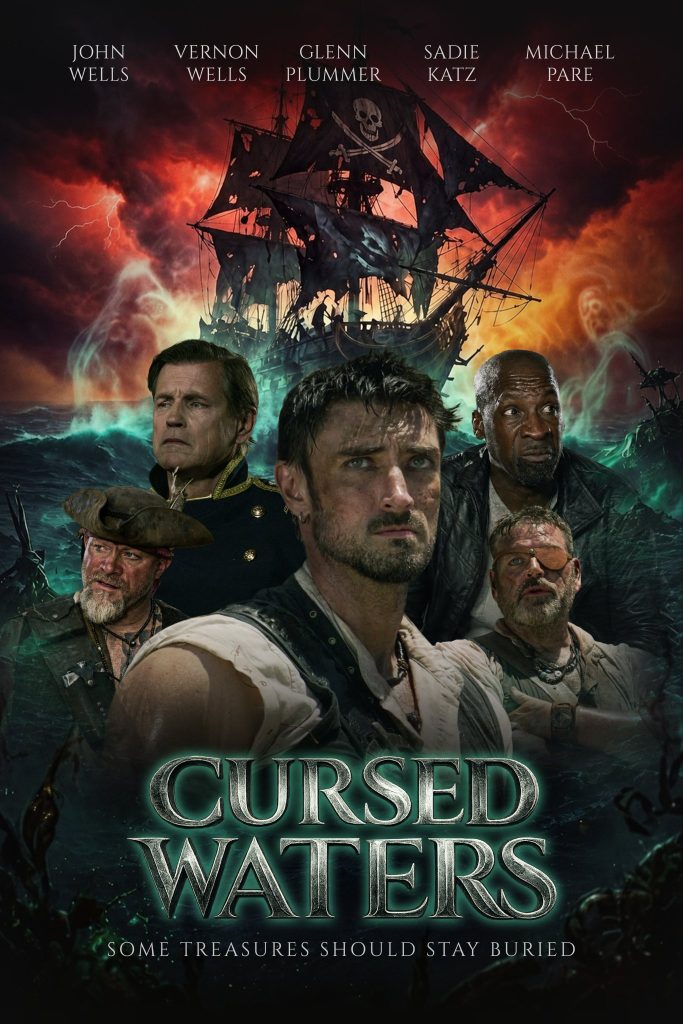
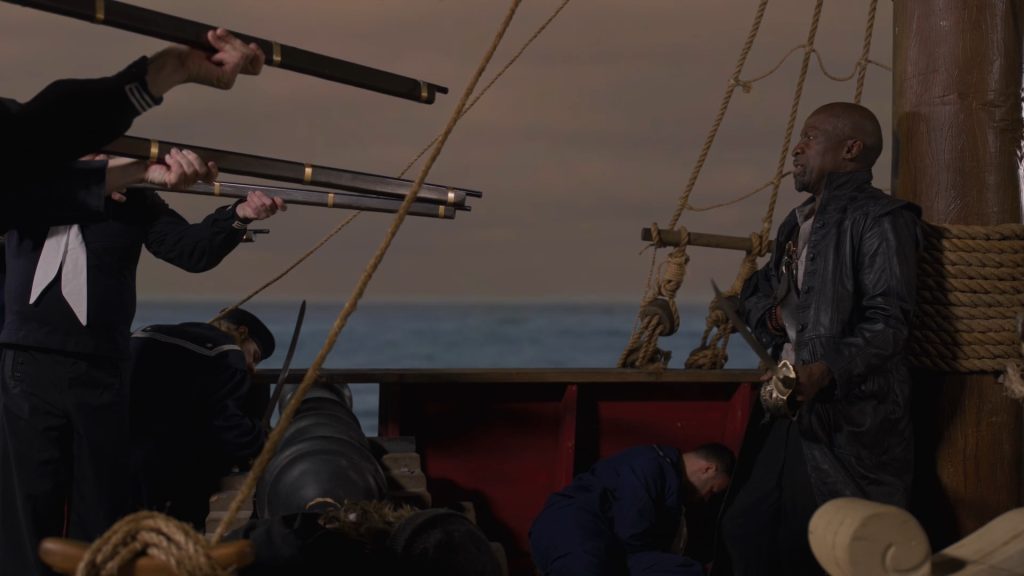
The film opens with a confrontation between an American naval vessel and a pirate ship known as the Chainbreaker. Originally belonging to the United States Navy, the vessel was stolen years earlier and repurposed to transport escaped slaves towards freedom. Its captain, Bure (Glenn Plummer), is himself a former slave, and his crew are determined to protect both their ship and the principles it represents.
When the Navy attempts to reclaim the vessel, cannon fire erupts across the water, resulting in an increasingly destructive confrontation. The opening sequence establishes the production’s intentions immediately, with explosions, casualties and enough activity to suggest a considerably larger undertaking than the film’s independent origins might imply.
The violence is also surprisingly graphic. One unfortunate pirate suffers a particularly spectacular injury when a cannonball removes her head, a moment that is simultaneously gruesome and unintentionally amusing. It is an early indication that Cursed Waters has little interest in presenting a restrained historical adventure, preferring instead to embrace the more excessive possibilities of its premise.
Following the naval confrontation, the story introduces Tiberius Shaw (John Wells), who finds himself standing trial for his involvement in the events surrounding the Chainbreaker. His defence maintains that he was not responsible for the crimes attributed to him, with the proceedings providing a framework through which the circumstances of the voyage are gradually revealed.
Among those presiding over the accusations is a prosecutor played by Vernon Wells, an actor whose appearances remain a welcome addition to independent genre cinema. Best remembered by many audiences for his memorable villainous performances in Mad Max 2 and Commando, Wells brings a recognisable screen presence to the proceedings. His role here is relatively limited, but he makes an impression whenever he appears, demonstrating that experience and confidence can elevate even a comparatively small part.
The cast also includes Costas Mandylor, familiar to horror audiences through the Saw franchise, and Robert LaSardo, whose extensive screen career has encompassed everything from mainstream productions to independent genre features. Michael Paré also appears as naval officer Captain Arnold, adding another established name to an already substantial ensemble.
As is often the case with productions of this nature, the presence of experienced performers alongside less established actors produces mixed results. Some of the supporting cast acquit themselves reasonably well, while others struggle with dialogue delivery and the physical demands of the material. The contrast can be noticeable, particularly when a confident veteran performer shares a scene with someone who appears less comfortable in front of the camera.
Nevertheless, there is an undeniable appeal to seeing so many recognisable faces gathered for a production operating outside the mainstream studio system. Their appearances help provide the film with a sense of scale, even when individual characters receive relatively limited development.
The narrative becomes considerably more unusual when the surviving pirates and naval personnel find themselves stranded on a remote island. Their initial conflict soon becomes secondary to the dangers awaiting them onshore, where an apparently welcoming community conceals a sinister secret.
The island’s inhabitants, including the mysterious Credonia (Sadie Katz), introduce a supernatural dimension that gradually shifts the film away from conventional pirate adventure. Strange rituals, deadly encounters and seductive sirens complicate the survivors’ attempts to escape, while the hostility between the pirates and the Navy becomes increasingly difficult to maintain in the face of a shared threat.

It is an interesting combination of genres, although not always a particularly cohesive one. Cursed Waters begins as a historical action film before introducing elements of mystery, fantasy and outright horror. The transition is occasionally awkward, with the screenplay struggling to balance the seriousness of its historical themes against the more extravagant developments of the island storyline.
The Chainbreaker’s connection to the liberation of enslaved people provides the film with a potentially compelling dramatic foundation. Captain Bure’s determination to protect those seeking freedom gives the pirates a moral purpose beyond the usual pursuit of wealth and adventure, while the Navy’s relentless efforts to recapture them establish a clear conflict.
Unfortunately, these ideas are not always explored with the depth they deserve. As the narrative becomes increasingly occupied with supernatural threats and violent confrontations, some of the more interesting historical and moral questions are pushed into the background. The result is a film with several promising ideas competing for attention rather than a single consistently developed dramatic direction.
Where Cursed Waters frequently succeeds, however, is in its willingness to deliver the sort of action audiences might reasonably expect from a pirate adventure. The production includes numerous sword fights, physical confrontations and moments of exaggerated violence, with practical-looking gore effects providing some of its most entertaining sequences.
Severed heads, torn flesh and particularly unpleasant injuries appear throughout the film, and the effects are often more convincing than the surrounding production might suggest. There is a pleasingly old-fashioned enthusiasm to the bloodshed, with Werth and his collaborators apparently determined to make the most of every opportunity for a spectacular death.
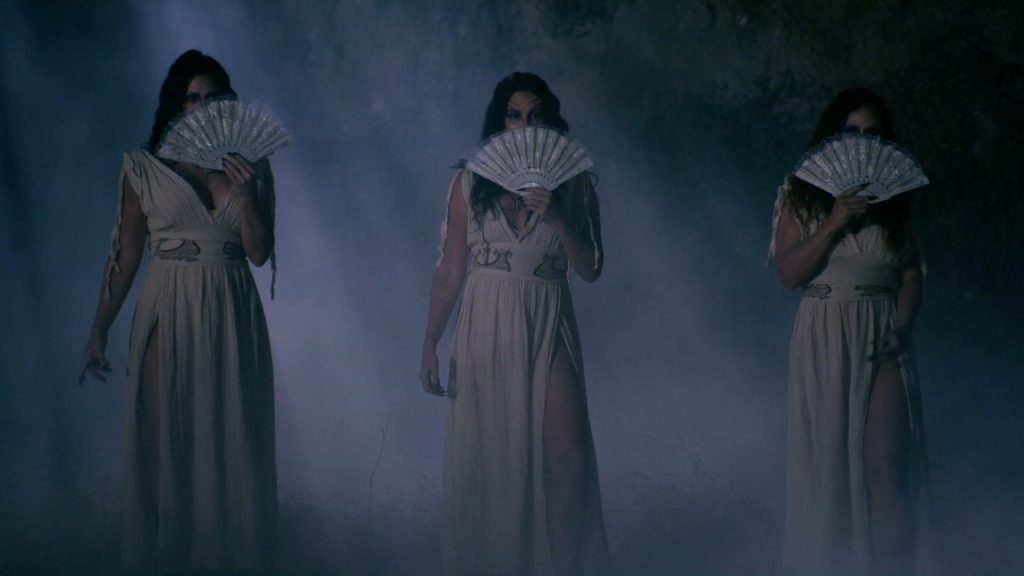
The sirens are another welcome addition, introducing creatures capable of luring unsuspecting sailors towards their doom through their appearance and haunting songs. Their presence provides some of the film’s more distinctive supernatural imagery, although the screenplay could have made considerably greater use of them.
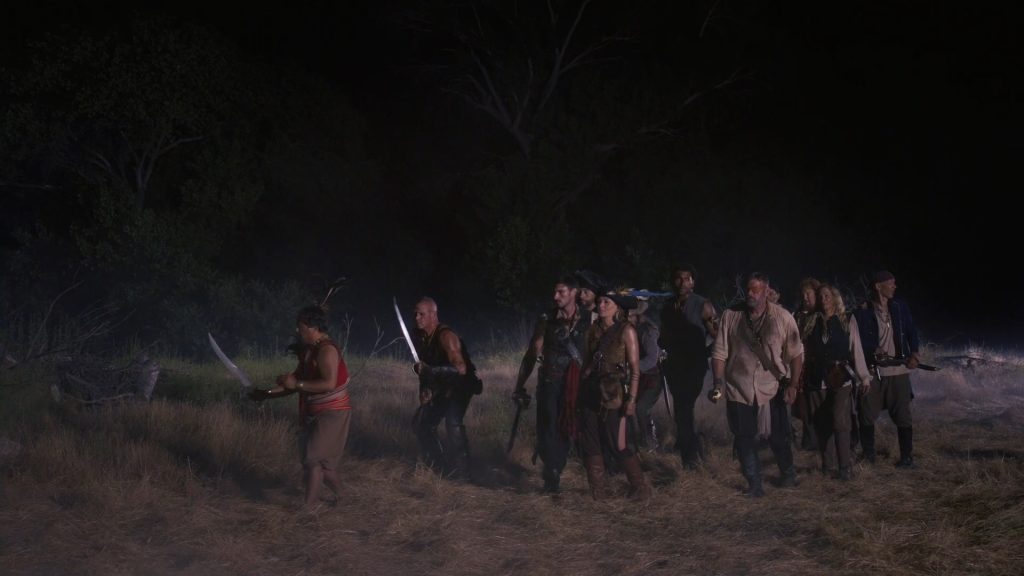
Despite these enjoyable elements, Cursed Waters continues to exhibit a visual weakness that has affected some of Werth’s previous productions. The cinematography relies heavily upon close-ups and medium close-ups, often at the expense of wider compositions that would better establish the geography of a scene.
This becomes particularly problematic during action sequences, where the audience needs to understand the positioning and movement of the performers. Effective blocking is essential when staging confrontations involving multiple characters, yet the film frequently appears more concerned with capturing individual reactions than presenting the action as a coherent whole.
There is also a tendency for performers to enter and leave the frame without sufficient visual preparation. During the opening naval confrontation, for example, American sailors suddenly appear aboard the pirate vessel and engage in sword fights, despite the audience never being shown how they managed to board the ship. The moment is unintentionally amusing, giving the impression that the attackers have simply materialised whenever the screenplay requires another confrontation.
Greater use of establishing shots, carefully considered blocking and camera movement designed around the performers would considerably improve the film’s presentation. These are not necessarily expensive changes, but they require planning and a stronger understanding of how visual storytelling can create the impression of scale.
Michael Su’s cinematography is more effective when the action moves away from the ships and onto the island, where the natural surroundings provide greater visual variety. The exterior locations help create a more convincing environment, while the contrast between the attractive scenery and the increasingly unpleasant events unfolding within it gives the supernatural material an additional dimension.

The maritime sequences are less successful. Creating the illusion of vessels battling on the open ocean is a considerable undertaking for any independent production, and the limitations of the visual effects and compositing are occasionally apparent. Nevertheless, the decision to attempt these sequences deserves recognition, particularly when the alternative would have been to avoid such ambitious material altogether.
Audiences approaching Cursed Waters expecting something comparable to Pirates of the Caribbean should adjust their expectations accordingly. This is neither a lavish fantasy blockbuster nor a straightforward swashbuckling adventure, but a comparatively modest production that places greater emphasis on conflict, character allegiances and supernatural danger.
Its pleasures are often found in the smaller details rather than the overall spectacle. A familiar actor delivering an entertaining performance, an unexpectedly gruesome death or an absurdly staged confrontation can provide enough enjoyment to compensate temporarily for the film’s more obvious shortcomings.
There is also a certain charm to the production’s refusal to acknowledge its limitations. Mahal and Werth clearly want to make films that feel larger than their budgets, and although the results are not always convincing, their enthusiasm is evident. That determination is preferable to a lack of ambition, even if it occasionally leads to sequences that expose the very restrictions the filmmakers are attempting to overcome.
Cursed Waters is far from a polished production. Its performances vary considerably, the screenplay struggles to integrate its competing genres, and the visual presentation would benefit from more confident staging and a greater variety of compositions. The supernatural storyline also takes time to establish itself, leaving the film occasionally uncertain about whether it wants to be a historical drama, a pirate adventure or a horror feature.
Yet despite these weaknesses, there is enough entertainment to make the experience worthwhile. The cast includes several welcome familiar faces, the gore effects provide some memorable moments, and the combination of pirates, naval warfare and sinister island inhabitants gives the film a personality of its own.
Of the Mahal productions we have encountered, Cursed Waters is among the more enjoyable. It may never fully achieve the epic scale its creators are striving for, but it demonstrates a willingness to take risks and attempt something considerably more ambitious than its resources might comfortably accommodate.
Ultimately, Cursed Waters is an uneven but entertaining independent adventure that succeeds more through enthusiasm and occasional moments of inspired excess than through technical refinement. Werth and Mahal still have areas of their filmmaking that would benefit from greater attention, particularly in the staging and presentation of action, but their determination to create ambitious genre entertainment remains commendable. For viewers willing to overlook the rough edges, there is enough blood, swordplay and supernatural mischief here to make the voyage an enjoyable one.
| Acting | |
| Direction | |
| Cinematography | |
| Writing | |
| Sound | |
| Screen Critix Rating |