
Mental health, grief and psychological trauma have become increasingly common subjects within independent cinema, but Cure.net approaches them from a refreshingly original angle. Rather than following a conventional story about depression or recovery, writer and director Veekrant Raj imagines a world where emotional pain can supposedly be cured by a mysterious online service. The result is an engaging psychological thriller that combines uncomfortable moral dilemmas with a genuinely intriguing central premise.
Running for eighteen minutes, the short wastes little time establishing the desperate emotional state of its protagonist, Ethan (Daniel Rundle). We first meet him sitting alone at a glass coffee table littered with alcohol bottles, white powder and tablets. It’s immediately clear that his life has spiralled out of control. After swallowing more pills, he places a plastic bag over his head in an attempt to end his life, only to tear it away moments later before collapsing in frustration and vomiting. It’s a difficult opening to watch, but one that quickly communicates just how broken Ethan has become.

Searching for help, he discovers a website called Cure.net. The site asks him a series of psychological questions, beginning with the deceptively simple, “On a scale of one to ten, how deeply does your sadness rest beneath your skin?” Ethan answers honestly. Ten.
As the questions continue, he reveals the source of his pain. His marriage has collapsed after his wife left him for another man, leaving him consumed by betrayal, self-loathing and an overwhelming fear of being alone. Just as he submits his final response, the website appears to malfunction, suggesting that something far more sinister may be happening behind the scenes.
The following day Ethan reluctantly attends a house party, despite clearly being in no emotional state to socialise. There he briefly catches the attention of a confident young woman who attempts to strike up a conversation, but Ethan quietly slips away before she returns with a drink. It’s a small moment, yet it effectively demonstrates how deeply withdrawn he has become.

His journey home marks the point where Cure.net transforms from emotional drama into psychological thriller.
Dragged into a vehicle by masked strangers, Ethan awakens tied to a chair inside a warehouse with a hood covering his head. Over a tannoy system, an unseen voice calmly informs him that he has been selected by Cure.net and that the organisation intends to cure his suffering. The only requirement is that he follows every instruction they give him.
What follows becomes an increasingly disturbing series of psychological tests designed to force Ethan to confront his pain in the most extreme way imaginable. The first involves a hooded prisoner who is revealed to be the man who has been sleeping with Ethan’s wife. Shown explicit footage of the affair moments before being released, Ethan is encouraged to take violent revenge. Later, the tests escalate even further as his wife herself becomes the focus of Cure.net’s twisted treatment programme.
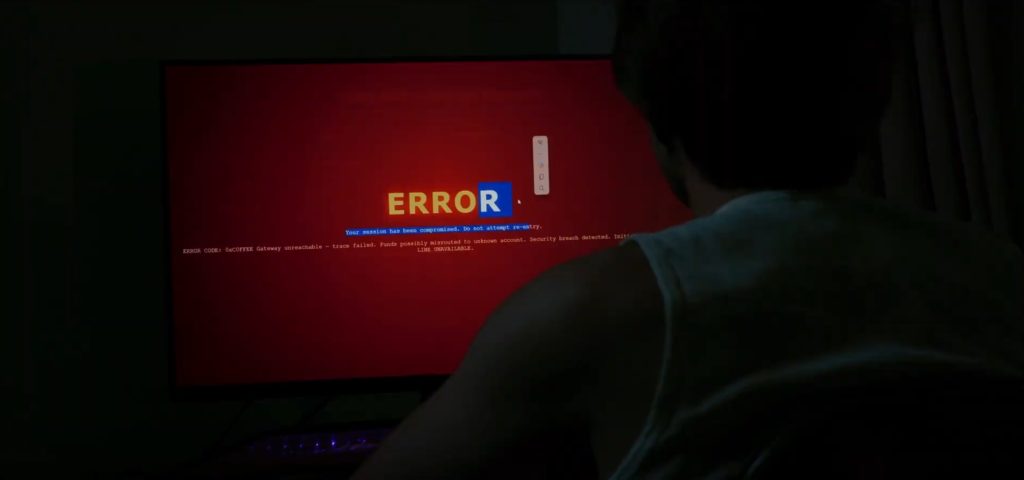
Without venturing too far into spoiler territory, the film steadily asks whether healing can ever come through violence or whether revenge simply deepens emotional wounds. It’s a thought-provoking idea that elevates the story beyond simple kidnapping or torture-thriller territory.
Daniel Rundle delivers a convincing central performance, carrying much of the film through Ethan’s emotional breakdown. Even when very little dialogue is required, he successfully communicates exhaustion, grief and simmering anger, making it easy to understand why someone in his position might be tempted by an impossible promise of emotional relief.
Technically, the production is equally assured. The cinematography creates an appropriately bleak atmosphere throughout, while the warehouse sequences make effective use of lighting and confined spaces to increase the sense of helplessness. The editing maintains a brisk pace, ensuring the eighteen-minute runtime never feels stretched despite the story’s dialogue-heavy middle section.
Perhaps the film’s greatest strength is its concept. The notion of an anonymous online company offering to cure depression through increasingly immoral psychological exercises is genuinely fascinating. It feels like an idea that could comfortably support a feature-length film or even a limited television series, as each new participant could face entirely different trials tailored to their own emotional trauma.
There is, however, one question the screenplay never fully answers.
The organisation itself remains almost entirely mysterious. While secrecy undoubtedly adds to the unease, it’s difficult not to wonder what motivates the people behind Cure.net. Kidnapping vulnerable individuals, staging elaborate psychological scenarios and presumably disposing of evidence would require enormous resources, yet the film offers little indication of what its operators gain in return. Had the organisation possessed a clearer business model or motivation, similar to the wealthy clients funding the elaborate experiences in David Fincher’s The Game, the central premise might have felt even more believable.

That said, the unanswered questions never derail the film. If anything, they leave viewers continuing to think about the concept long after the credits roll, which is often the sign of an interesting piece of science fiction or psychological horror.
Having previously reviewed Tender Lies and Heresy, it’s encouraging to see Veekrant Raj continue exploring original ideas rather than repeating himself. Each project tackles a different concept, yet they all share a willingness to take creative risks and avoid familiar storytelling conventions. Cure.net arguably presents his most commercially appealing premise yet, combining emotional drama with high-concept psychological suspense in a way that feels both accessible and distinctive.
While the film leaves a few logical questions unanswered, its originality, confident filmmaking and compelling central performance make Cure.net another impressive addition to Raj’s growing body of work. Thought-provoking, unsettling and built around a concept that lingers in the mind, it’s a short psychological thriller that demonstrates once again that some of the most interesting ideas in genre filmmaking continue to emerge from independent cinema.
| Acting | |
| Direction | |
| Cinematography | |
| Writing | |
| Sound | |
| Screen Critix Rating |