
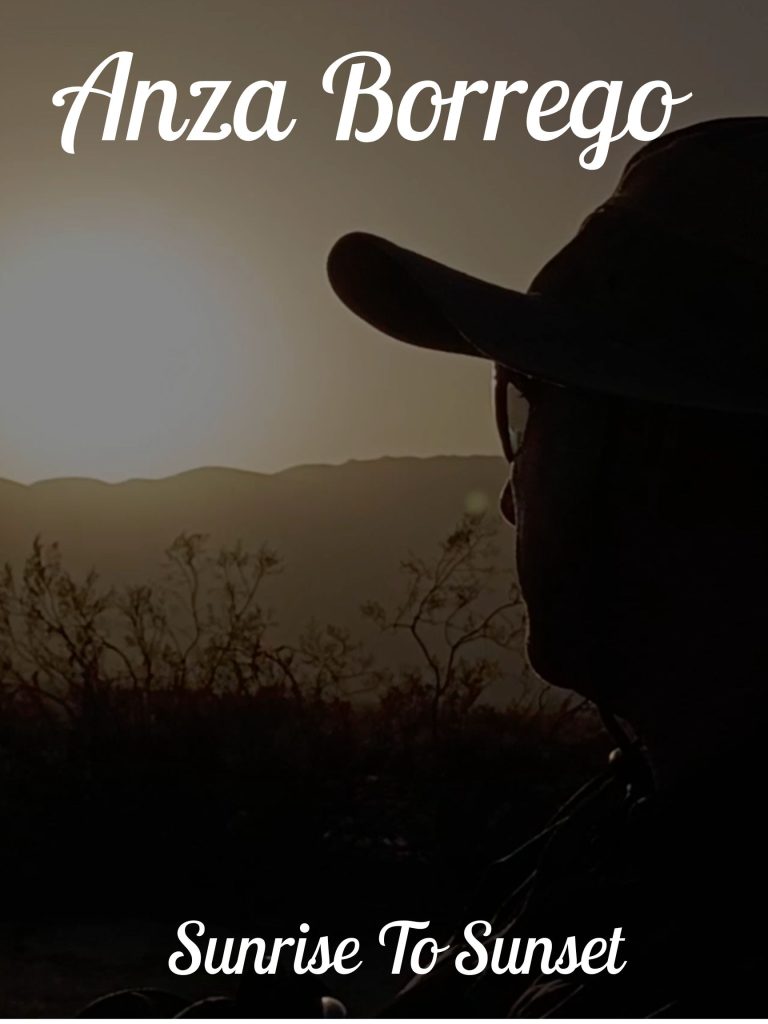
There is something quietly amusing about attempting to turn sitting down into an extreme sport. No speed is involved, there are no competitors racing towards a finish line and, for much of the time, very little actually happens. Yet that is precisely the unusual proposition at the centre of Anza Borrego: Sunrise to Sunset, Peter Wick’s documentary about world traveller Robert Silk and his determination to spend hours doing something most of us would barely consider an activity at all.
Running for approximately an hour, the documentary follows Wick and Silk as they prepare for a sunrise-to-sunset sit in California’s Anza-Borrego Desert. It is a deliberately uncomplicated premise, and the film never tries to manufacture drama that isn’t there. Instead, it combines travel documentary, video essay, observational filmmaking and an enjoyably eccentric friendship into something considerably more engaging than the words “two men sit in the desert” might suggest.
Wick introduces himself beside the California coast, explaining his own affection for the water before turning his attention to Silk, a man who prefers the desert. The pair had previously made Silk Finds What He’s Looking For, which documented Silk undertaking a sunrise-to-sunset sit in Joshua Tree National Park. According to the information accompanying this new film, that earlier endurance sit lasted 14 hours and 27 minutes and subsequently screened as part of the FlickFair Festival as well as receiving recognition on the festival circuit.
The title Silk Finds What He’s Looking For immediately invites thoughts of U2’s I Still Haven’t Found What I’m Looking For and The Joshua Tree, although the material provided for this review does not confirm that the title was deliberately conceived as a reference. It is the sort of connection that viewers familiar with the album may nevertheless make for themselves.
What began in Joshua Tree has apparently developed into something of a personal pursuit for Silk. He jokingly refers to “extreme sitting” as a sport and has undertaken lengthy sits in a variety of locations. The background information supplied with the documentary lists Qatar, Palo Duro Canyon in Texas, Antarctica, Wyoming, Nebraska and western Colorado among them, with Silk’s personal record said to be 14 hours and 39 minutes in Bangs Canyon, Colorado.
The documentary’s best decision is not to treat any of this too seriously. Silk clearly appreciates the absurdity inherent in describing prolonged sitting as a sport, while Wick approaches his friend with curiosity rather than attempting to convince us that we are witnessing some previously undiscovered athletic discipline.
Early in the film, Wick speaks to Matt Francis, who has previously accompanied Silk on one of his sitting expeditions. Francis describes the experience positively and agrees that he would do it again, although Silk’s proposed destination for their next outing sounds considerably less appealing. He wants to attempt a swamp sit, complete with the inevitable mosquitoes.
There are apparently rules to all of this, although Anza Borrego: Sunrise to Sunset leaves some questions unanswered. Can an extreme sitter stand up for a stretch without invalidating the attempt? What happens when nature calls? At what point does an ordinary sit become an extreme one? The lack of rigid explanation actually suits the slightly tongue-in-cheek nature of the endeavour, although a little more detail about Silk’s self-created rules might have added another amusing dimension to the documentary.
Anza Borrego: Sunrise to Sunset Finds Beauty in Doing Very Little
Silk’s employment as a writer and editor for Travel Weekly has enabled him to travel extensively, and this provides Wick with an opportunity to expand the documentary beyond its Californian desert setting. Silk discusses having recently returned from India and talks about visiting Antarctica, accompanied by some particularly attractive footage of that extraordinary environment.
Aerial images reveal huge formations of rock and ice, while groups of penguins populate the landscape below. Silk is subsequently seen sitting beside the water with the vessel on which he arrived visible in the distance and penguins wandering nearby. He distinguishes this from his more demanding efforts by describing it as a recreational rather than sporting sit, and whatever terminology you choose to use, it looks wonderfully peaceful.
These sequences also help establish what is genuinely appealing about Silk’s unusual hobby. Modern travel is frequently built around movement. There is always another attraction to reach, another photograph to take or another destination to tick off the list. Silk’s approach is almost the opposite. He goes somewhere and then deliberately stops.
There is something meditative about that philosophy, even if you have absolutely no desire to replicate it yourself. By remaining in one location for an extended period, Silk allows the environment to change around him rather than constantly moving through it. Light changes, temperatures rise and fall, wildlife appears and disappears, and the landscape gradually reveals details that might easily be missed by somebody rushing through.
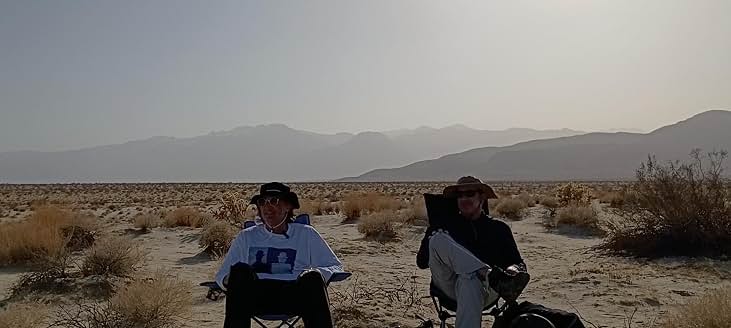
That philosophy becomes particularly important once Wick and Silk reach Anza-Borrego. Before undertaking the sit, the pair scout for a suitable location and explore the surrounding area, eventually retiring to a motel before returning ahead of sunrise the following morning. They set up their chairs, unpack their provisions and even have a football nearby before settling down for the considerably less energetic activity ahead.
Wick isn’t merely observing this time. He is going to join Silk.
Given the desert environment, the heat and the length of time involved, there is a legitimate physical component to what initially sounds ridiculous. The film doesn’t inflate that into artificial peril, which is important, but sitting exposed in a desert environment for many hours is clearly different from spending an afternoon on the sofa.
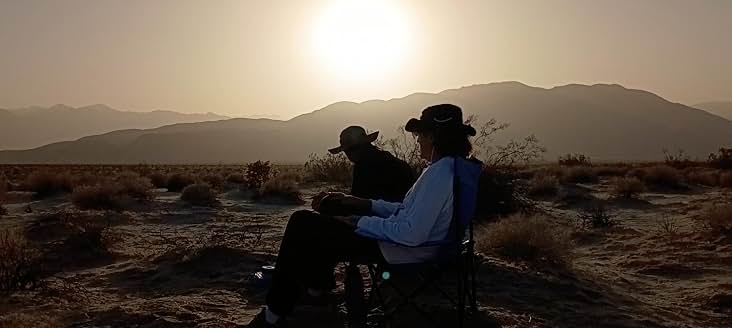
Once the sit begins, Anza Borrego: Sunrise to Sunset becomes increasingly committed to its own concept. Cameras positioned on tripods observe the pair from different angles as they stare towards the distant hills, sit quietly and occasionally talk. The sun climbs higher and beats down upon their hats while the desert stretches around them.
There is no late revelation waiting to transform the documentary into something else. There isn’t a hidden mystery concerning Robert Silk’s past, nor does Wick suddenly uncover a shocking explanation for why his friend likes sitting in deserts. This is exactly the documentary it claims to be, and whether that sounds appealing will probably determine how much enjoyment an individual viewer gets from it.
Large stretches are intentionally uneventful. Music accompanies images of the men simply sitting in place, and the documentary asks its audience to accept some of the same stillness that Silk finds attractive. For viewers accustomed to documentaries structured around constant revelations, dramatic confrontations or rapidly changing information, that pace could prove challenging.
Yet speeding everything up would arguably defeat the entire point.
Wick and Silk’s conversations provide much of the personality during these passages, particularly when they discuss previous sits and Silk’s various achievements. Their friendship gives the film an easygoing quality and prevents the exercise from becoming overly self-important. They are aware that what they are doing is unusual, and the documentary is comfortable allowing the humour of the situation to emerge naturally.
The editing is occasionally less successful. There are moments when Marceline De Angelis’ edit cuts away from conversations rather abruptly, including an instance where Wick’s narration effectively tells us that he will spare us from hearing the remainder of an exchange. It is funny in principle, but some transitions can feel more sudden than the otherwise relaxed nature of the film would suggest.
Visually, however, there is plenty to enjoy. Wick’s cinematography is supplemented by De Angelis, who is also credited as sound mixer, and the film benefits enormously from the range of landscapes accumulated through Silk’s travels. The contrast between California’s coastline, the desert and the immense frozen environment of Antarctica helps prevent a documentary about remaining stationary from feeling visually stationary itself.
The desert sequences inevitably have a more restrained visual vocabulary once the main event begins. With cameras largely fixed in position, the filmmakers cannot disguise the fundamental reality of what they are documenting. Two men are sitting in chairs for a very long time. The landscape, changing daylight and conversations therefore become the film’s principal sources of movement.
That honesty is ultimately one of Anza Borrego: Sunrise to Sunset’s strengths. Wick doesn’t pretend that extreme sitting is more dramatic than it really is, and Silk doesn’t need some profound justification for doing it. Asked why he continues undertaking these lengthy sits, the accompanying material quotes him responding, “Does everything have to have a reason?” That attitude captures much of the documentary’s personality.
Perhaps it doesn’t need one. People climb mountains, run marathons, travel thousands of miles to photograph wildlife or spend entire weekends beside lakes hoping that a fish will eventually bite. Robert Silk likes travelling to remarkable places and sitting in them for hours. It may not become the next Olympic event, but there are certainly worse ways to spend a day.
Anza Borrego: Sunrise to Sunset is unlikely to convert everybody to the burgeoning world of extreme sitting, and its deliberately uneventful stretches require viewers to accept the film on its own unusual terms. Some additional explanation of the rules and perhaps more exploration of why Silk is drawn to the practice could have given the documentary greater depth, while a handful of editing choices interrupt its otherwise relaxed rhythm.
Nevertheless, Wick has taken a premise that sounds almost comically uneventful and found an engaging little documentary inside it. The travel footage is often beautiful, Silk makes for an amiable subject, and the relationship between the two men brings humour and warmth to proceedings without forcing either quality.
We won’t be packing a chair and heading into the Californian desert to attempt a 14-hour sit anytime soon. Spending an hour watching Robert Silk do it, however, proves considerably more interesting than expected.
| Acting | |
| Direction | |
| Cinematography | |
| Writing | |
| Sound | |
| Screen Critix Rating |