
Independent filmmaking often comes down to determination. When budgets are limited and crews are small, passion tends to drive the entire production. That spirit is very much present in The Dead Guy, a paranormal thriller directed, written by, and starring King Jeff.
The film introduces us to Justice Brown, an FBI agent who also happens to be a medium capable of hearing and communicating with the dead. It is an unusual combination for a protagonist, but the film leans into the idea rather than treating it as a gimmick. Brown’s ability is presented as something he has lived with since childhood, not a superpower but a responsibility that follows him everywhere.
The opening scene sets the tone when Brown appears on a small paranormal television show. During the interview he explains how his abilities helped him solve a past case involving the voice of a seven-year-old girl murdered decades earlier. Following the voice, Brown eventually located the child’s body hidden inside a tree. The story immediately establishes that Brown’s relationship with the dead is both personal and professional.
Soon after, the film shifts to FBI agents investigating a murder in the woods. Brown’s reputation precedes him, and some agents openly question his abilities. One even suggests a darker possibility: perhaps Brown himself is the killer and simply pretends to “discover” the bodies. The suspicion arises because of his perfect track record, having successfully located bodies and clues in eight cases.
The main story begins when Brown starts hearing the voices of three female spirits who claim they were murdered and buried by a park ranger named Auggie Doggett in Bar Harbor, Maine. Brown believes the spirits without hesitation and begins investigating before the violence continues.

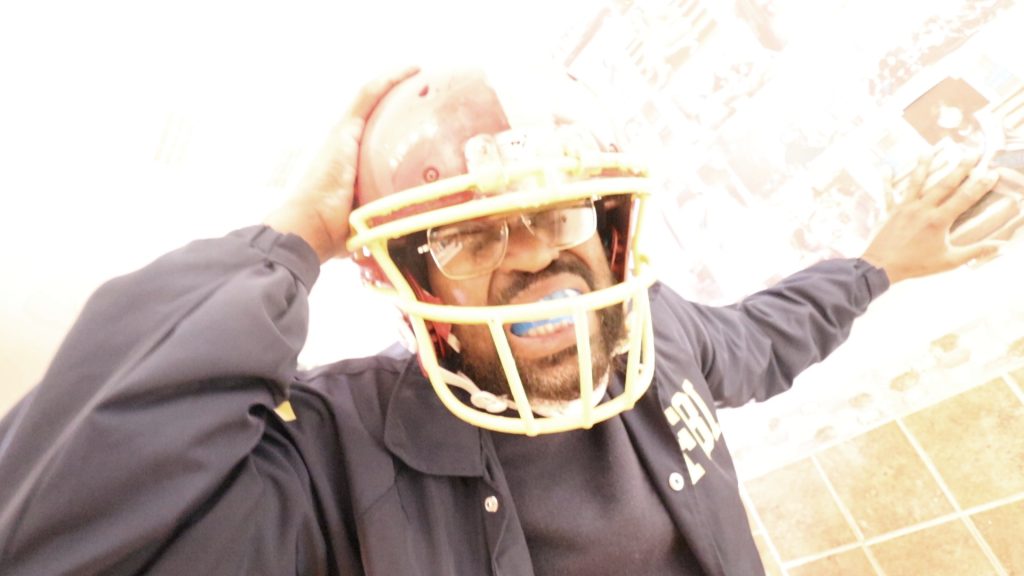
One of the film’s most memorable sequences involves Brown preparing to contact the spirits more clearly. In a surprisingly unusual ritual, he places a football helmet on his head and bites down on a mouthguard before entering a bathroom whose walls are covered with photographs of missing persons.
Inside the room, strange things begin to happen. The toilet paper starts fluttering, lights flash, and a bright glow fills the room as Brown calls out to the spirits. A voice responds, identifying herself as Alice Hall and accusing Auggie Doggett of murdering her. The spirit even delivers the information with a slightly sarcastic tone, asking Brown why he talks like a game show host.
Just as Brown prepares to leave the room, another voice emerges claiming to have been killed by the same man. It is a fascinating concept and visually one of the film’s most atmospheric scenes. However, the sequence lasts nearly thirty minutes, which is a large portion of the film’s 78-minute runtime. While the conversation establishes the mystery clearly, the extended exposition slows the pacing considerably.
Once Brown begins looking into the claims, the story shifts toward a more straightforward investigative thriller. Auggie Doggett, the suspected killer, is revealed to be a park ranger with access to remote woodland areas where bodies could easily be hidden.
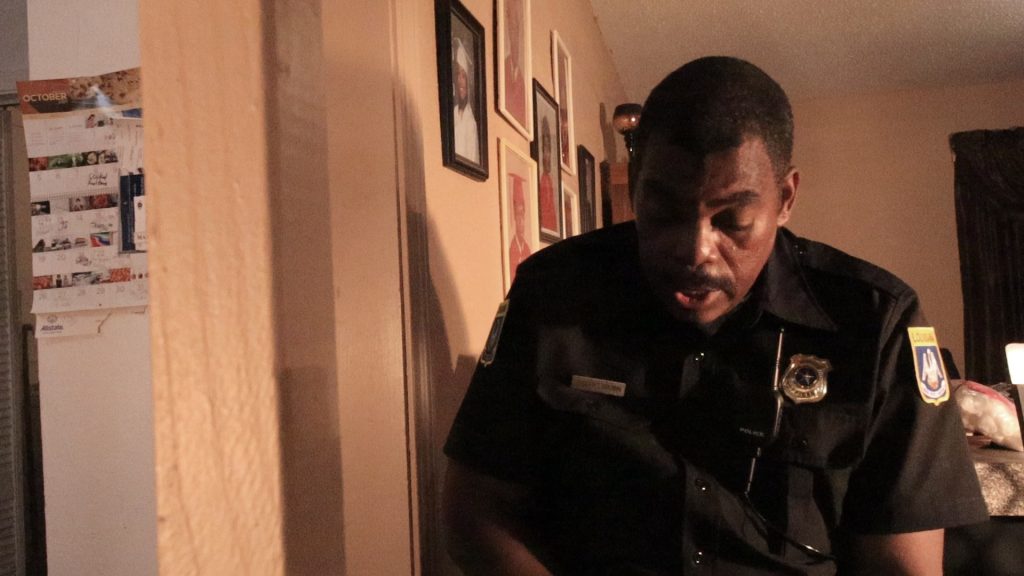
From that point forward, Brown works to uncover the truth and prevent further violence. Along the way he interacts with several law enforcement characters including Officer Joe Brown (Gorio), Detective Sugarshack (Dusty Brown), and a group of detectives portrayed by David E. Chapman Jr., Demorian Lizana, Roy L. Jackson Jr., and Brian Lanigan.
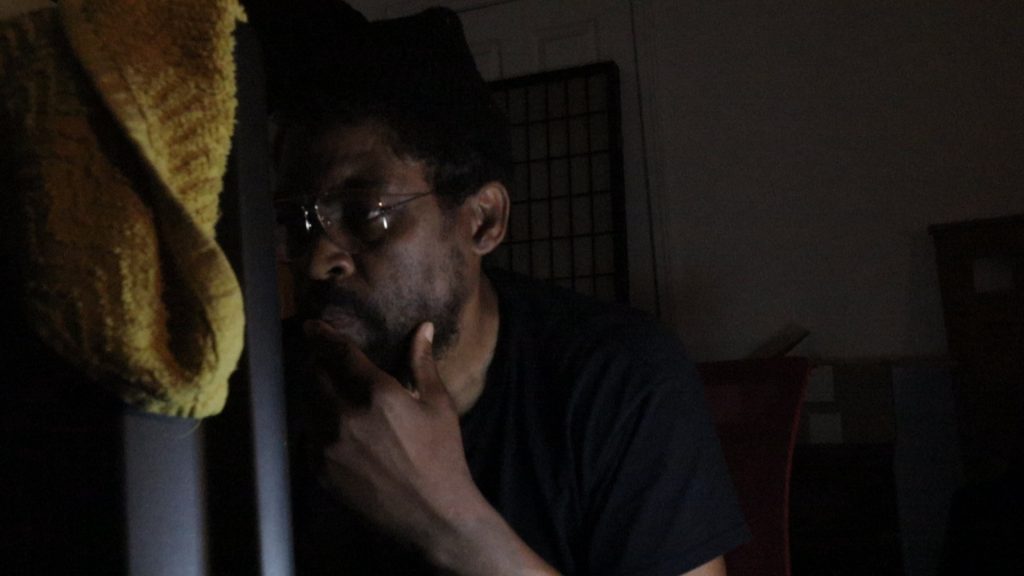
Visually, The Dead Guy carries a very raw independent aesthetic. King Jeff also served as the film’s cinematographer, favouring natural locations and shadowy compositions that help build an eerie atmosphere. Occasionally the film experiments with more stylised framing such as Dutch angles, which add some visual interest to otherwise simple setups.
That simplicity is partly due to the extremely small-scale production. Many scenes are filmed with the camera locked off, sometimes showing only King Jeff in the frame as he delivers dialogue or makes phone calls. In independent filmmaking this is not uncommon and often reflects the reality of working with limited crew members.
The audio is somewhat mixed throughout the film. Dialogue is clear in many scenes, but environmental sounds occasionally creep into the recordings. At one point lawnmowers can be heard in the background, and later a plane passes overhead during a scene. These are small distractions, but they do pull attention away from the story momentarily.
One area where the film works particularly well is the music. King Jeff composed the score, with additional music written and performed by El Timo. The soundtrack adds atmosphere in several scenes and helps support the film’s paranormal tone.
The Dead Guy – An Interesting Concept
Behind the camera, King Jeff wears multiple hats, serving as director, writer, producer, cinematographer, composer, editor, and actor. Editing duties are shared with Gorio, who also contributed to sound and camera operation. The film is produced by Gorio, Jamie Grefe, Gregory Hatanaka, and King Jeff.
The central idea of a medium FBI agent solving murders by listening to the dead is a genuinely strong concept. It blends paranormal storytelling with crime investigation in a way that could easily support a larger series of stories. In this particular film, however, the pacing and limited production resources occasionally hold the idea back from reaching its full potential.
Still, The Dead Guy is clearly a passion project. It was made by filmmakers who wanted to tell a supernatural story about justice and about listening to voices that were ignored in life.
With a tighter script and faster pacing, the premise could become something even stronger in future projects. For now, The Dead Guy remains an earnest independent thriller that shows ambition and determination, even if the execution does not always match the scale of its ideas.
| Acting | |
| Direction | |
| Cinematography | |
| Writing | |
| Sound | |
| Screen Critix Rating |