
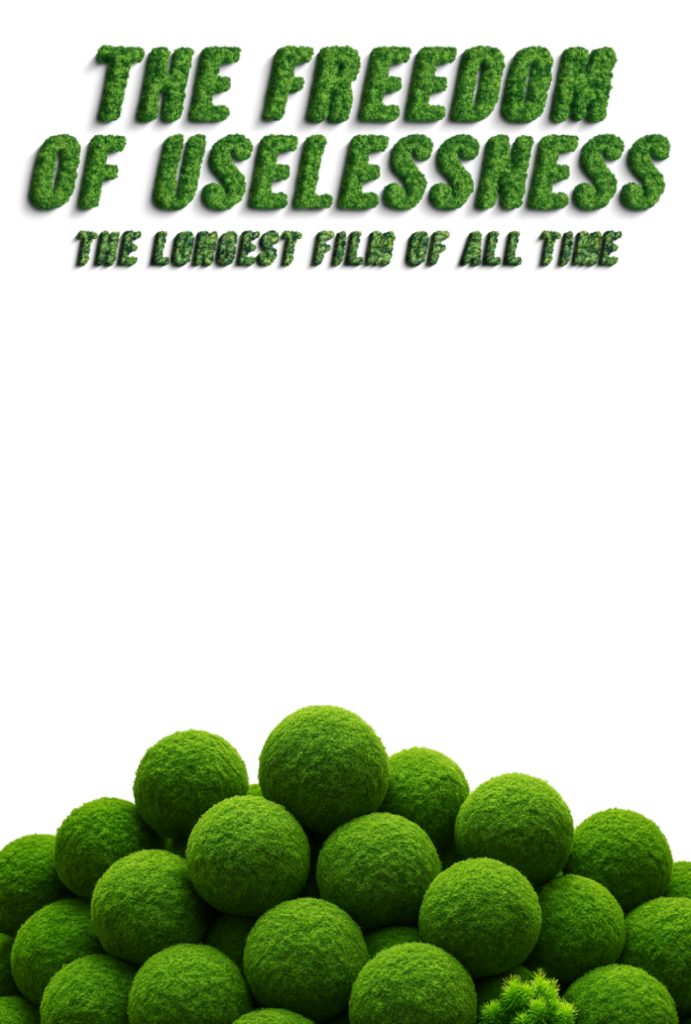
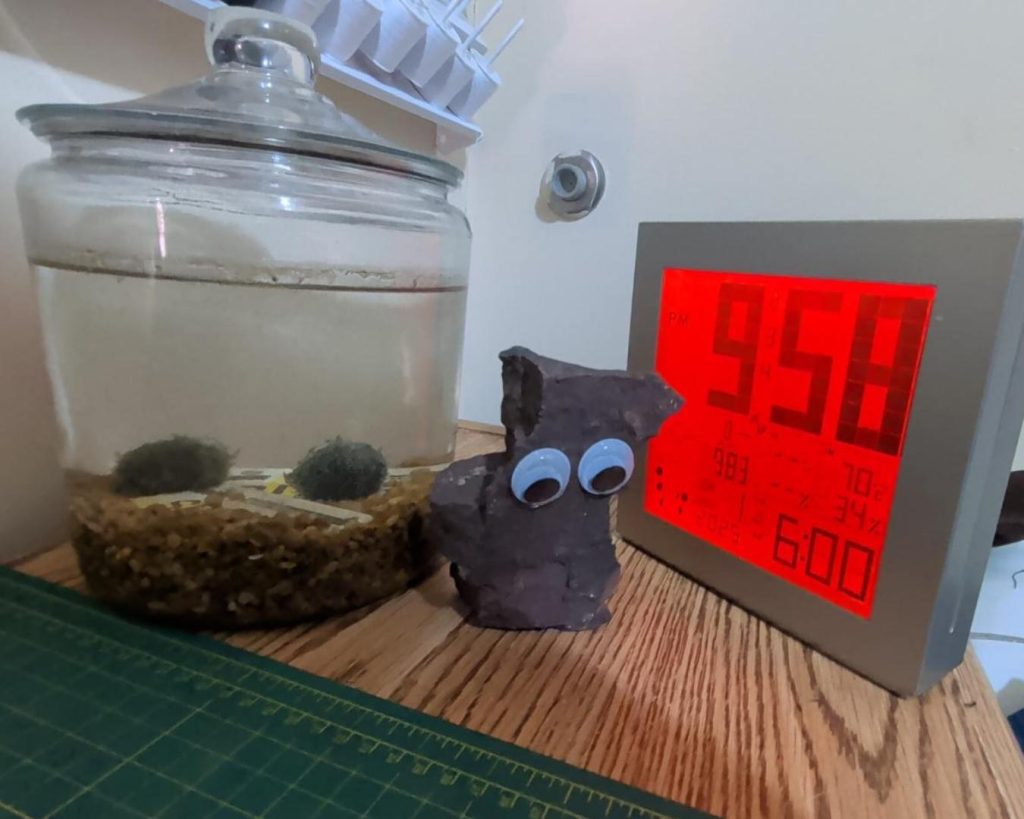
A jar of moss balls, a rock with googly eyes, and a digital clock sit on a table and quietly exist for twenty five minutes in the experimental short The Freedom of Uselessness.
We get sent a wide range of films at Screen Critix. Shorts, features, documentaries, student work, micro budget passion projects, and the occasional experiment that seems to actively challenge the very idea of why films exist at all. The Freedom of Uselessness firmly plants itself in that last category. Directed by Samuel Felinton and Declan Mungovan, this is a film that does not tell a story, does not feature characters in any traditional sense, and does not appear to have any interest in engaging the viewer beyond asking them to sit and watch time pass.
The entire film consists of a static overhead shot of a table. On that table sits a small glass jar containing two moss balls, a rock with googly eyes, a digital clock, and a small metal fisherman ornament positioned behind it. The only movement across the entire runtime is the clock changing minute by minute. There is no sound. No music. No dialogue. No shift in framing. No escalation. No resolution. When the clock ticks forward enough times, the film ends.
That is not an exaggeration. That is the film.
The Freedom of Uselessness is reportedly a condensed version of a much longer livestream experiment that ran online for an extended period of time, presenting the same image continuously. In that context, as a conceptual endurance piece or philosophical exercise, it may have some academic or artistic merit for those deeply invested in experimental media or process driven art. As a twenty five minute short film submitted for review, however, it is an extremely difficult sell.
The filmmakers frame the project as an exploration of non productivity, stillness, and resistance to constant output. The moss balls, referred to as Bubba and Spoiled, are positioned as figures who simply exist without purpose or ambition. Time itself becomes the subject, with the digital clock serving as the only indicator of movement or progression. The intention is clearly to challenge the audience’s relationship with productivity, patience, and expectation.
In theory, that is all very thoughtful. In practice, it results in a film where nothing happens. At all.
There is no visual progression, no conceptual development within the runtime, and no moment where the film rewards the viewer for sticking with it. Watching The Freedom of Uselessness feels less like engaging with cinema and more like accidentally staring at a desk while waiting for a computer to unfreeze. By the halfway point, the curiosity has worn off. By the final minutes, it becomes an exercise in endurance rather than contemplation.
What makes this particularly frustrating is that the film does not even attempt to meet the viewer halfway. Experimental cinema can be challenging, slow, and abstract while still offering moments of discovery or transformation. Here, the image at minute one is functionally identical to the image at minute twenty five. The absence of sound removes even the possibility of ambient immersion. If this is meant to function as a meditative experience, it is an oddly hollow one.
It is impossible not to be reminded of infamous protest submissions like the long running paint drying anecdote, where a filmmaker submitted hours of paint drying to classification boards to make a point about bureaucracy. That gesture at least had an adversarial purpose. The Freedom of Uselessness does not feel like protest. It feels like a conceptual joke that the audience is expected to sit through out of politeness.
To be clear, there is nothing technically wrong with the film. The image is stable. The lighting is consistent. The props are arranged deliberately. It is exactly what it claims to be. The issue is that what it claims to be is, for many viewers, profoundly unengaging.
Some audiences may find value in the act of watching nothing happen. Others may project meaning onto the stillness, the passage of time, or the quiet absurdity of anthropomorphised moss. That is valid. Art is subjective. But subjectivity does not mean immunity from criticism, and as a short film experience, The Freedom of Uselessness offers very little beyond its own concept.
By the end, the overwhelming question is not what the film means, but why it needed to be watched in this format at all. As an idea, it may work better as an installation piece, a gallery loop, or an online experiment encountered incidentally rather than deliberately sat through. The full film actually ran for 115 days. I can’t imagine anyone making it through that.
For those seeking narrative, emotion, tension, or even visual curiosity, this will likely test patience more than provoke insight. For everyone else, it may simply confirm that sometimes, uselessness is exactly what it says on the tin. Based on the criteria for how we rate films, this isn’t going to be pretty.
| Acting | |
| Direction | |
| Cinematography | |
| Writing | |
| Sound | |
| Screen Critix Rating |