
Jack Sambrook’s Little Brother is a tightly constructed and emotionally resonant short film that explores brotherhood, responsibility and the pull of past mistakes with precision and maturity. At just 13 minutes long, the film demonstrates impressive economy in its storytelling while showcasing strong performances, assured direction, and a compelling emotional core.
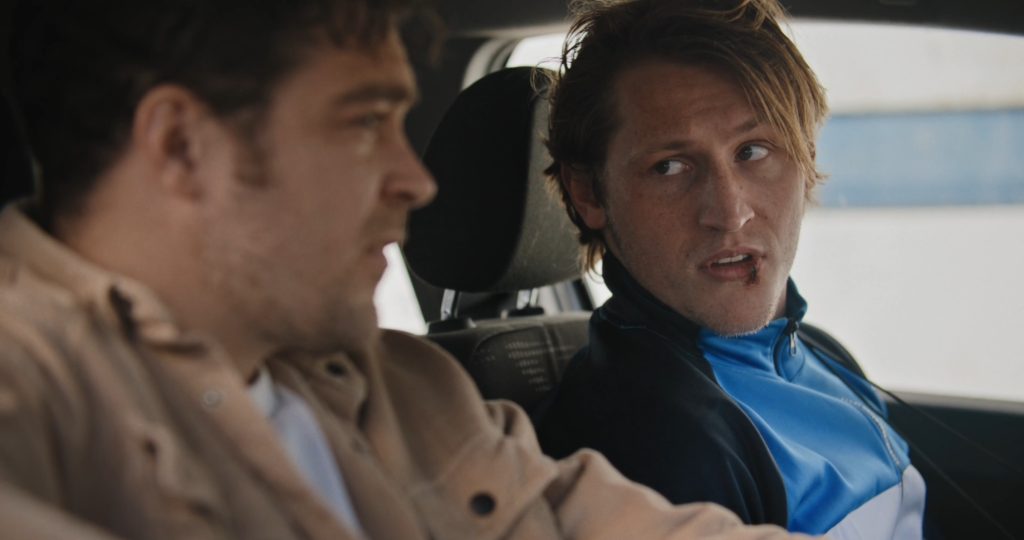
The story follows Mark (Frankie Wilson), a grounded and thoughtful man picking up his younger brother Lee (Théodore Sylvain) from prison after a two-year sentence. Lee is restless, impulsive and still very much clinging to a way of life that threatens to drag him back down. From the opening scene, the dynamic between the two is clear. Mark has tried to move forward. He is married to Sarah (Catie Ridewood) and the couple are attempting to conceive, bringing added pressure to his already conflicted emotions about his brother’s return.
Lee, meanwhile, is immediately painted as someone who has not truly changed. He cracks jokes, uses cruder language, and despite reading Animal Farm in prison (a book their father used to read to him as a child), it becomes apparent that his outlook has not evolved. His decision to immediately pick up a rucksack full of drugs confirms Mark’s worst fears. While Mark protests, Lee defends himself with a resigned “I have no other options.” The film does not moralise. Instead, it lets this moment of tension sit with the viewer, letting them weigh the pull of familial loyalty against self-preservation.

The chemistry between Wilson and Sylvain carries much of the emotional weight. Their performances are understated but effective, capturing a complicated relationship defined by love, frustration, and years of emotional distance. Their scenes together, often confined to the interior of a car, are filled with subtext and quiet resentment. Sylvain’s portrayal of Lee is particularly strong, allowing vulnerability to leak through the bravado. Wilson grounds the film with his more restrained presence, providing a strong counterbalance.
Catie Ridewood delivers a brief but powerful performance as Sarah. Her role may be small, but she injects it with warmth and credibility, creating a fully formed character who reflects the emotional cost Mark’s choices are having on his home life.
Technically, Little Brother is an impressive piece of work. The cinematography by Rowan Bahçeli Holford makes great use of close-ups and natural light. Given that much of the film takes place in a car or in tight spaces, the shots are well-framed and filled with tension. The intimacy of the visuals supports the central themes of emotional claustrophobia and the struggle to forgive. Simon Pitt’s score is also worthy of praise. While some of the piano-led compositions lean toward the sentimental, the overall effect is subtle and atmospheric. It enhances the emotion without overpowering it.

Director Jack Sambrook, who previously made Bad Guys and a string of shorts, shows clear growth as a storyteller. His direction here is focused and confident, allowing moments to breathe while avoiding unnecessary exposition. There is a refreshing restraint throughout the film. Dialogue is tight and authentic. While some of the transitions between scenes feel a little abrupt due to brief fades to black, the overall pacing is excellent.
If there is anything holding Little Brother back from reaching even greater emotional heights, it is that it feels like it ends just as it is hitting full stride. The story is effective and well contained, but there is a sense that these characters have more to reveal, that the wounds run deeper than the runtime allows us to see. Rather than feeling too neat, it plays more like a snapshot of a larger story, one that could resonate even more with a little more space to breathe.
Still, this is a minor quibble in what is otherwise a well-crafted and affecting short. Little Brother succeeds through strong performances, thoughtful direction, and an unflinching look at forgiveness and the weight of family ties. It is a film that balances sincerity with realism and confirms that Jack Sambrook is a filmmaker worth following.
| Acting | |
| Direction | |
| Cinematography | |
| Writing | |
| Sound | |
| Screen Critix Rating |