
Independent filmmaking is often driven by ambition rather than resources. Filmmakers gather their friends, a camera, and a story they want to tell and simply go for it. That spirit is very much present in WallDale, a British sci-fi mystery written and directed by Matthew Cathcart.
Set in the town of WallDale, the film opens with the arrival of a new resident named Meghan Knight, played by Brianna Rose Seymour. Almost immediately after her arrival, strange events begin unfolding within the community. The town appears normal on the surface, with quiet streets and familiar faces, but it quickly becomes clear that something beneath that calm exterior is not quite right.
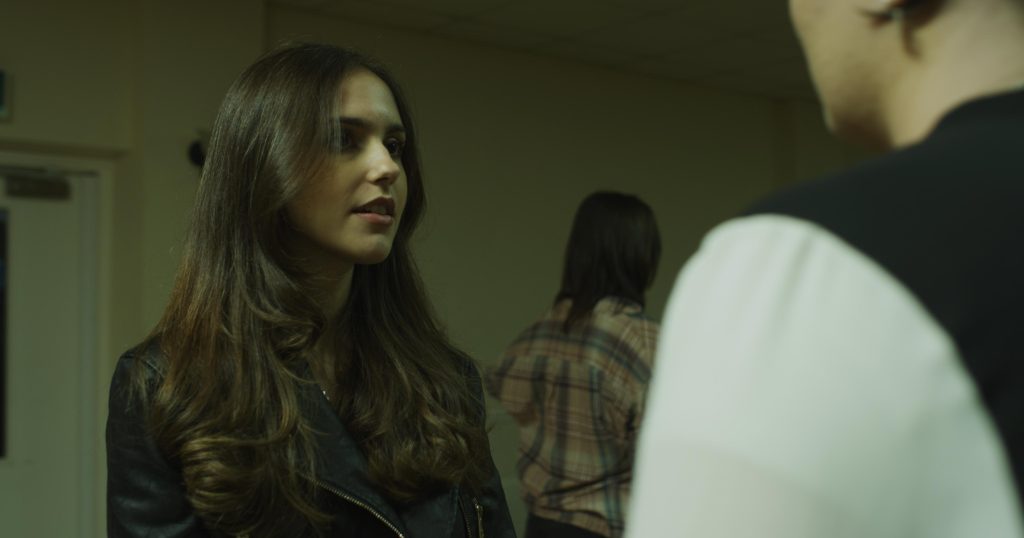
Early in the film we are introduced to several residents who each have their own issues and tensions. Luca, recently released from prison, believes he was framed and betrayed by Jenna, while his former partner Eliza is far from happy to see him back in town.
The residents gather for a community meeting to welcome Meghan, and it is here that the story’s mystery begins to unfold. The meeting is attended by only around fifteen people, which is unusual considering the town appears large enough to support a much bigger population. During Meghan’s introduction, chaos erupts when a fire breaks out at a nearby bakery.
At the same time, the young police officer Nigel begins accusing Meghan of being responsible for the disruption. Nigel, played by Andrei Apetrei, appears surprisingly young for someone tasked with policing the town, even wearing a small badge in his shirt pocket that gives the impression of someone still finding their way in the role.
Things escalate further when the power suddenly cuts out during the meeting. In the darkness, one of the girls begins coughing violently before collapsing with what appears to be a slit throat. Panic spreads through the room as the group tries to understand what has just happened.

There is, however, an unintentionally humorous moment during this scene. As one character mourns over the body, the actress playing the deceased victim can clearly be seen breathing, her upper torso rising and falling quite noticeably. It is one of those small filmmaking slips that can momentarily pull viewers out of the drama.
From that point forward, suspicion spreads rapidly among the group. Nigel attempts to blame Jenna, but his own son Joseph intervenes before things spiral further out of control. The group soon realise that they are locked inside the meeting room, adding another layer of tension to the unfolding mystery.
As the film progresses, Meghan begins investigating the town more closely. She asks for schematics of the buildings in WallDale, which leads to the discovery of something unusual beneath both the burned bakery and the local mechanic’s garage. The mechanic himself has already noticed something odd, particularly the fact that his electricity bills are unusually high.
Meghan also speaks with various residents, including Allison, played by Josée Bekker. Bekker stands out in the film thanks to a more natural and sincere performance. In several scenes she feels like a breath of fresh air and adds a welcome sense of authenticity to the story.
Meanwhile, other storylines emerge within the town. Ashley finds himself being blackmailed into selling drugs after someone threatens to release compromising photographs of his wife if he refuses to cooperate.

Gradually the narrative begins revealing that WallDale is hiding a much darker secret. The film introduces ideas involving cloning, hidden facilities, and organ harvesting as the town’s true purpose begins to emerge.
These ambitious sci-fi concepts are clearly what Cathcart is aiming for, but the scale of the story occasionally feels larger than what the production can comfortably support.
Technically speaking, WallDale is a very basic production. Many scenes are shot with a static camera, and the framing and lighting are minimal. Blocking is simple, and the colour grading is fairly plain throughout. Some audio issues are also noticeable, with certain lines drifting out of sync or becoming difficult to hear when actors move away from the microphone.
WallDale is an ambitious first feature film
The film runs for 135 minutes, which is a long runtime for a project of this scale. With such a large ensemble cast and multiple plot threads, the pacing can sometimes feel stretched.
One element that does work surprisingly well is the music composed by Erica Porter. The score has an eerie quality that occasionally brings to mind the haunting tone of the Phantasm theme from the late 1970s. That style of music adds a layer of atmosphere that helps elevate several scenes beyond the limitations of the visuals.
WallDale often feels like an extremely extended episode of a soap opera, though with a heavy science fiction twist. When a group of friends make a feature film together, especially with limited resources, maintaining believability can be difficult. Many of the characters appear to be similar ages, even when they are meant to be playing parents or authority figures, which occasionally makes the world of the story harder to fully accept.
That said, the effort behind the project is clear. Completing a feature film is no small achievement, particularly with little to no budget. Cathcart and his cast and crew deserve credit for bringing the project across the finish line.
WallDale was also recognised within the independent film circuit, receiving nominations for Best UK Feature Film at the 2026 Liverpool Indie Awards and recognition at the International Indie Film and Screenplay Awards.
Ultimately, WallDale feels like a debut feature with big ideas and ambition, even if the execution does not always match the scale of the story. The concept of a town hiding a dark scientific experiment has potential, but the film might have benefited from a shorter runtime or a more focused narrative approach.
Still, every filmmaker has to start somewhere, and WallDale represents an earnest attempt to create a full-length sci-fi mystery with the resources available.
| Acting | |
| Direction | |
| Cinematography | |
| Writing | |
| Sound | |
| Screen Critix Rating |